Dental Implants After 65: Investing in How You Want to Live

Reaching your 60s, 70s, or even 80s changes the way you think about many healthcare decisions.
The question is no longer simply:
“Can this be fixed?”
It may become:
“Will fixing this meaningfully improve the way I live?”
I think that is a much better way to approach dental implants for older adults. When patients ask me whether they are “too old” for dental implants, they are often expecting a discussion about age. But chronological age by itself tells me relatively little about whether implant treatment makes sense.
I am much more interested in your health, the condition of your mouth and jawbone, the teeth you still have, your medications, your ability to heal, what you can comfortably eat, and what you want your quality of life to look like in the years ahead.
For some older adults, keeping a removable denture may be completely reasonable.
For others, replacing a missing tooth or stabilizing an entire denture with dental implants, can make everyday life noticeably easier. That is why I prefer to frame the conversation differently.
Dental implants after 65 aren’t necessarily about rebuilding a younger smile. They can be about preserving independence, function, comfort, and confidence as you age.
“When I talk with an older patient about dental implants, I don’t begin with their birthday. I begin with how they live, what they can eat comfortably, what their health allows us to do, and what they want their smile to do for them in the years ahead.”
— Marielaina Perrone, DDS
Age Is a Number. Health Is the Real Conversation.
There is no universal birthday at which someone suddenly becomes “too old” for a dental implant.
A healthy 75-year-old may be a more straightforward implant candidate than someone considerably younger with uncontrolled medical problems, significant periodontal disease, heavy smoking, inadequate bone, or other factors that can interfere with healing.
That distinction matters.
When evaluating an older adult for dental implants, I consider factors such as:
- Overall medical health
- Medications
- Diabetes control
- Smoking history
- Periodontal health
- Available jawbone
- Oral hygiene
- Bite forces
- Existing teeth and restorations
- Ability to undergo and recover from treatment
- Expectations and personal goals
In other words, we treat the patient. Not the age printed on the chart.
What Would You Like Your Smile to Do for You in the Years Ahead?
Dental implant treatment isn’t determined by age alone. Your health, remaining teeth,
jawbone, lifestyle, and what you want to improve all help determine which option may make sense.
Missing One or More Teeth?
Dental implants can replace individual missing teeth without relying on neighboring teeth
for support and may help restore comfortable chewing and smile confidence.
Struggling With Many Teeth or Dentures?
For patients facing extensive tooth loss, All-on-4 dental implants may provide a more
stable, fixed approach to rebuilding function and confidence.
Not Sure Which Option Fits?
A personalized evaluation can determine whether implants are appropriate and which treatment
best fits your health, anatomy, needs, and long-term goals.
Marielaina Perrone, DDS
Personalized Cosmetic & Implant Dentistry in Henderson, NV
Serving Green Valley, Henderson, Anthem, Seven Hills, Summerlin, & the Greater Las Vegas Valley
The Better Question: How Do You Want to Eat 10 Years From Now?
This is one of the most overlooked parts of the dental implant conversation.
Teeth are functional equipment. We use them every single day.
Think about how many meals you may eat over the next decade. Even at only three meals a day, that is more than 10,000 meals.
If you are otherwise healthy and active, your dental decisions today could influence thousands of future breakfasts, lunches, dinners, vacations, celebrations, and meals with family. That puts implant treatment into a very different perspective.
For someone struggling with a loose denture or multiple missing teeth, the issue isn’t merely whether the smile photographs well.
It is whether eating has become work.
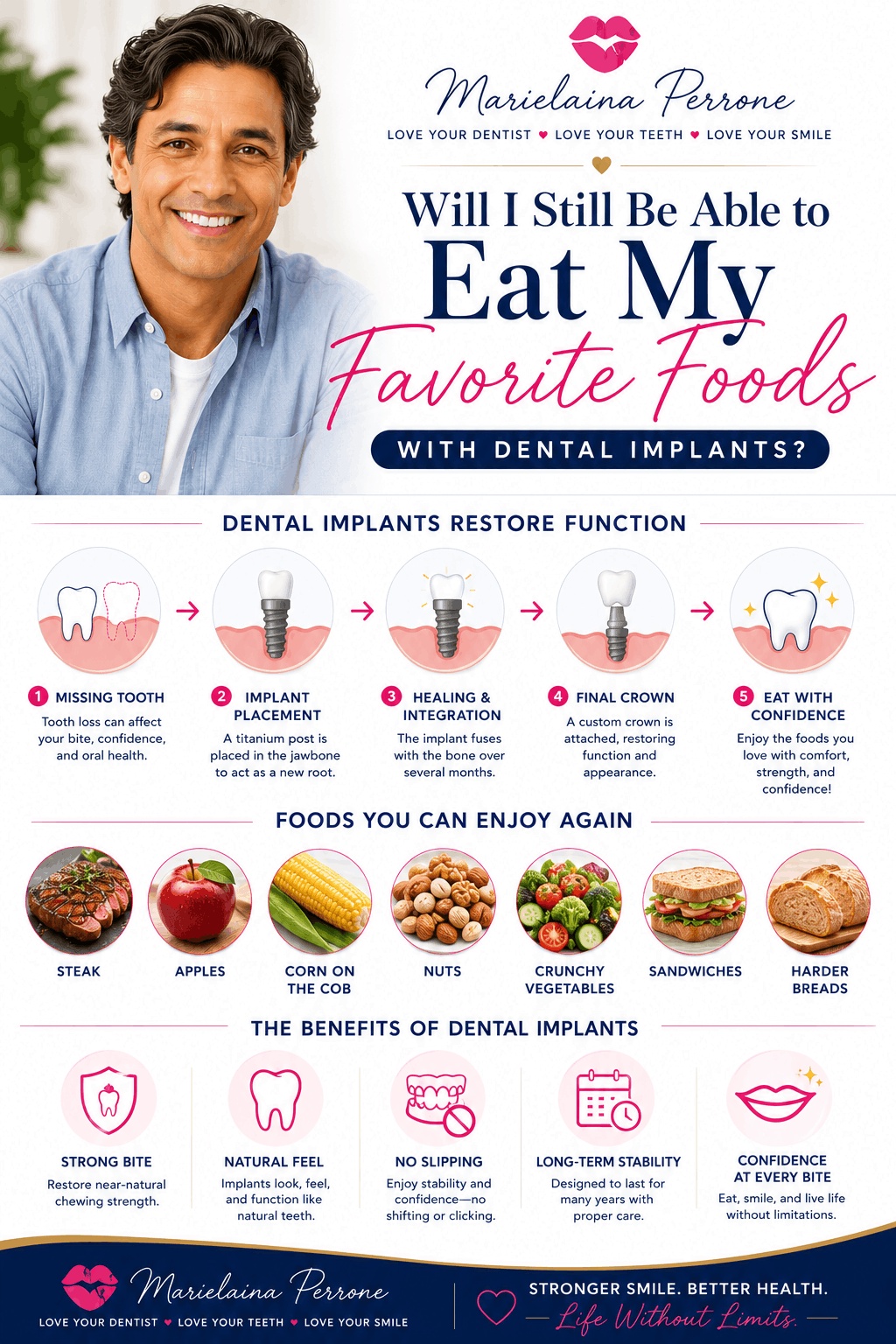
Can you comfortably chew vegetables?
Can you bite into foods you enjoy?
Are you avoiding certain meats?
Do you choose restaurants based on what you think you will be able to chew?
Do you remove foods from your diet because your denture moves?
Do you worry about your teeth when eating around other people?
Those seemingly small compromises can gradually become part of everyday life. Sometimes patients don’t realize how much they have adapted until we start talking about it.
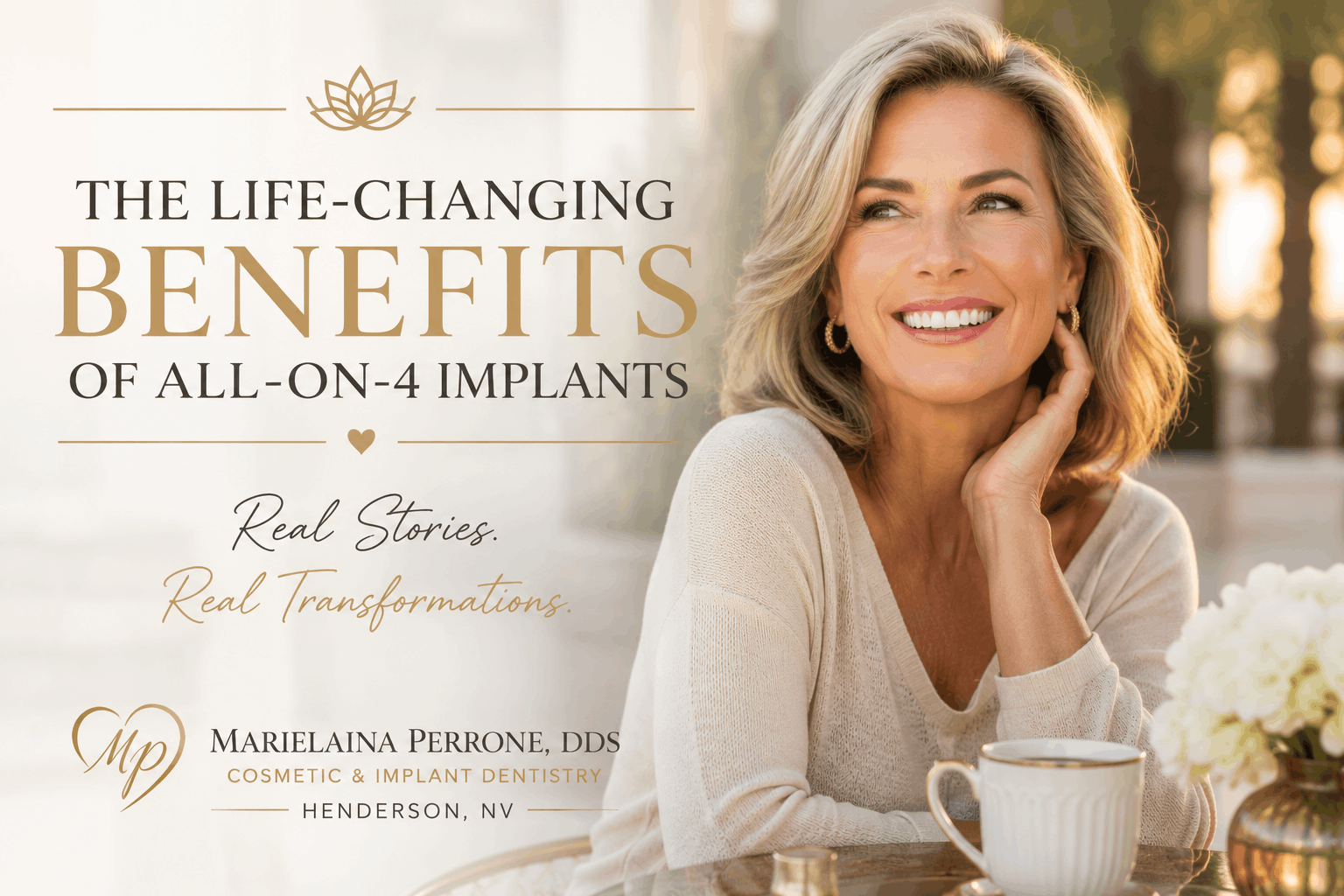
Dental Implants and Independence
We often talk about healthy aging in terms of mobility, exercise, vision, hearing, nutrition, and cognitive health. Oral function belongs in that conversation too.
Being able to chew comfortably, maintain your own oral hygiene, speak confidently, and eat without constantly thinking about your teeth contributes to independence. That doesn’t mean every older adult needs dental implants. It means dentistry should consider what allows someone to continue living comfortably and confidently.
For one person, preserving existing natural teeth may be the best strategy.
For another, replacing a single missing tooth with an implant may prevent the need to involve neighboring teeth.
Someone who has struggled with a loose lower denture for years may benefit from implant stabilization.
Another patient with extensive dental problems may need a broader discussion about whether maintaining individual compromised teeth or transitioning to an implant-supported solution makes more sense.
The correct treatment is the one that fits the individual. Not the one associated with a particular age group.
“But How Long Do I Need the Implant to Last?”
Patients occasionally ask this in a surprisingly practical way.
They may say:
“I’m 72. Does it really make sense to spend money on an implant now?” I understand the question. But consider another way of looking at it.
If you are 72 and healthy, how important would comfortable eating be at 77? At 82? At 87? None of us knows exactly how long we will live. That uncertainty doesn’t mean we stop investing in things that improve daily life.
We replace hips.
We get cataract surgery.
We buy hearing aids.
We exercise.
We improve our homes.
We travel.
We make decisions intended to help us enjoy the years ahead. Dental treatment deserves the same thoughtful evaluation. The question isn’t simply whether an implant will “pay for itself.”
It is:
What value would better oral function provide during the years I expect to use it?
The Goal Isn’t Necessarily More Dentistry
This is an important distinction in my practice. Being technically capable of performing dental treatment does not automatically mean we should.
Sometimes an older patient has a missing tooth that does not significantly affect appearance, function, bite stability, or quality of life. Depending on the circumstances, monitoring the situation or choosing another treatment may be perfectly reasonable.
Likewise, extensive implant reconstruction may not make sense for someone whose medical condition, healing ability, anatomy, personal priorities, or ability to maintain the restoration makes treatment unnecessarily burdensome. I don’t believe successful treatment planning means finding the maximum amount of dentistry we can perform.
It means finding the appropriate amount.
That becomes especially important as we age.

Your Remaining Natural Teeth Matter
Dental implants should never make us forget about natural teeth. If healthy teeth can predictably be maintained, preserving them may be preferable. Before recommending an implant, I evaluate the entire mouth.
Is periodontal disease present?
Are other teeth failing?
Is the bite stable?
Are existing crowns or bridges healthy?
Is there significant tooth wear?
Would replacing one tooth solve the problem, or is the mouth showing signs of a larger pattern of breakdown?
A dental implant should fit into a long-term plan. I don’t want to successfully replace one tooth while ignoring problems that could compromise the rest of the smile.
Bone Changes After Tooth Loss
When a natural tooth is lost, the jawbone in that area no longer receives the same mechanical stimulation associated with the tooth and its root. Over time, changes in bone volume can occur. That is one reason waiting many years after tooth loss can sometimes make implant treatment more complicated.
It doesn’t necessarily mean an implant becomes impossible. Modern implant dentistry includes techniques for managing many bone deficiencies, including bone grafting when appropriate.
But it reinforces an important point:
Even if you aren’t ready to replace a tooth immediately, it can be useful to discuss your long-term options sooner rather than later.
Understanding what may happen allows you to make an informed decision rather than discovering years later that your choices have changed.
What About Osteoporosis?
This question comes up frequently among older adults. Having osteoporosis does not automatically mean someone cannot receive dental implants. However, osteoporosis, bone quality, medical history, and medications all need to be evaluated carefully.
Certain medications used for osteoporosis and other conditions can have important implications for dental surgery and healing. Your dentist needs an accurate medication history, including prescription medications, injections, infusions, supplements, and relevant previous treatments. In some circumstances, coordination with your physician may be appropriate.
This is another reason implant candidacy cannot be determined simply by looking at someone’s age.
Diabetes and Dental Implants
Diabetes also deserves individualized consideration. The diagnosis itself does not automatically rule out implant treatment. The level of disease control, periodontal health, healing capacity, medical history, and other risk factors matter.
Patients should never stop or alter prescribed medications simply because they are considering dental treatment unless directed by the healthcare professional managing those medications.
Good communication between the patient, dentist, and medical team becomes increasingly important when medical conditions and dental surgery overlap.
One Missing Tooth Is Different From an Entire Denture
“Dental implants” can describe very different treatments.
A patient missing one tooth may need a single implant supporting one restoration.
Someone missing several teeth may have different implant or bridge options.
A patient who has worn dentures for many years may be considering implants primarily because the denture moves. Others may be evaluating more comprehensive fixed implant-supported teeth, including concepts commonly described as All-On-4 or All-On-6.
These are not interchangeable treatments.
The surgical requirements, maintenance, cost, anatomy, number of implants, prosthetic design, and long-term considerations can differ substantially. That is why an implant consultation should begin with the problem you are trying to solve, not with a predetermined procedure.
Don’t Forget Maintenance
Implants are not “install them and forget them” dentistry. They require ongoing care.
The restoration needs to be cleaned appropriately. The tissues surrounding the implants need to remain healthy. Professional examinations and maintenance remain important.
Implants can develop biological and mechanical complications, just as natural teeth and conventional restorations can. That means I also consider whether a proposed restoration will be realistic for the patient to maintain. This becomes particularly important with larger implant-supported restorations. A technically beautiful restoration that a patient cannot adequately clean is not an ideal long-term solution.
What If You’ve Worn Dentures for Years?
Long-term denture wear does not automatically eliminate dental implants as an option. However, the amount and shape of remaining bone may be different from that of someone who recently lost teeth.
Three-dimensional imaging can help us evaluate the anatomy and determine whether implants may be feasible and whether additional procedures might be necessary.
Some patients are surprised to learn that they still have options.
Others discover that their anatomy makes treatment more complicated than expected.
Either way, having accurate information is better than assuming.

The Emotional Side of Tooth Loss Matters Too
Dentistry tends to describe missing teeth in clinical terms.
Bone.
Occlusion.
Mastication.
Prosthetics.
But patients experience tooth loss differently.
Some stop smiling in photographs.
Some cover their mouth when they laugh.
Some avoid eating in public.
Others become extremely conscious of a removable denture. And some genuinely don’t care about any of those things and simply want to chew comfortably.
All of those perspectives are legitimate. You do not need dental implants because society says everyone should have a perfect smile.
Treatment should solve a problem you consider worth solving.
“Successful dentistry isn’t about giving every patient the same solution. It’s about understanding what matters to that particular person and designing treatment around the life they actually want to live.”
— Marielaina Perrone, DDS
Dental Implants Can Be About Healthy Aging. Not Anti-Aging
I think this distinction is particularly important. There is tremendous pressure to “look younger.” That isn’t how I view dental implants for older adults.
A healthy smile at 70 does not need to look 30. The goal is not to erase age.
The goal may simply be to maintain function, replace what has been lost, protect remaining oral structures, and allow someone to continue eating, speaking, smiling, traveling, socializing, and living confidently.
That is healthy aging dentistry. And I think it is a much more meaningful objective than chasing youth.
Questions I Encourage Older Patients to Ask
Instead of asking only, “Am I too old for dental implants?” consider asking:
What happens if I do nothing?
What alternatives do I have?
How will this affect what I can eat?
Can my natural teeth be preserved?
What maintenance will I need?
Does my medical history change the risks?
Will I need bone grafting?
How long will treatment take?
What happens if my health changes later?
Is this treatment appropriate for the way I actually live?
Those questions produce a much more useful conversation than age alone.
Dental Implants for Seniors in Henderson, NV
At my Henderson, Nevada dental practice, serving Green Valley, Anthem , Seven Hills, Summerlin, and the greater Las Vegas Valley, I evaluate dental implant treatment from a long-term, individualized perspective.
Some patients want to replace one missing tooth.
Others want greater stability after years of living with removable dentures.
Some are exploring implant-supported dentures or fixed full-arch options.
And occasionally the best recommendation is to preserve what someone already has rather than pursue additional treatment. There isn’t one correct solution for everyone over 65. Your health, anatomy, existing teeth, priorities, lifestyle, and expectations should determine the plan.
So, Are Dental Implants Worth It After 65?
They certainly can be. But I think “worth it” is a better question than “am I too old?”
If implant treatment can predictably improve your ability to eat, stabilize your smile, replace an important missing tooth, reduce problems associated with a removable prosthesis, or improve your confidence and your health and anatomy make you an appropriate candidate, the potential value can extend far beyond appearance.
If the treatment adds complexity without providing a meaningful benefit, another solution may make more sense.
Age shouldn’t make that decision for you.
Good diagnosis should.
And perhaps the most useful question of all is not how old you are today.
It is:
How do you want your smile to function during the years still ahead?
Frequently Asked Questions
Is 70 too old for dental implants?
Not necessarily. Chronological age alone does not determine implant candidacy. Overall health, oral health, available bone, medications, healing capacity, smoking, periodontal condition, and other individual factors are generally more meaningful considerations.
Can someone get dental implants in their 80s?
Potentially, yes. An individualized medical and dental evaluation is necessary. Treatment should also provide enough practical benefit to justify the procedure from the patient’s perspective.
Are dental implants better than dentures for seniors?
Neither is automatically better. Conventional dentures may work very well for some people. Others struggle with movement, chewing, comfort, or confidence and may benefit from implant-supported options. Anatomy, health, cost, maintenance requirements, and patient preferences all matter.
Can osteoporosis prevent me from getting dental implants?
Not automatically. Osteoporosis, bone quality, and especially medications used to manage certain bone conditions need to be considered carefully before dental surgery.
Can seniors with diabetes receive dental implants?
Some can. Diabetes control, healing, periodontal health, medical history, and other risk factors need to be evaluated individually.
Do dental implants require special care as I get older?
They require consistent home care and professional maintenance. Larger implant-supported restorations may require specific cleaning techniques or devices. Long-term maintainability should be considered when choosing treatment.
Should I replace a missing tooth if it doesn’t bother me?
Not every missing tooth automatically requires an implant. Its location, bite, neighboring teeth, bone, appearance, function, and potential future consequences should be evaluated before deciding whether replacement is beneficial.
Where can I learn whether dental implants are right for me?
A comprehensive dental implant evaluation can assess your oral health, remaining teeth, jawbone, medical history, medications, goals, and available treatment alternatives before deciding whether implant treatment makes sense.
About Marielaina Perrone
Dr. Marielaina Perrone, DDS, is a trusted cosmetic and family dentist in Henderson, NV, known for helping patients achieve healthy,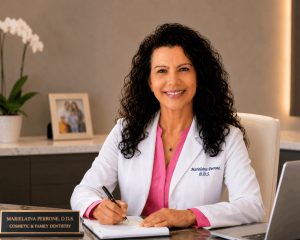 beautiful smiles through personalized, compassionate care. With more than 20 years of clinical experience, she combines advanced dental expertise with an artistic eye to deliver exceptional results in porcelain veneers, dental implants, smile makeovers, periodontal therapy, Botox, dermal fillers, and facial aesthetic treatments.
A graduate with honors from Stony Brook University School of Dental Medicine, Dr. Perrone remains committed to lifelong learning and regularly pursues advanced continuing education in cosmetic dentistry, implant dentistry, and facial aesthetics. Her comprehensive approach focuses on enhancing oral health, facial harmony, and overall confidence through customized treatment plans tailored to each patient’s unique goals.
Dr. Perrone is passionate about patient education, preventive care, and building lasting relationships founded on trust, communication, and comfort. She believes every patient deserves individualized attention and treatment that supports both long-term health and a confident smile.
Proudly serving Henderson, Green Valley, Las Vegas, Summerlin, and surrounding communities, Dr. Perrone is dedicated to providing modern, patient-centered dentistry in a welcoming environment. Outside the office, she enjoys cooking, staying active, spending time with family, and participating in community activities throughout the Las Vegas Valley.

Reviewed for Clinical Accuracy
This article has been written and clinically reviewed by Marielaina Perrone, DDS, to ensure it reflects current evidence-based dentistry and the personalized philosophy of care practiced at her Henderson, Nevada office.
Last Reviewed: September 2026