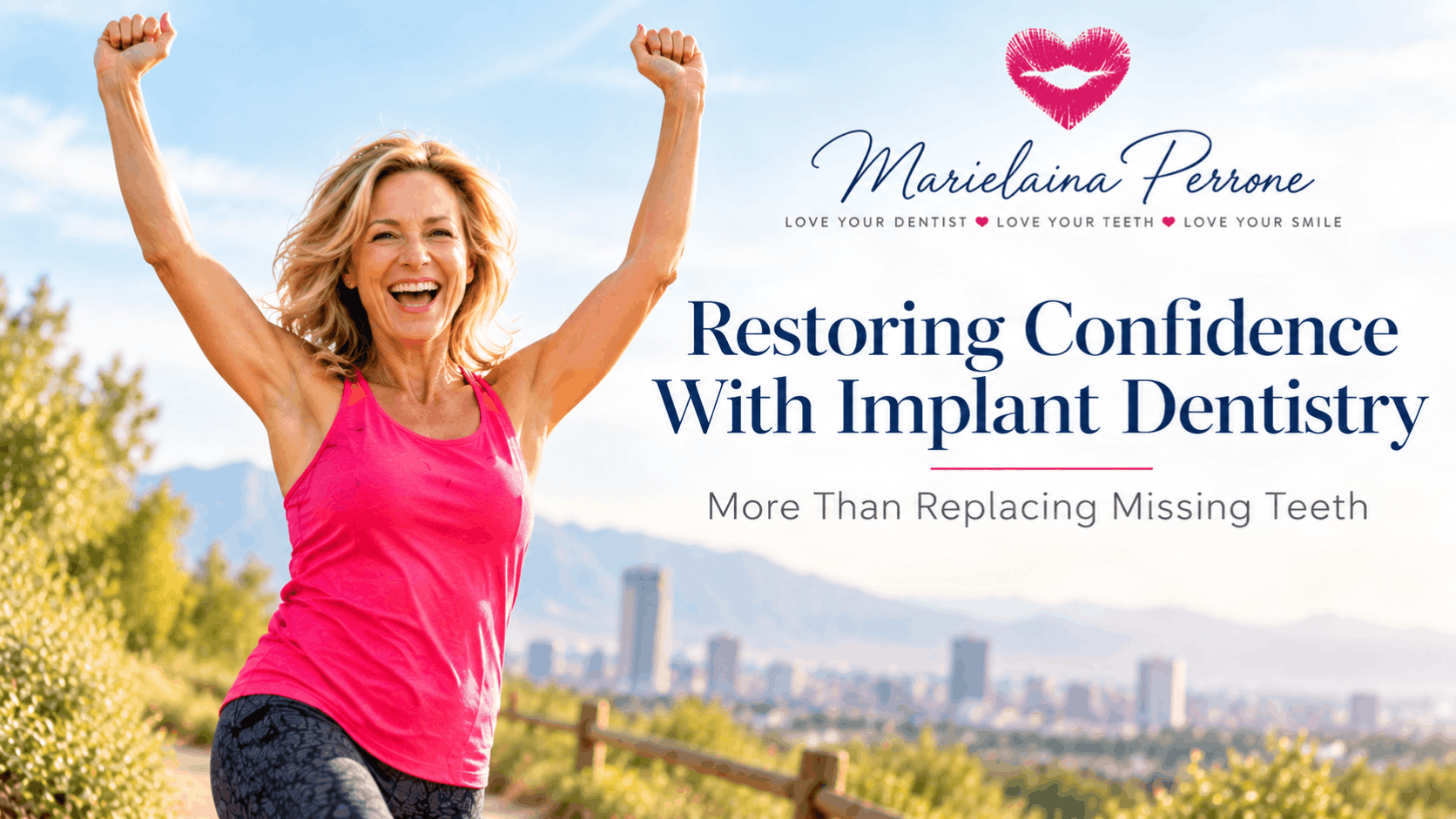
Restoring Confidence With Implant Dentistry: More Than Replacing Missing Teeth
When we talk about dental implants, the conversation often begins with teeth.
How many teeth are missing? How much bone remains? Is an implant possible? Will a crown, bridge, or implant-supported restoration be needed? Those are important clinical questions.
But after more than 25 years in dentistry, I have learned that patients frequently come into my office carrying something less visible. They have learned to smile differently. They cover their mouth when they laugh. They avoid photographs. They chew primarily on one side. They hesitate when ordering certain foods. Some become uncomfortable speaking in a group because they worry someone will notice a missing tooth or loose denture.
Over time, people can quietly adapt their lives around their teeth. That is why I believe implant dentistry is about much more than filling an empty space.
For the right patient, restoring missing teeth can also mean restoring comfort, freedom, and confidence.
“Patients rarely come to me simply asking for a piece of titanium. They want to eat comfortably again. They want to smile without thinking about it. They want their teeth to feel like a natural part of their life again.”
— Marielaina Perrone, DDS
Tooth Loss Can Affect More Than Your Smile
Losing a tooth is a physical event, but the experience can also be emotional. A missing back tooth may not be visible when you smile, yet it can change how you chew. Losing a front tooth can immediately affect appearance and speech. Losing several teeth can alter the way someone approaches meals, photographs, social situations, and even relationships.
Sometimes those changes happen gradually.
You stop biting into an apple.
You choose softer foods.
You smile with your lips closed.
You position yourself differently for photographs.
You decline dinner invitations because eating with a loose denture makes you uncomfortable.
Eventually, those accommodations can begin to feel normal. They shouldn’t automatically be dismissed as simply part of getting older.
Modern implant dentistry gives us another option for many patients.
What Would Feeling Confident in Your Smile Mean to You?
Whether you are missing one tooth, several teeth, or struggling with a removable denture,
implant dentistry begins with understanding what you want to change—and what can be preserved.
Start With the Philosophy, Not the Procedure
Dr. Perrone’s approach begins by determining what can be preserved, understanding your goals,
and choosing treatment that makes sense for your health, function, and long-term smile.
Explore Your Implant Options
Missing One or Several Teeth?
Learn how dental implants can replace missing teeth while restoring stability,
function, and a natural-looking smile.
Facing Extensive Tooth Loss?
If many teeth are failing or removable dentures have become frustrating,
discover how All-on-4 dental implants may provide another option.
The goal isn’t simply to replace teeth. It’s to create a healthy, comfortable solution
that lets you eat, speak, laugh, and smile without constantly thinking about your teeth.
Not Sure Which Option Is Right for You?
Your first step doesn’t have to be choosing a procedure. Start with a conversation.
Dr. Perrone can evaluate your smile, discuss what can be preserved, and help you understand
your options without judgment or pressure.
What Is a Dental Implant?
A dental implant is a small biocompatible post, typically made of titanium, placed into the jawbone to support a dental restoration.
After appropriate healing and integration with the surrounding bone, an implant can support a:
- Single dental crown
- Implant-supported bridge
- Implant-retained or implant-supported denture
- Full-arch fixed restoration
Unlike a traditional removable denture, an implant receives support from the jaw rather than relying entirely on the gums. And unlike a conventional tooth-supported bridge, replacing a single missing tooth with an implant can often avoid preparing the neighboring healthy teeth solely to support the replacement. But the implant itself is only part of the treatment.
What the patient ultimately experiences is the tooth or teeth we build around it.
That’s why implant dentistry should be planned with the final result in mind from the beginning.

Confidence Often Starts With Function
We tend to think of confidence as an aesthetic issue. Sometimes it is. A missing front tooth can obviously affect someone’s willingness to smile. But confidence can also come from something much simpler:
trusting your teeth.
Imagine going to dinner without first wondering what you will be able to chew.
Imagine laughing without thinking about whether a removable denture will move.
Imagine speaking without constantly being aware of your teeth.
Imagine ordering from the menu based on what sounds good rather than what seems safest.
Those may sound like small things until you have spent years thinking about them.
“One of my favorite moments in implant dentistry isn’t necessarily when I place the final restoration. It’s when a patient comes back and tells me they stopped thinking about their teeth all the time. That’s when dentistry has truly become part of their life again.”
— Marielaina Perrone, DDS
One Missing Tooth Can Change How You Feel About Your Smile
You don’t have to be missing all of your teeth to feel the effects of tooth loss. A single missing tooth, particularly one visible when you smile, can become the only thing a patient sees when looking in the mirror.
Dental implants can provide an independent replacement for many single missing teeth. The goal isn’t simply to put a crown into the space.
Especially in the smile zone, we need to think about:
- Tooth proportion
- Implant position
- Gum contours
- Bone support
- Shade
- Translucency
- Neighboring teeth
- Bite
- The patient’s smile line
- How the restoration fits the face
This is where implant dentistry and cosmetic dentistry intersect. A technically successful implant can still be disappointing if the final tooth doesn’t belong in the patient’s smile. The implant has to function. The restoration has to look natural. And the two have to work together.
What If You’re Missing Several Teeth?
Multiple missing teeth can sometimes be replaced using implant-supported restorations without necessarily placing an implant for every missing tooth. For example, strategically positioned implants may support an implant bridge.
This can provide greater stability and function while avoiding reliance on removable appliances in selected patients. But there isn’t one universal formula.
The number and position of implants depend on bone anatomy, bite forces, remaining teeth, restorative design, health considerations, and the long-term treatment plan. That is why the planning stage matters so much.
The question isn’t:
“How many implants can we place?”
It is:
“What is the most appropriate way to rebuild this patient’s function?”

When Dentures Begin Controlling Your Life
Traditional dentures remain a valuable treatment and can work very well for many people. But some patients struggle with them.
A lower denture in particular may move because it rests on tissues influenced by the tongue, cheeks, muscles, and changing jaw anatomy. Other patients become frustrated with adhesive, food collecting beneath the denture, reduced chewing confidence, or simply the feeling of having a removable prosthesis that doesn’t feel secure.
Implants can sometimes change that experience significantly. Even when the final restoration remains removable, implants may provide additional retention and stability.
For other patients, multiple implants may support a fixed full-arch restoration. These are very different treatments, and the appropriate choice depends on anatomy, health, expectations, maintenance requirements, finances, and personal preferences.
But for a patient who has spent years worrying about denture movement, improved stability can represent something much larger than dentistry. It can mean trusting their smile again.
Full-Arch Implant Dentistry: A New Chapter, Not New Natural Teeth
You’ve probably seen advertisements describing full-arch implant treatment as “teeth in a day” or implying that implant-supported teeth are essentially indestructible replacements for natural teeth. I think patients deserve a more thoughtful conversation.
Full-arch implant dentistry can be transformative for appropriately selected patients. But implant-supported teeth are still restorations.
They require planning.
They require maintenance.
They can experience complications.
And implants themselves can develop inflammation and disease in the surrounding tissues. The goal isn’t to convince someone that implants are better than natural teeth.
Healthy, maintainable natural teeth are extraordinarily valuable.
My first question is always what should be preserved.
When teeth truly cannot be predictably maintained, however, implant dentistry may give us an opportunity to rebuild function and create a stable new foundation.
“I don’t believe implant dentistry begins with removing teeth. It begins with deciding which teeth deserve to stay. Replacement should come after preservation has been thoughtfully considered.”
— Marielaina Perrone, DDS
Dental Implants Can Help Preserve Independence
There is another aspect of implant dentistry that becomes increasingly important as we age.
Independence.
Being able to chew comfortably affects food choices.
Being able to speak comfortably affects communication.
Feeling comfortable with your appearance affects social interaction. And being able to maintain your own oral health affects long-term dental wellness. This doesn’t mean everyone needs implants as they get older. Many people maintain their natural teeth throughout life.
Nor does it mean dental implants automatically improve nutrition or overall health. But when missing or unstable teeth significantly interfere with chewing, restoring function can expand a patient’s practical choices.
That can be especially meaningful for someone who has spent years adapting to compromised teeth.

The Emotional Side of Tooth Loss Deserves Respect
Patients sometimes apologize to me for the condition of their teeth.
They may say:
“I should have taken better care of myself.”
“I can’t believe I let things get this bad.”
“I’m embarrassed for you to look.”
I never find those conversations productive when they’re centered on blame. People lose teeth for many reasons.
Decay.
Fractures.
Medical conditions.
Dry mouth.
Past dental experiences.
Financial limitations.
Genetics and individual susceptibility.
Sometimes several factors have accumulated over decades. The condition of your mouth today is simply where we begin.
“I can’t change what happened to a patient’s teeth ten or twenty years ago. I can listen, understand where they are today, and help them decide what they want the next ten or twenty years to look like.”
— Marielaina Perrone, DDS
That is a much more useful conversation.
What If You’re Embarrassed to See a Dentist?
This is more common than many people realize. Sometimes the people who need help most are the ones who postpone an appointment because they are afraid of being judged. If you haven’t seen a dentist in years, you don’t need a lecture.
You need information.
The first visit should help answer questions such as:
What is healthy?
What can be saved?
What needs treatment?
What are my options?
Do I actually need implants?
What happens if I do nothing right now?
Can treatment be completed in stages?
Only after those questions are answered does it make sense to discuss a treatment plan.
You May Not Need a Dental Implant
This is important. Not every missing or damaged tooth requires an implant.
A natural tooth may still be treatable.
A dental bridge may be appropriate.
A removable partial denture may make sense.
Orthodontic treatment may sometimes change how a space should be managed.
And in certain circumstances, leaving a space alone may be reasonable. Implants are excellent tools.
They are not automatically the answer to every missing tooth.
The best treatment is the one that fits the patient’s health, anatomy, goals, expectations, lifestyle, and long-term dental plan.

Are You a Candidate for Dental Implants?
Many adults can be considered for implant treatment, but candidacy is individualized.
During an implant evaluation, I may consider:
- Overall medical history
- Medications
- Smoking or nicotine use
- Gum health
- Remaining teeth
- Bone quantity and quality
- Available space
- Bite forces
- Grinding or clenching
- Previous dental treatment
- Ability to maintain the restoration
- Aesthetic expectations
Three-dimensional imaging may also be used when appropriate to evaluate bone anatomy and important surrounding structures. If insufficient bone is present, bone grafting may sometimes be considered.
The presence of a medical condition does not automatically rule out implant dentistry, but health conditions and medications need to be understood before treatment.
Implant Dentistry Is a Process
Patients understandably want to know:
“How long will this take?”
There isn’t one timeline.
A straightforward single implant can be very different from treatment involving extraction, bone grafting, multiple implants, or full-arch reconstruction.
Treatment may involve several stages:
Evaluation and planning → tooth removal when necessary → bone or tissue preparation when indicated → implant placement → healing → final restoration → maintenance.
In selected circumstances, a temporary tooth or restoration can be provided during treatment.
In other situations, allowing adequate healing before loading the implant may be the more predictable choice.
I would rather build treatment around the biology than force every patient into an advertising slogan.
What Will My Implant Teeth Look Like?
This is one of the reasons I enjoy combining implant and cosmetic dentistry. Replacing the tooth is only part of the job. The restoration should make sense within the smile.
A beautiful result doesn’t necessarily mean perfectly white teeth. Natural teeth contain subtle variations in color, translucency, texture, proportion, and light reflection. The objective is often for the replacement tooth to disappear into the smile.
With larger implant cases, we also consider how tooth length, width, position, lip support, smile line, and facial proportions interact.
My goal isn’t to give every patient the same smile. It is to create a result that looks appropriate for that individual.
Dental Implants Still Need Maintenance
An implant cannot develop tooth decay the way a natural tooth can. But that does not make it maintenance-free.
Plaque can accumulate around implant restorations, and the surrounding tissues can become inflamed. Long-term maintenance includes effective home care and professional evaluation.
Depending on the restoration, home care may involve:
- Toothbrushing
- Interdental brushes
- Floss or specialized floss
- Oral irrigation
- Other individualized cleaning techniques
We also evaluate the bite, restoration, surrounding tissues, and bone over time.
Implant dentistry shouldn’t be viewed as:
place it and forget it.
The objective is to protect the investment for as long as possible.
What About the Cost of Dental Implants?
Cost matters, and patients deserve transparency. Implant treatment varies because “a dental implant” isn’t a single product.
The total treatment may involve:
- Imaging and diagnosis
- Tooth extraction
- Bone grafting
- Implant placement
- Abutment
- Temporary restoration
- Final crown or prosthesis
- Additional procedures when required
A single implant restoration and a full-arch implant reconstruction are fundamentally different treatments.
Rather than comparing only an advertised implant price, I encourage patients to understand what is included, what isn’t, and what the complete treatment is expected to accomplish.
For some patients, treatment can also be staged over time. At our Henderson practice, we can discuss available dental financing options when appropriate.
The Moment Confidence Comes Back
One of the interesting things about confidence is that you can’t measure it on an X-ray.
There isn’t a number for it in a dental chart. But you can see it.
You see it when someone smiles for a photograph without hesitation.
When they stop covering their mouth.
When they go to dinner and don’t immediately search the menu for the easiest thing to chew.
When they begin talking about travel, dating, family events, or professional opportunities instead of talking about their teeth.
Dentistry doesn’t create someone’s confidence. That belongs to the person. But sometimes dental problems have been standing in its way. And when we remove that obstacle, something changes.
“The most rewarding implant cases aren’t necessarily the largest ones. They’re the cases where dentistry gives someone one less reason to hold back from their own life.”
— Marielaina Perrone, DDS
Implant Dentistry in Henderson, NV
At my Henderson dental practice in Green Valley, I provide personalized implant dentistry for patients throughout Henderson and the Las Vegas Valley.
Some patients come to me missing one tooth. Others have several failing teeth.
Some are tired of struggling with removable dentures. And others simply want to understand their options before making any decisions.
The starting point is the same:
We talk. We evaluate. We determine what can be preserved. And then we build a plan around you.
Implant dentistry can replace teeth. But when treatment is thoughtfully planned around the individual, it may also help restore something much harder to manufacture in a dental laboratory:
the freedom to eat, speak, laugh, and smile without constantly thinking about your teeth.
And that may be the most meaningful restoration of all.
Frequently Asked Questions About Dental Implants
Are dental implants worth it?
For appropriately selected patients, implants can provide a stable, independent method of replacing missing teeth. Whether they are worthwhile for you depends on your anatomy, health, alternatives, goals, maintenance ability, cost, and the type of restoration required.
Do dental implants look natural?
They can look extremely natural when implant position, gum contours, restorative materials, tooth proportions, shade, and the surrounding smile are carefully planned. Aesthetic demands are especially important when replacing a front tooth.
Can dental implants restore confidence?
Dental implants themselves don’t create confidence, but restoring missing teeth may reduce concerns about appearance, chewing, speaking, or unstable dentures. The emotional effect varies from person to person.
Am I too old for dental implants?
Chronological age alone does not determine implant candidacy. Overall health, bone anatomy, oral health, medications, functional needs, and ability to maintain the restoration are more important considerations.
Can I get implants if I have bone loss?
Possibly. The amount and location of bone loss matter. Some patients may be candidates for bone grafting or alternative implant treatment strategies. Appropriate imaging and clinical evaluation are necessary.
Can implants replace all of my teeth?
Implants can support full-arch restorations in appropriately selected patients. This doesn’t necessarily mean placing one implant for every missing tooth. The number and position of implants depend on the individual treatment plan.
Do implants last forever?
No dental treatment should be promised to last forever. Dental implants have strong long-term success records, but biological and mechanical complications can occur. Good planning, health, hygiene, professional maintenance, and management of risk factors are important.
Should I remove a damaged tooth and replace it with an implant?
Not automatically. If a natural tooth has a reasonable long-term prognosis, preserving it may be preferable. The condition of the tooth, root, bone, gums, bite, restorability, and alternatives should be evaluated before extraction.
Author Bio
Dr. Marielaina Perrone, DDS, is a highly skilled cosmetic and family dentist based in Henderson, NV, dedicated to transforming smiles and improving lives through compassionate, patient-centered care. With over 20 years of clinical experience, Dr. Perrone blends advanced dental techniques with an artistic eye to deliver exceptional results in porcelain veneers, dental implants, smile makeovers, periodontal therapy, dermal fillers, Botox, and comprehensive facial aesthetic treatments.
A graduate at the top of her dental class, Dr. Perrone continually pursues advanced training to remain at the forefront of modern dentistry and aesthetic medicine. Her integrative approach focuses on oral health, facial harmony, and personalized treatment planning—helping patients achieve natural, confident smiles that enhance both appearance and overall well-being.
Dr. Perrone is passionate about patient education, preventive care, and creating long-term relationships built on trust, comfort, and communication. She proudly serves the communities of Henderson, Green Valley, and the greater Las Vegas area. When she’s not caring for patients, she enjoys cooking, staying active, and spending time with her family.

Reviewed for Clinical Accuracy
This article has been written and clinically reviewed by Marielaina Perrone, DDS, to ensure it reflects current evidence-based dentistry and the personalized philosophy of care practiced at her Henderson, Nevada office.
Last Reviewed: September 2026