What Is Smile Rehabilitation? When Your Smile Needs More Than a Makeover
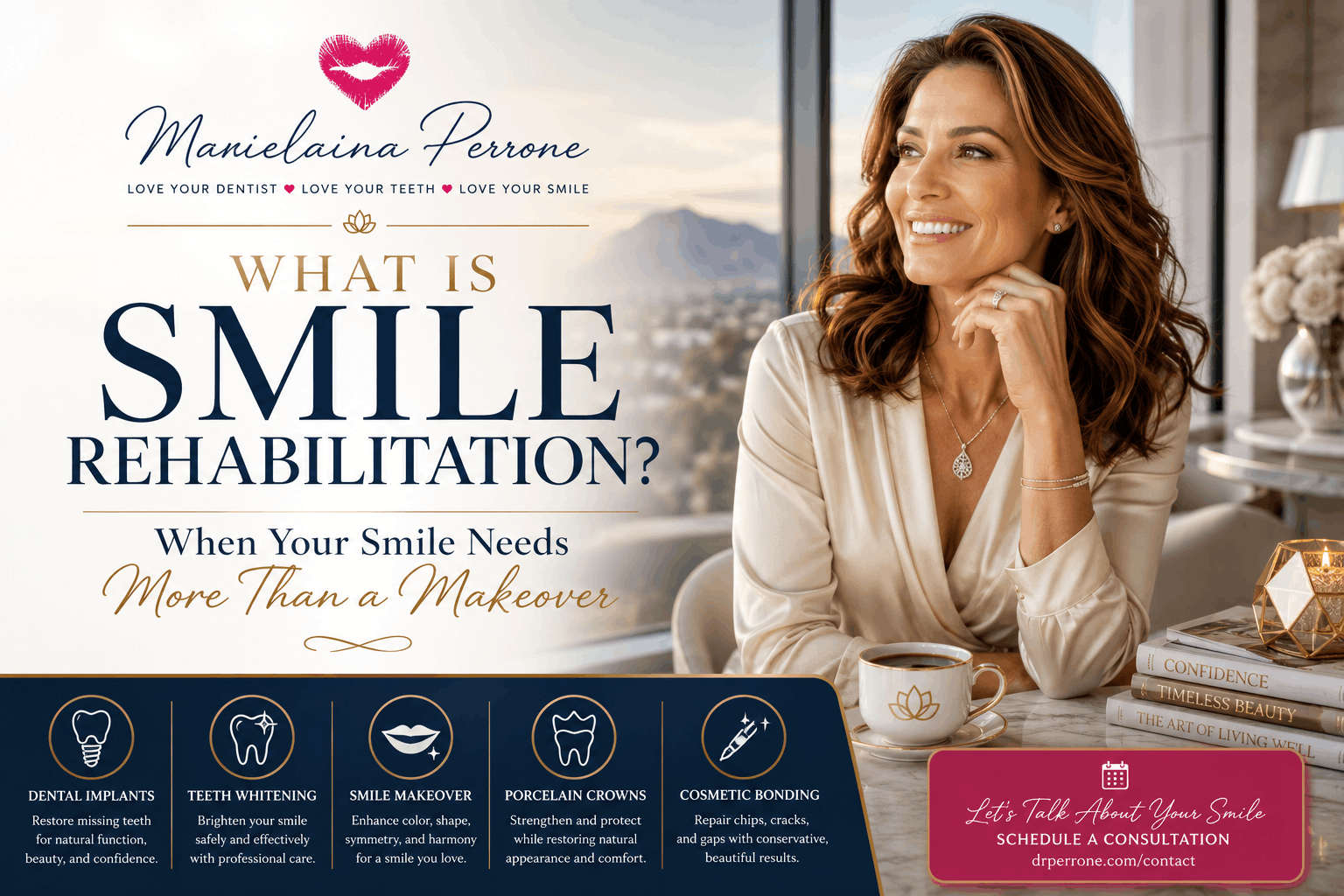
When patients talk about improving their smiles, the phrase “smile makeover” naturally comes to mind. And for many people, that is exactly what they need.
Perhaps their teeth are healthy but they would like them to be whiter. Maybe they dislike a few chips, spaces, uneven edges, or proportions. Porcelain veneers, cosmetic bonding, whitening, orthodontics, or another relatively focused treatment may provide the improvement they are looking for.
But some patients come to me with a very different situation.
Their teeth have been worn down over decades. Several crowns are beginning to fail. A tooth may be missing. Their bite has changed. Teeth that once looked youthful have become shorter, flatter, darker, or uneven. They may have gum recession, fractured restorations, or a collection of dental work completed at different times that no longer looks or functions as though it belongs together.
These patients aren’t necessarily looking for a completely different smile. Very often, they want their smile back.
That is where I think the concept of smile rehabilitation becomes useful.
“A smile makeover usually begins with something a patient would like to change. Smile rehabilitation often begins with something they’ve lost. Comfort, function, tooth structure, confidence, or simply the smile they remember having. My job is to determine what actually needs to be rebuilt and what should be left alone.”
— Marielaina Perrone, DDS
What Is Smile Rehabilitation?
I use smile rehabilitation to describe a comprehensive approach to restoring a smile that has been affected by a combination of dental wear, damage, missing teeth, aging restorations, bite changes, or other functional and aesthetic problems.
It is not one specific dental procedure. And that’s important.
Smile rehabilitation might involve porcelain crowns or veneers. It could include cosmetic bonding, dental implants, replacement of an old bridge, orthodontic treatment, periodontal care, whitening, or management of excessive bite forces.
For another patient, rehabilitation may require far less treatment. The objective isn’t to perform as much dentistry as possible.
It is to understand what has happened to the smile, why it happened, what remains healthy, and what actually needs to be restored.
That makes smile rehabilitation somewhat different from traditional cosmetic dentistry.

Smile Rehabilitation vs. Smile Makeover: What’s the Difference?
There can certainly be overlap between the two.
A smile makeover generally begins with an aesthetic goal. A patient wants to improve the color, shape, alignment, proportion, symmetry, or overall appearance of the smile.
A smile rehabilitation often begins with a combination of aesthetic and functional concerns.
A simple way to think about it is this:
Smile makeover:
I like my teeth, but I would like my smile to look better.
Smile rehabilitation:
My teeth and smile aren’t what they used to be. How can we restore them?
Neither approach is inherently better. They simply start from different places.
Someone with healthy teeth who dislikes their color and several uneven front teeth may benefit from a relatively straightforward cosmetic treatment.
Someone with worn teeth, multiple old restorations, a missing tooth, bite changes, and recurring fractures needs a different conversation.
In that situation, changing how the front six teeth look without understanding everything happening around them could create a beautiful result that isn’t necessarily a durable one.
The Worn-Down Smile Is a Common Reason for Rehabilitation
One of the clearest examples is a patient whose teeth have gradually worn down. This doesn’t usually happen overnight.
Years of grinding or clenching can flatten the biting edges of teeth. Teeth may chip or develop cracks. Old fillings and crowns may begin showing their age. Natural enamel can become thinner. Tooth proportions can change.
Eventually, patients sometimes notice something else:
Their smile looks older.
The teeth may appear shorter. Less tooth may show when they smile or speak. The edges may no longer have the natural contours they once had. This is where cosmetic dentistry and restorative dentistry begin to intersect.
I don’t want to simply make worn teeth longer without understanding why they became shorter in the first place.
If excessive forces contributed to the damage, those forces become part of the diagnosis and long-term treatment planning.
“When teeth are worn down, rebuilding their appearance is only part of the job. I also want to understand the forces that created the wear. Otherwise, we may beautifully restore the evidence of the problem without addressing the problem itself.”
— Marielaina Perrone, DDS

Sometimes the Problem Is Years of Dentistry
Many adults reach their 50s, 60s, and 70s with dentistry that has accumulated gradually over their lifetime.
One crown was placed 20 years ago. Another was added eight years later.
There may be several large fillings, a bridge, a dental implant, an old veneer, or a tooth that has changed color after root canal treatment.
None of these restorations necessarily represents poor dentistry. Dental work simply exists in a biological environment that continues to change.
Teeth wear. Gum levels can change. Materials age. Bites change. New dental problems develop.
Eventually, restorations completed at different stages of life may no longer work together aesthetically or functionally as well as they once did.
Smile rehabilitation allows us to look at the entire picture instead of treating each tooth as an isolated event. That still doesn’t mean everything should automatically be replaced.
If an older crown remains healthy, functional, maintainable, and aesthetically acceptable within the new treatment plan, there may be no reason to remove it merely because it is old.
I strongly believe that age alone is not a dental diagnosis.
Missing Teeth Can Change the Rehabilitation Plan
A missing tooth creates another dimension. The question isn’t simply how to fill the empty space.
We need to consider why the tooth was lost, the health of neighboring teeth, available bone, gum tissue, bite forces, tooth position, smile line, and the patient’s long-term goals.
A dental implant may be an excellent solution in one situation.
A bridge may make more sense in another.
Someone missing many or all of their teeth may need an entirely different discussion involving implant-supported restorations or full-arch treatment.
Smile rehabilitation provides a framework for considering the missing tooth as part of the entire smile and bite, rather than treating it as an isolated hole that needs to be filled.
Your Bite Matters More Than You May Realize
Patients naturally focus on what they see in the mirror. Dentists also have to think about what happens when the teeth come together.
Your bite produces significant forces every day through chewing, swallowing, speaking, and—in some people—clenching and grinding.
When I evaluate a smile that has experienced repeated fractures, excessive wear, chipping, or failing restorations, I want to know why.
Are the teeth positioned in a way that concentrates force?
Is the patient grinding at night?
Has the loss of one or more teeth altered how the remaining teeth function?
Are existing restorations carrying loads they weren’t designed to handle?
Beautiful dentistry still has to survive in a functioning mouth.
That is one of the biggest differences between simply changing the appearance of a smile and rehabilitating one that has been structurally compromised.
Gum Health Is Part of the Smile Too
Teeth don’t exist independently from the tissues surrounding them. Healthy gums and supporting bone are fundamental to both restorative and cosmetic dentistry.
Periodontal disease may need to be stabilized before extensive restorative treatment begins. Gum recession can affect tooth proportions and expose root surfaces or restoration margins. Uneven gum contours can change the symmetry of a smile.
Sometimes patients believe their teeth are the entire cosmetic problem when the gumline is actually contributing significantly to what they see. Other times, gum recession is a clue that we need to investigate periodontal health, brushing habits, tissue thickness, tooth position, or other contributing factors.
Before rebuilding a smile, I want the foundation supporting that smile to be healthy.

Does Smile Rehabilitation Mean Crowning Every Tooth?
No.
In fact, that is precisely the impression I would like to avoid. Comprehensive dentistry does not have to mean aggressive dentistry. The appropriate treatment could involve a combination of different procedures because different teeth may have different needs.
One tooth might require a porcelain crown because it has lost substantial structure.
Another may benefit from bonding.
A healthy tooth might need nothing at all.
An implant could replace a missing tooth.
Whitening may improve the natural teeth before the final shade of porcelain is selected.
Orthodontics might improve tooth position and reduce how much restorative treatment is necessary.
The best rehabilitation isn’t necessarily the one involving the greatest number of restorations. It is the one that accomplishes the patient’s objectives while preserving as much healthy biology and tooth structure as reasonably possible.
Where Do Porcelain Veneers Fit?
Porcelain veneers can play an important role in certain smile rehabilitation cases, particularly when the front teeth need changes in shape, proportion, color, or symmetry. But veneers aren’t automatically appropriate simply because someone wants a more attractive smile.
If a tooth is extensively filled, fractured, structurally weakened, or already has a crown, another restoration may be more appropriate.
Likewise, if teeth are severely worn because of an underlying bite problem, I don’t want to begin with porcelain before understanding the forces that will act upon it.
This is why I prefer to think in terms of treatment planning rather than procedure shopping.
The patient doesn’t need to decide whether they need veneers, crowns, implants, or bonding before walking through the door.
That’s what the evaluation is for.
Can Dental Implants Be Part of Smile Rehabilitation?
Absolutely.
When teeth are missing or cannot predictably be preserved, dental implants may become part of a larger rehabilitation plan. But the implant itself is only the foundation.
Where the implant is positioned influences where the final tooth can be placed. Bone and gum tissue influence the appearance. The bite affects long-term loading. The shape of the final crown affects both aesthetics and cleansability.
Especially when an implant is replacing a visible tooth, it has to be planned as part of the smile, not simply as a titanium implant placed into available bone.
For patients missing most or all of their teeth, treatment such as All-on-4 may sometimes represent a much more extensive form of oral rehabilitation. But again, the diagnosis comes first.
The fact that we can replace teeth does not automatically mean natural teeth should be removed.

Is Smile Rehabilitation the Same as Full-Mouth Reconstruction?
Not necessarily.
The terminology in dentistry can overlap, and there isn’t one universally required definition of “smile rehabilitation.”
I think of full-mouth reconstruction or full-mouth rehabilitation as generally describing more extensive restorative treatment involving many or most of the teeth, often because substantial functional and structural problems exist throughout the mouth.
Smile rehabilitation can be more flexible.
A patient may have a significant combination of problems that requires coordinated treatment but does not require rebuilding every tooth.
That’s actually why I like the term.
It describes the objective without predetermining the amount of treatment. We’re rehabilitating what needs rehabilitation.
Smile Rehabilitation After Previous Cosmetic Dentistry
Another group of patients comes to me because they’ve already had cosmetic dentistry but aren’t happy with the result—or the dentistry has aged.
Perhaps veneers that once looked beautiful no longer match neighboring teeth.
Maybe gum recession has exposed margins.
A crown has fractured.
The smile looks too uniform, too opaque, or simply no longer feels like the patient. The temptation can be to remove everything and start over. I don’t believe that should be automatic.
First, I want to determine which restorations are healthy, which are failing, what specifically bothers the patient, and whether selective treatment can achieve the desired result.
Sometimes comprehensive rehabilitation is appropriate.
Sometimes the most sophisticated treatment plan is knowing what not to touch.
Smile Rehabilitation and Facial Aging
Our smiles don’t exist independently from our faces. As we age, lips and surrounding facial tissues change. Tooth display can decrease. Teeth can wear and become shorter. Enamel may darken. Gum levels can change. The cumulative effect can make a smile appear older even when no single tooth seems dramatically different.
This is one reason I find smile rehabilitation particularly relevant for patients in midlife and beyond. The objective doesn’t have to be creating the smile of a 25-year-old.
It can be restoring characteristics that have gradually been lost while respecting the patient’s current face, age, personality, and appearance.
Natural-looking dentistry should look as though it belongs to the person wearing it.
What I Evaluate Before Rehabilitating a Smile
Before recommending treatment, I want to understand the patient first.
What bothers you?
What do you like about your current smile?
Have your teeth become shorter?
Do you have recurring fractures?
Are you uncomfortable when chewing?
Do you grind your teeth?
Which restorations have caused problems?
Has your bite changed?
Are there missing teeth?
What would you like your smile to look like?
Then I evaluate the clinical picture: the teeth, existing restorations, periodontal health, tooth wear, bite, tooth position, smile line, lips, facial proportions, available bone where teeth are missing, and other relevant factors.
Those pieces begin to tell us what actually needs rehabilitation.
What Might a Smile Rehabilitation Include?
Depending on the individual, treatment might incorporate porcelain veneers, porcelain crowns, cosmetic bonding, dental implants, bridges, orthodontics, teeth whitening, periodontal treatment, gum contouring, replacement of failing restorations, or management of grinding and bite forces.
But I don’t start by deciding how many procedures I can combine.
I start by asking:
What is healthy?
What is damaged?
What caused the damage?
What needs to be restored?
What can we preserve?
And finally:
What does this patient want their smile to become?
Those questions matter more than the label attached to the treatment.
A Smile Rehabilitation Should Still Look Like You
There is a misconception that extensive dentistry must produce an obvious cosmetic result.
It shouldn’t.
Natural teeth aren’t identical blocks of white porcelain. They have individual proportions, subtle translucency, surface texture, varying line angles, and relationships with the lips and surrounding face.
When restoring several teeth, those small details become extremely important.
I don’t want patients to walk into a room and have everyone immediately notice their dentistry.
I’d much rather people notice them.
“The goal of smile rehabilitation isn’t to erase every sign that someone has lived with their teeth. It’s to restore health, function, balance, and beauty in a way that still feels like that person. The dentistry should support the smile. Not become the entire story.”
— Marielaina Perrone, DDS
How Long Does Smile Rehabilitation Take?
There isn’t one timetable because there isn’t one smile rehabilitation treatment.
A relatively limited case may be completed fairly quickly.
A more complex rehabilitation involving periodontal treatment, orthodontics, dental implants, healing periods, provisional restorations, and final porcelain can take considerably longer.
Sometimes that additional time is valuable.
Complex treatment gives us opportunities to evaluate comfort, bite, tooth proportions, aesthetics, and function before committing to the final result.
For significant cases, planning is part of the treatment. Not something that happens before the treatment.
Who Might Consider Smile Rehabilitation?
Smile rehabilitation may be worth discussing if you have several concerns occurring together rather than one isolated cosmetic issue.
Perhaps your teeth have become noticeably worn or shortened. You may have multiple old crowns or large fillings. Teeth keep chipping. One or more teeth are missing. Your bite no longer feels the way it once did. Previous cosmetic dentistry is beginning to fail. Or you simply feel that your smile has gradually deteriorated over the years and aren’t sure where to begin.
You don’t need to know which procedures you need.
And you don’t need to arrive asking for a “smile rehabilitation.”
You can simply tell me:
“This isn’t the smile I used to have.”
That’s enough to start the conversation.

The Most Important Question Isn’t “What Can We Do?”
Modern dentistry allows us to do remarkable things.
We can replace missing teeth with dental implants. We can restore severely damaged teeth with porcelain. We can change tooth shape and proportion with veneers. We can move teeth orthodontically, rebuild worn surfaces, improve gum contours, and create restorations that look extraordinarily natural.
But technical possibility shouldn’t be the starting point.
The better question is:
What should we do for this particular patient?
That may mean extensive treatment.
It may mean staged treatment.
It may mean preserving several restorations and replacing only what is failing. And occasionally, it means telling someone they need much less dentistry than they expected.
That philosophy becomes even more important as treatment becomes more comprehensive.
Frequently Asked Questions About Smile Rehabilitation
What is smile rehabilitation?
Smile rehabilitation is a comprehensive approach to restoring a smile affected by dental wear, damage, missing teeth, aging restorations, bite changes, or combinations of functional and aesthetic concerns. It is a treatment-planning concept rather than one specific procedure.
How is smile rehabilitation different from a smile makeover?
A smile makeover is generally driven primarily by cosmetic goals. Smile rehabilitation more often addresses existing structural or functional problems while also improving appearance. There can be considerable overlap between the two.
Is smile rehabilitation the same as full-mouth reconstruction?
Not necessarily. Full-mouth reconstruction usually refers to extensive restorative treatment involving many or most teeth. Smile rehabilitation may involve comprehensive treatment without requiring restoration of the entire mouth.
Does smile rehabilitation always require porcelain veneers or crowns?
No. Treatment depends on the diagnosis. Veneers, crowns, bonding, implants, orthodontics, whitening, periodontal treatment, or other procedures may be used individually or in combination. Healthy teeth may require no restorative treatment at all.
Can dental implants be part of smile rehabilitation?
Yes. Dental implants can replace missing teeth as part of a larger rehabilitation plan. Implant position, bone and gum health, bite forces, aesthetics, cleansability, and long-term maintenance all need to be considered.
Am I too old for smile rehabilitation?
Chronological age alone doesn’t determine whether someone is a candidate. Overall health, oral health, periodontal condition, existing teeth and restorations, medications, treatment objectives, and ability to maintain the result are generally more meaningful considerations.
Can you rehabilitate a smile if I grind my teeth?
Potentially, but the grinding and resulting forces need to be considered when designing treatment. Restoring worn teeth without considering why they became worn may compromise the longevity of the new dentistry.
What if I already have crowns, veneers, bridges, or implants?
Existing dentistry is evaluated individually. A comprehensive treatment plan does not automatically mean replacing every old restoration. Healthy and serviceable dentistry may sometimes be incorporated into the new plan.
Restoring a Smile Without Losing the Person Behind It
For me, the distinction between a smile makeover and smile rehabilitation ultimately comes down to where we’re starting and what we’re trying to accomplish.
A makeover may enhance an already healthy smile. Rehabilitation often asks us to restore something that has gradually been lost.
Tooth structure.
Comfort.
Function.
Symmetry.
A stable bite.
Aging dental work.
Missing teeth.
Or simply the confidence someone once had when they smiled.
At my dental practice in Henderson, Nevada, I approach these cases by looking at the entire person rather than starting with a predetermined procedure. Patients visit us from Green Valley, Anthem, Seven Hills, Inspirada, Las Vegas, Summerlin, and surrounding Southern Nevada communities for cosmetic, restorative, and implant dentistry.
The philosophy remains the same whether we’re treating one tooth or rebuilding much of a smile:
Diagnose first. Understand the patient. Preserve what is healthy. Then restore what truly needs to be restored.
Because sometimes a patient doesn’t need a brand-new smile.
They need the right way to bring their own smile back.
About Marielaina Perrone, DDS
Dr. Marielaina Perrone, DDS, is a trusted and experienced family and cosmetic dentist in Henderson NV, known for helping patients achieve healthy, beautiful smiles through personalized, compassionate care. With more than 20 years of clinical experience, she combines advanced dental expertise with an artistic eye to deliver exceptional results in porcelain veneers, dental implants, smile makeovers, periodontal therapy, Botox, dermal fillers, and facial aesthetic treatments.
A graduate with honors from Stony Brook University School of Dental Medicine, Dr. Perrone remains committed to lifelong learning and regularly pursues advanced continuing education in cosmetic dentistry, implant dentistry, and facial aesthetics. Her comprehensive approach focuses on enhancing oral health, facial harmony, and overall confidence through customized treatment plans tailored to each patient’s unique goals.
Dr. Perrone is passionate about patient education, preventive care, and building lasting relationships founded on trust, communication, and comfort. She believes every patient deserves individualized attention and treatment that supports both long-term health and a confident smile.
Proudly serving Henderson, Green Valley, Seven Hills, Anthem, Las Vegas, Summerlin, and surrounding communities, Dr. Perrone is dedicated to providing modern, patient-centered dentistry in a welcoming environment. Outside the office, she enjoys cooking, staying active, spending time with family, and participating in community activities throughout the Las Vegas Valley.
Reviewed for Clinical Accuracy
Every article published on drperrone.com is personally written or clinically reviewed by Marielaina Perrone, DDS to ensure it reflects current evidence-based dentistry, modern treatment recommendations, and her philosophy that beautiful smiles are created through personalized care, facial harmony, and long-term oral health.
Last Reviewed: September 2026