Why Does My Tooth Hurt at Night? What Nighttime Tooth Pain May Be Telling You

You finally get into bed, the house becomes quiet, and suddenly your tooth starts throbbing. Maybe it bothered you a little during the day but became significantly worse at night. Perhaps you felt almost nothing until you lay down. Or you wake at two in the morning with a toothache that seems impossible to ignore.
Patients often ask me, “Why does my tooth hurt at night when it wasn’t nearly this bad during the day?”
The simplest answer is that nighttime doesn’t usually create the dental problem. It can make an existing problem much easier to feel.
Changes in position, pressure within an inflamed tooth, nighttime grinding or clenching, temperature sensitivity, and the simple absence of daytime distractions can all make dental pain seem more intense after you go to bed. Sometimes nighttime tooth pain is relatively minor. Other times, it can be an important warning that the nerve inside a tooth is significantly inflamed or that an infection is developing.
The timing of the pain gives me useful information, but it is only one part of the diagnosis.
“When a patient tells me a tooth starts throbbing at night or wakes them from sleep, I pay attention. Nighttime doesn’t necessarily cause the problem, but the pattern of the pain can tell us a great deal about what may be happening inside the tooth.”
— Marielaina Perrone, DDS
Why Can a Toothache Feel Worse at Night?
One reason is surprisingly simple: you notice it more.
During the day, your brain is processing conversations, work, driving, meals, phones, family responsibilities, and everything else competing for attention. When you lie in a quiet room trying to sleep, there are far fewer distractions.
A toothache that blended into the background during the afternoon can suddenly become the only thing you are thinking about. But perception isn’t the whole explanation.
When you lie flat, changes in blood flow and pressure around an already inflamed area may make throbbing or pressure sensations more noticeable. If the pulp (the living tissue containing nerves and blood vessels inside your tooth) is inflamed, even relatively small changes can feel significant because it is enclosed within the rigid structure of the tooth.
This helps explain why some patients tell me:
“As soon as I lie down, it starts pounding.”
That symptom doesn’t tell me the diagnosis by itself, but it is clinically useful information.
The Tooth’s Nerve May Be Inflamed
One of the more important causes of persistent nighttime tooth pain is inflammation of the dental pulp, known as pulpitis.
The pulp sits in the center of the tooth and contains nerves, blood vessels, and connective tissue. Deep decay, cracks, trauma, leaking restorations, and other problems can irritate or inflame it.
Early pulp inflammation can sometimes be reversible if the source of irritation is addressed. More advanced inflammation may become irreversible, meaning the pulp can no longer recover normally. The character of the pain often helps us distinguish between the two.
A tooth that experiences a brief response to cold that disappears quickly may be very different from a tooth that throbs spontaneously, continues hurting long after the temperature stimulus is gone, wakes you from sleep, or begins hurting without any obvious trigger.
Those aren’t distinctions I expect patients to diagnose themselves. They’re clues I use during an examination.

Why Does My Tooth Throb When I Lie Down?
Throbbing pain often gets people’s attention because it feels rhythmic or as though they can feel their heartbeat inside the tooth.
Inflammation can create pressure in and around the affected tissues. Because the inside of a tooth cannot expand like swollen soft tissue elsewhere in the body, inflammation involving the pulp can become particularly uncomfortable.
Lying down may make the sensation more noticeable. But a throbbing tooth doesn’t automatically mean you need a root canal, and I wouldn’t make that diagnosis from one symptom alone.
I would want to know whether the tooth reacts to cold or heat, whether the pain lingers, whether biting hurts, whether there is swelling, whether the tooth has a large filling or crown, whether there is a visible crack, and what the X-rays and clinical examination show.
Dentistry works much better when we diagnose first and treat second.
A Cavity May Be Deeper Than You Realize
Dental decay can progress quietly. A small cavity may produce no symptoms at all. As decay extends farther through enamel and dentin toward the pulp, sensitivity and pain may become more noticeable.
At first, you might experience sensitivity to sweets or cold. Later, discomfort may become stronger or last longer.
If decay reaches or severely irritates the pulp, pain can become spontaneous, including at night.
This is one reason waiting for a tooth to hurt before having it evaluated can be misleading. Pain is not an accurate measure of how much dental disease is present.
Some badly damaged teeth barely hurt. Others hurt tremendously.
A Cracked Tooth Can Cause Mysterious Nighttime Pain
Cracked teeth can be frustrating because the symptoms are not always predictable.
A patient may bite something at lunch and feel a quick sharp sensation but then feel fine. Later that evening, the tooth begins aching.
Another person may experience pain when releasing their bite rather than when biting down. Temperature sensitivity may come and go. The exact tooth may even be difficult to identify.
Cracks can range from relatively limited fractures to deeper structural problems involving the pulp or root. Treatment depends heavily on the location and extent of the crack.
A crown may protect some compromised teeth. Others may require root canal treatment in addition to restoration. A tooth with a severe crack extending into the root may not be predictable to save.
The important point is that intermittent pain doesn’t necessarily mean an insignificant problem.
You May Be Grinding or Clenching Your Teeth While You Sleep
Not every nighttime toothache begins inside the tooth.
Bruxism (grinding or clenching) can overload teeth, restorations, jaw muscles, and the temporomandibular joints. Because much of this activity occurs during sleep, patients may have no idea they are doing it.
They simply wake with sore teeth.
Other clues may include morning jaw fatigue, headaches, facial muscle soreness, flattened or worn tooth surfaces, small fractures, chipped enamel, damaged restorations, or increased sensitivity.
Some patients describe the sensation as if all of their teeth hurt rather than one specific tooth. That distinction can be helpful.
If one tooth consistently throbs spontaneously at night, I may think differently than I would if multiple teeth and jaw muscles feel sore every morning.
Again, diagnosis matters. A nightguard can be valuable for appropriate patients, but putting a nightguard over an undiagnosed infected tooth isn’t the solution.
Sinus Pressure Can Sometimes Feel Like a Toothache
The roots of the upper back teeth can be anatomically close to the maxillary sinuses. Because of that relationship, sinus inflammation or pressure can sometimes create discomfort that feels as though it is coming from the upper teeth.
Patients may notice several upper teeth aching simultaneously, particularly when they also have nasal congestion, facial pressure, or recent sinus symptoms.
Dental problems can mimic sinus pain too, which is why assuming that an upper toothache is “just my sinuses” can be risky.
If the pain is persistent, localized to a particular tooth, associated with temperature sensitivity, swelling, or pain on biting, a dental evaluation is appropriate.
Could Gum Disease Cause Nighttime Tooth Pain?
Periodontal disease behaves differently from decay or pulp inflammation, but advanced gum and bone problems can cause dental discomfort.
A periodontal abscess, significant inflammation, mobility, food trapped beneath the gums, or advanced bone loss can create pressure and soreness around a tooth.
Gum recession can also expose root surfaces that are more sensitive to temperature.
If the pain seems to come from the gum rather than inside the tooth or if you notice swelling, bleeding, a bad taste, drainage, or a localized bump on the gum tell your dentist.
Those details help us understand where the problem may be originating.
Why Does My Tooth Hurt More With Hot or Cold at Night?
Temperature sensitivity can provide some of the most useful information about the condition of a tooth.
What matters isn’t simply whether something hurts.
How long does it hurt?
A quick sensation that disappears immediately can have several possible explanations, including exposed dentin, recession, whitening-related sensitivity, or relatively mild irritation. Pain that lingers well after cold or heat has been removed is more concerning for significant pulpal inflammation.
Spontaneous temperature-like pain when nothing is actually touching the tooth can also deserve investigation.
I don’t want patients timing their toothaches with a stopwatch, but I do encourage them to notice patterns. Those observations can be extremely helpful during an examination.
What If My Tooth Hurts When I Bite Down?
Pain with biting introduces another group of possibilities.
The tooth may be cracked.
A filling or crown may be affecting the bite.
The tissues surrounding the root may be inflamed.
There may be infection around the root.
A tooth may have experienced trauma.
Grinding and clenching may also make a tooth sore under pressure.
A dentist can use bite testing, percussion, pulp testing, periodontal evaluation, X-rays, and the clinical examination to help separate these possibilities. The same symptom can have several causes, which is why internet symptom lists can only take you so far.
When Nighttime Tooth Pain May Signal an Abscess
A dental abscess occurs when infection develops within or around a tooth or its supporting tissues.
Pain can range from mild to severe. Some abscesses cause intense throbbing, while others eventually become surprisingly painless if the nerve inside the tooth dies.
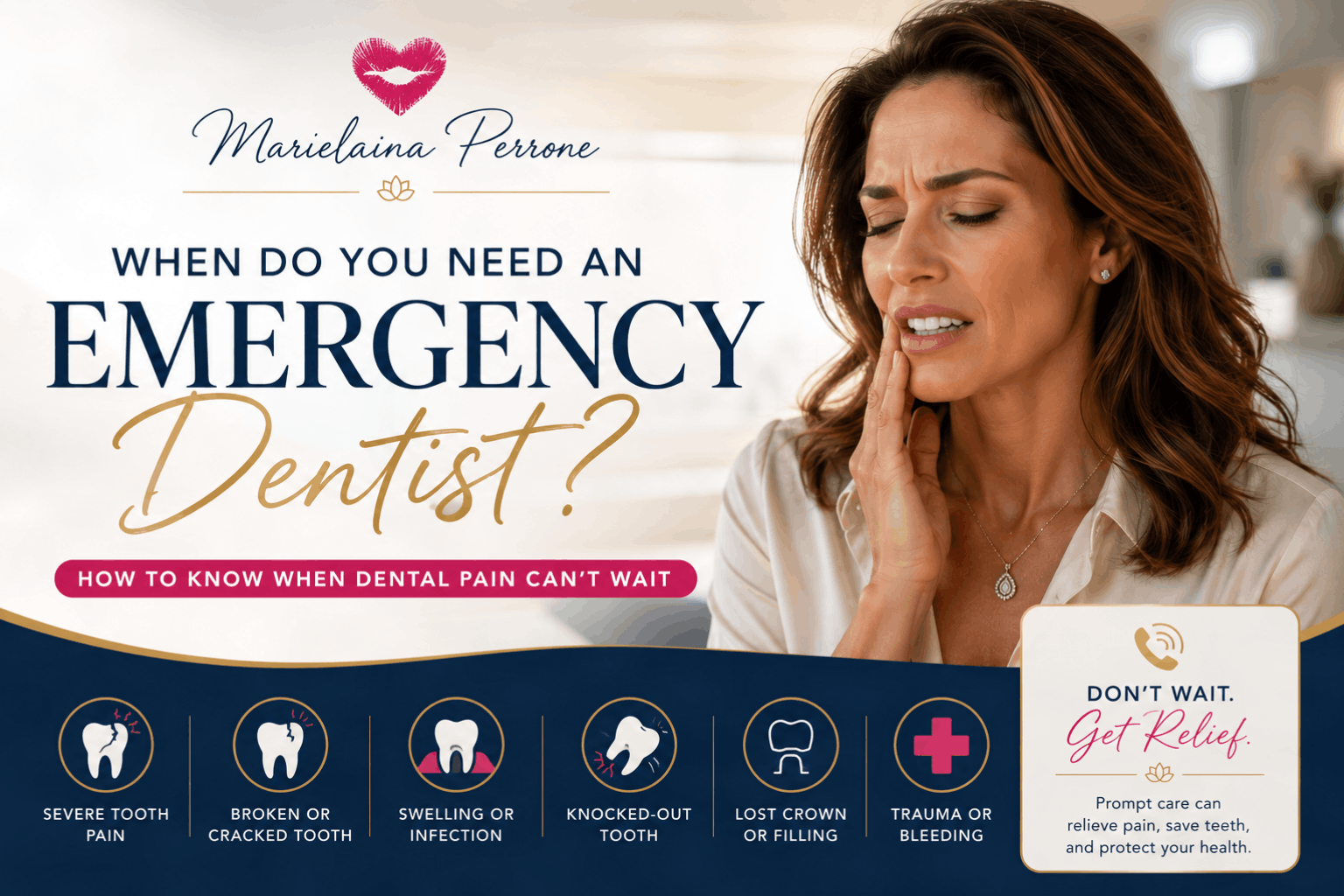
Possible warning signs include swelling of the gum or face, tenderness when biting, a pimple-like bump on the gum, drainage or an unpleasant taste, fever, swollen lymph nodes, or increasing pressure. An abscess should not be ignored simply because the pain temporarily improves.
The underlying infection still requires evaluation and appropriate treatment.
“Pain is not the disease. It is a symptom. A tooth can stop hurting while the underlying dental problem is still present, which is why I don’t use the disappearance of pain as proof that a tooth has healed.”
— Marielaina Perrone, DDS
When a Toothache Becomes a Medical Emergency
Most toothaches belong in a dental office rather than a hospital emergency department.
There are important exceptions.
Difficulty breathing or swallowing, rapidly increasing facial or neck swelling, serious facial or jaw trauma, uncontrolled bleeding, or symptoms suggesting that an infection is spreading require urgent medical attention.
Those situations should not wait for a routine dental appointment. A severe dental infection can extend beyond the tooth and surrounding tissues. Although that is not what happens with most ordinary toothaches, it is why significant swelling accompanied by systemic or airway symptoms must be taken seriously.
What Can I Do Tonight Until I See a Dentist?
If you’re dealing with a toothache at night, the goal is to make yourself reasonably comfortable without masking a potentially important problem indefinitely.
Keeping your head somewhat elevated may make throbbing less noticeable for some people. Gently cleaning around the tooth and flossing can help if trapped food is contributing to discomfort. Avoid foods or temperatures that clearly trigger the pain.
For pain medication, follow the labeled directions and consider your medical history, allergies, medications, pregnancy status, and any instructions previously given by your physician or dentist. The American Dental Association supports non-opioid medications such as NSAIDs, alone or in combination with acetaminophen when appropriate, as first-line therapy for acute dental pain in many situations.
Do not place aspirin directly against a painful tooth or gum. It can injure the soft tissues.
And if you are tempted to take leftover antibiotics from an old prescription, don’t.
Antibiotics do not repair cavities, seal cracks, remove infected pulp, or fix damaged restorations. For many localized dental pain conditions, definitive dental treatment, not antibiotics, is what addresses the source of the problem.

Why Painkillers Aren’t a Dental Treatment
This is worth emphasizing because nighttime pain creates a powerful temptation to manage the symptom and postpone the appointment.
If medication makes the tooth feel better, that’s useful. It doesn’t necessarily mean the tooth is getting better.
Imagine a deep cavity irritating the nerve. Pain medication can reduce the discomfort, but the cavity remains. If the pulp eventually dies, the pain may even disappear temporarily before infection develops around the root.
That apparent improvement can create false reassurance. The objective is not merely to silence the tooth. It is to understand why it is hurting.
Will I Need a Root Canal?
Not necessarily.
Nighttime tooth pain is not an automatic root canal diagnosis. Treatment depends entirely on what we find.
A cavity may need a filling. A cracked or structurally weakened tooth may require a crown. Gum-related discomfort may need periodontal treatment. Bruxism may require management of the forces affecting the teeth. A tooth with irreversible pulp inflammation or infection may require root canal treatment if it can predictably be restored. A severely damaged or non-restorable tooth may need extraction and discussion of replacement options.
Sometimes the solution is relatively simple. The mistake is deciding what treatment you need before anyone has diagnosed the problem.
What I Look for When You Tell Me Your Tooth Hurts at Night
When I evaluate a patient with nighttime tooth pain in my Henderson dental practice, I want to hear the story before I ever decide what the tooth needs.
When did it begin? Is the pain sharp, dull, throbbing, or pressure-like? Does it wake you? Does cold trigger it? Does heat? Does the pain stop immediately or linger? Does biting hurt? Is there swelling? Have you recently had dental treatment? Do you grind your teeth? Has the tooth been heavily restored before?
Then I examine the tooth in the context of the entire mouth.
X-rays may be necessary, but an X-ray isn’t the diagnosis by itself either. I may evaluate the gums, bite, restorations, cracks, tenderness, mobility, temperature response, and surrounding tissues.
All of those pieces help tell the story.
Don’t Wait for Nighttime Tooth Pain to Become Unbearable
One of the unfortunate patterns I see in dentistry is the patient who has had an occasional toothache for weeks but waits until the pain becomes impossible to sleep through.
I understand why.
Dental pain often comes and goes. Life is busy. People hope it will disappear. Some patients are anxious about dentistry, worried about cost, or embarrassed because they haven’t been to a dentist for a long time.
None of those things should prevent you from asking for help.
I would much rather evaluate a problem while we still have more treatment options than meet someone after several sleepless nights when the situation has become an emergency.
There is no judgment in that conversation. There is simply a tooth that needs a diagnosis.

Frequently Asked Questions About Tooth Pain at Night
Why does my tooth only hurt at night?
Reduced distractions, lying down, nighttime grinding or clenching, and inflammation within or around a tooth can all make discomfort more noticeable at night. The timing alone cannot identify the cause.
Why does my tooth start throbbing when I lie down?
Changes associated with lying flat can make pressure and throbbing in inflamed dental tissues more noticeable. Persistent spontaneous throbbing deserves a dental evaluation.
Can a cavity cause nighttime tooth pain?
Yes. As decay progresses closer to the dental pulp, sensitivity and spontaneous pain can develop. Deep decay can cause significant inflammation of the nerve.
Does nighttime tooth pain mean I need a root canal?
No. Several dental problems can cause nighttime pain. A root canal is appropriate only when examination and diagnostic testing show that the pulp is irreversibly inflamed or infected and the tooth is suitable for restoration.
Why do several of my teeth hurt when I wake up?
Grinding or clenching during sleep is one possibility, particularly if you also experience jaw fatigue, headaches, worn teeth, or muscle soreness. Other causes should still be ruled out.
Can sinus pressure make my teeth hurt at night?
Yes. Sinus inflammation can sometimes create aching in the upper back teeth, although dental problems can produce similar symptoms.
Should I go to the emergency room for a toothache?
Most toothaches should be evaluated by a dentist. However, difficulty breathing or swallowing, rapidly spreading facial or neck swelling, uncontrolled bleeding, serious facial trauma, or other potentially life-threatening symptoms require emergency medical care.
What if my tooth suddenly stops hurting?
Don’t assume that means the problem resolved. In some cases, pain decreases because the pulp has lost vitality while infection remains or progresses.
Your Tooth Is Trying to Tell You Something
A toothache that appears at bedtime can feel mysterious, but the important question isn’t really:
“Why does my tooth hurt at night?”
It is:
“What is causing this tooth to hurt in the first place?”
Nighttime may simply be when the problem becomes impossible to ignore.
Sometimes the cause is sensitivity or excessive bite pressure. Sometimes it is a cavity, crack, damaged restoration, or gum problem. And sometimes severe spontaneous nighttime pain indicates that the pulp inside the tooth is significantly inflamed or infected.
The sooner we identify the source, the better chance we have of addressing the problem before it becomes more complicated.
“A tooth that wakes you up is asking for your attention. My goal isn’t simply to make the pain disappear. It’s to determine where the pain is coming from, why it started, and what we can do to protect your health and your tooth whenever possible.”
— Marielaina Perrone, DDS
For patients experiencing tooth pain or a dental emergency in Henderson, Green Valley, Anthem, Seven Hills, Summerlin, or the greater Las Vegas Valley, don’t wait for another sleepless night to find out what is happening. A careful examination can turn a frightening symptom into something much more useful: a diagnosis and a plan.
About Marielaina Perrone, DDS
Dr. Marielaina Perrone, DDS, is a trusted and experienced family and cosmetic dentist in Henderson NV, known for helping patients achieve healthy, beautiful smiles through personalized, compassionate care. With more than 20 years of clinical experience, she combines advanced dental expertise with an artistic eye to deliver exceptional results in porcelain veneers, dental implants, smile makeovers, periodontal therapy, Botox, dermal fillers, and facial aesthetic treatments.
A graduate with honors from Stony Brook University School of Dental Medicine, Dr. Perrone remains committed to lifelong learning and regularly pursues advanced continuing education in cosmetic dentistry, implant dentistry, and facial aesthetics. Her comprehensive approach focuses on enhancing oral health, facial harmony, and overall confidence through customized treatment plans tailored to each patient’s unique goals.
Dr. Perrone is passionate about patient education, preventive care, and building lasting relationships founded on trust, communication, and comfort. She believes every patient deserves individualized attention and treatment that supports both long-term health and a confident smile.
Proudly serving Henderson, Green Valley, Seven Hills, Anthem, Las Vegas, Summerlin, and surrounding communities, Dr. Perrone is dedicated to providing modern, patient-centered dentistry in a welcoming environment. Outside the office, she enjoys cooking, staying active, spending time with family, and participating in community activities throughout the Las Vegas Valley.

Reviewed for Clinical Accuracy
Every article published on drperrone.com is personally written or clinically reviewed by Marielaina Perrone, DDS to ensure it reflects current evidence-based dentistry, modern treatment recommendations, and her philosophy that beautiful smiles are created through personalized care, facial harmony, and long-term oral health.
Last Reviewed: September 2026