When Do You Need an Emergency Dentist? How to Know When Dental Pain Can’t Wait
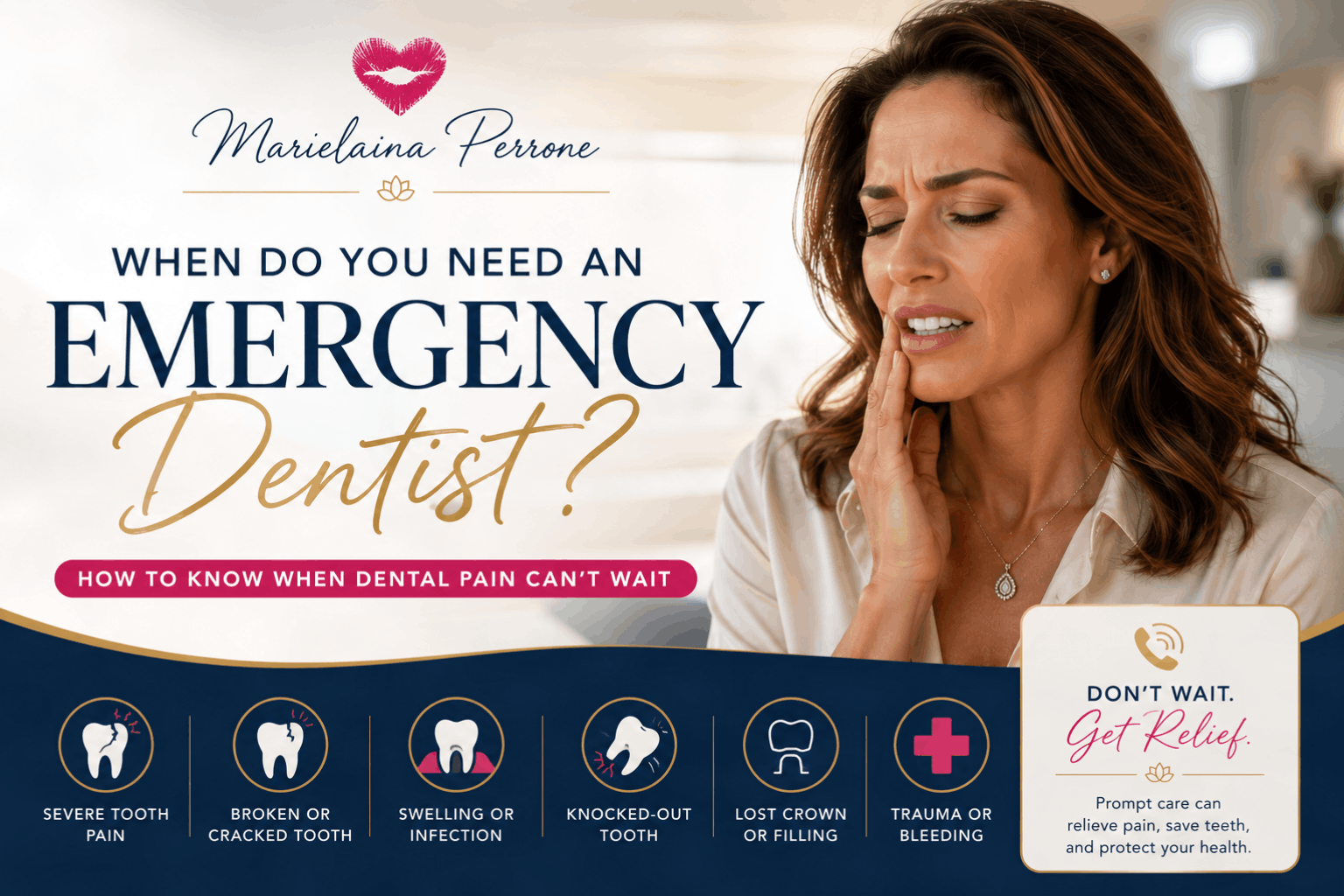
Dental problems rarely happen at convenient times.
A tooth may begin throbbing late at night. A crown can come off while you’re eating dinner. A child can fall and damage a front tooth. You may wake up with swelling that wasn’t there the night before.
When that happens, one question usually comes first:
Do I need an emergency dentist, or can this wait?
After more than 25 years in private practice, I’ve found that patients often fall into one of two groups. Some become understandably frightened by something that looks dramatic but may safely wait until the next business day. Others tolerate significant pain, swelling, or infection for far longer than they should.
The important distinction isn’t simply how uncomfortable something feels. It’s understanding what the symptoms may be telling us and how quickly the underlying problem needs to be evaluated.
“A dental emergency isn’t defined only by how much something hurts. Severe pain matters, but swelling, infection, trauma, uncontrolled bleeding, and the risk of losing a tooth can sometimes make a problem urgent even when the pain isn’t overwhelming.”
— Marielaina Perrone, DDS
At my Henderson, Nevada dental practice, I would rather have a patient call and let us help determine the appropriate next step than spend hours wondering whether a dental problem is serious.
What Is Considered a Dental Emergency?
There is an important difference between a dental emergency, urgent dental care, and a problem that should be evaluated but can reasonably wait for a regular appointment.
The American Dental Association has described true dental emergencies as potentially life-threatening situations requiring immediate treatment, including uncontrolled bleeding, serious infection or swelling that could compromise the airway, and certain facial trauma. The ADA also identifies conditions such as severe dental pain, abscesses, painful tooth fractures, knocked-out or displaced teeth, and some postoperative complications as requiring urgent dental attention.
For patients, however, those definitions can still feel confusing.
You don’t need to diagnose yourself. Instead, pay attention to what has changed.
Is the pain severe or worsening? Is there swelling? Did you injure a tooth? Is something loose or broken? Do you have fever or feel ill? Are you bleeding? Is the problem interfering with eating, sleeping, or normal activities?
Those details help your dentist determine how quickly you should be seen.
Severe Tooth Pain Shouldn’t Be Ignored
A mild, occasional sensitivity when drinking something cold is very different from a toothache that keeps you awake at night.
Severe, persistent, spontaneous, or throbbing pain can occur when the pulp (the tissue containing the nerves and blood vessels inside a tooth) becomes significantly inflamed or infected.
You may also notice pain when biting, lingering sensitivity to hot or cold, pressure, or discomfort that seems to radiate into the jaw or surrounding area.
The temptation is often to take pain medication and wait for the problem to disappear. Sometimes the pain does decrease.
That doesn’t necessarily mean the tooth has healed.
“Pain is information. My goal isn’t simply to make the pain disappear for a few hours. I want to understand why the tooth hurts, whether it can be preserved, and what treatment will address the cause of the problem.”
— Marielaina Perrone, DDS
If dental pain is severe, worsening, persistent, or disrupting your sleep and normal activities, contact your dentist promptly.

Dental Swelling Can Be More Important Than Pain
Swelling deserves particular attention because it can indicate infection.
A dental abscess is a collection of infection that can develop around a tooth or its supporting tissues. Symptoms can include throbbing pain, tenderness when chewing, facial or gum swelling, fever, swollen lymph nodes, and an unpleasant taste or drainage in the mouth. Untreated dental infections can spread beyond the original tooth.
One mistake patients sometimes make is assuming that if an abscess drains and the pain suddenly improves, the infection is gone.
It isn’t necessarily gone.
The Mayo Clinic specifically notes that a ruptured abscess may produce significant pain relief while still requiring dental treatment.
This is one of those situations where feeling better and being better are not always the same thing.
When Dental Swelling Becomes a Medical Emergency
Most toothaches belong in a dental office rather than a hospital emergency department.
There are important exceptions.
If swelling is affecting your ability to breathe or swallow, seek emergency medical care immediately.
Significant swelling extending into the face, neck, or around the eye, particularly when accompanied by fever or difficulty breathing or swallowing, can indicate that an infection is spreading and requires immediate medical attention.
Likewise, serious facial or jaw trauma, loss of consciousness following an injury, or uncontrolled bleeding can require hospital-level emergency care rather than waiting for a dental appointment.
That distinction matters:
Emergency dentist: most urgent problems involving teeth, restorations, localized dental infection, or dental pain.
Hospital emergency department/911: potentially life-threatening infection, airway involvement, serious facial trauma, loss of consciousness, or uncontrolled bleeding.
A Knocked-Out Permanent Tooth Is Truly Time-Sensitive
Few dental emergencies demonstrate the importance of time better than a knocked-out permanent tooth. If an adult tooth is completely knocked out, contact a dentist immediately.
Handle the tooth by the crown (the portion normally visible in the mouth) rather than unnecessarily touching the root. If it can be safely repositioned without forcing it, immediate replantation can sometimes be appropriate; otherwise, preserving the tooth correctly while obtaining emergency dental care is important.
The critical point is simple:
Don’t put a knocked-out permanent tooth on the counter and decide to see how it feels tomorrow.
This is one of the dental situations where acting quickly may influence whether the natural tooth can be saved. Guidance for urgent dental care treats an avulsed permanent tooth as requiring very prompt attention.
Baby teeth are different and generally should not be replanted, so call your dentist for instructions if you’re unsure.
What About a Broken or Cracked Tooth?
A broken tooth can range from a small enamel chip to a fracture involving the nerve or extending beneath the gumline. The appearance alone doesn’t always tell us how serious the damage is.
A tiny fracture can sometimes produce considerable discomfort, while a surprisingly large fracture may initially cause little pain.
I become particularly concerned when a fractured tooth is painful, extremely sensitive, loose, bleeding, associated with facial trauma, or has a large portion missing.
The sooner I can evaluate it, the sooner I can answer the most important question:
Can we save the tooth?
Treatment might involve bonding, a filling, porcelain crown, root canal therapy, or another restorative approach depending on how much healthy tooth remains and where the fracture extends.
Not every broken tooth requires treatment in the middle of the night. But a painful or significantly fractured tooth should not simply be ignored.
My Crown Fell Off. Is That an Emergency?
A lost crown feels alarming because the tooth underneath may suddenly look very different and become sensitive. Usually, this isn’t a life-threatening emergency. But I still recommend contacting your dentist.
The exposed tooth may be vulnerable to sensitivity, additional damage, or movement, and we need to determine why the crown came off.
Sometimes a crown can be recemented. In other cases, decay, fracture, loss of tooth structure, or a problem with the restoration may mean a different solution is necessary.
Keep the crown if you have it and bring it to your appointment.
And please don’t permanently glue it back onto the tooth yourself with household adhesive.
What If a Veneer Breaks?
A chipped or detached porcelain veneer is usually more of an urgent restorative and aesthetic problem than a medical emergency.
However, if the underlying tooth is painful, fractured, extremely sensitive, or has suffered trauma, the situation becomes more urgent.
Save any piece of porcelain you can find and contact your dentist.
The same principle applies to broken fillings and bridges. The urgency depends on the underlying tooth, symptoms, extent of damage, and risk of further fracture. Not simply the fact that a restoration came loose.

What If a Dental Implant Feels Loose?
A dental implant restoration should not suddenly become mobile.
But patients sometimes use the phrase “my implant is loose” to describe several different things.
The implant itself could potentially be mobile, but a screw may also have loosened or the crown or restoration attached to the implant may be moving.
Those are very different problems.
Avoid repeatedly wiggling it to see how loose it is. Contact your dentist and have it evaluated.
Earlier diagnosis may allow us to address a mechanical problem before additional components become damaged.
Bleeding After Dental Treatment
A small amount of oozing after an extraction or oral surgery can be expected. Persistent or heavy bleeding is different.
Follow the postoperative instructions provided by your dentist and contact the office if bleeding is more than expected or isn’t resolving.
Heavy bleeding that cannot be controlled warrants emergency attention. The ADA includes uncontrolled bleeding among true dental emergencies.
Patients taking anticoagulant or antiplatelet medications should make sure their dentist knows their complete medication history. Do not independently stop prescribed medication because of dental bleeding unless the clinician managing that medication tells you to do so.
Severe Pain After an Extraction
Some discomfort after an extraction is normal.
Pain that becomes severe or worsens several days later may indicate a complication such as alveolar osteitis, commonly called dry socket.
Dry socket isn’t the same thing as a spreading dental infection, but the pain can be intense and deserves dental evaluation. The ADA includes postoperative osteitis among conditions requiring urgent dental care.
Your dentist can examine the extraction site and determine what is happening rather than asking you to endure the pain until it eventually resolves.
Do You Just Need Antibiotics?
This is an important misconception.
Patients sometimes call with a toothache and assume that a prescription for antibiotics will solve the problem.
For many pulpal and localized dental conditions, antibiotics are not a substitute for definitive dental treatment.
Current ADA guidance recommends prioritizing appropriate dental procedures for most pulpal and periapical dental pain and localized swelling in otherwise healthy adults rather than routinely prescribing antibiotics. Antibiotics become appropriate in certain circumstances, including evidence of systemic involvement such as fever or malaise.
If an infected tooth requires root canal treatment, drainage, extraction, or another procedure, medication alone may not eliminate the source.
“The question isn’t simply whether an antibiotic might make someone feel better temporarily. We need to identify the source of the infection and determine what actually needs to be treated.”
— Marielaina Perrone, DDS

Should You Go to the Emergency Room for a Toothache?
Usually, your dentist is the better first call for an isolated dental problem.
Hospital emergency departments play a critical role when there is a medical emergency, but they generally are not where definitive restorative dental treatment takes place. The ADA has specifically developed programs aimed at redirecting appropriate non-traumatic dental problems from hospital emergency departments to dental practices where the underlying dental condition can be treated.
For ordinary tooth pain, a broken restoration, localized dental problem, or dental abscess without signs of a medical emergency, contact a dentist.
But again, difficulty breathing or swallowing, potentially dangerous facial or neck swelling, uncontrolled bleeding, or serious facial trauma changes that recommendation.
Those symptoms require emergency medical attention.
What Should You Do While Waiting for an Emergency Dental Appointment?
The safest advice depends on what happened, which is another reason I recommend calling the dental office for specific instructions.
For a toothache, avoid placing aspirin directly against the tooth or gum tissue. If you can safely take them based on your medical history and other medications, over-the-counter pain relievers may provide temporary relief while you are waiting for definitive care. The ADA’s current acute dental pain guidance supports non-opioid medications as first-line approaches for many common acute dental pain situations.
If a restoration falls out, save it.
If a tooth fractures, save any pieces you can locate.
If trauma occurs, let us know exactly what happened.
And if symptoms change while you’re waiting—particularly rapidly increasing swelling, fever, difficulty swallowing, difficulty breathing, or uncontrolled bleeding. Don’t simply continue waiting for the dental appointment.
What Happens at an Emergency Dental Visit?
An emergency appointment isn’t simply about making the pain stop.
First, I need to determine why you’re having the emergency.
That may involve discussing when the symptoms began, examining the tooth and surrounding tissues, evaluating your bite, testing the tooth, reviewing your medical history, and taking appropriate dental X-rays.
Then we determine what needs to happen immediately and what can be completed later.
Depending on the diagnosis, treatment might involve repairing a fractured tooth, replacing or stabilizing a restoration, addressing infection, initiating root canal treatment, extracting a tooth that cannot be saved, controlling bleeding, adjusting the bite, or referring for appropriate specialty or medical care.
Sometimes the emergency visit stabilizes the situation and definitive treatment follows later. That’s perfectly appropriate. The priority is making the right diagnosis first.

Don’t Be Embarrassed to Call an Emergency Dentist
This may be one of the most important things I can tell someone who has been avoiding dental care.
Please don’t stay home with a serious dental problem because you’re embarrassed about how your teeth look or how long it has been since you’ve seen a dentist.
I’ve treated patients who haven’t been to a dentist in many years. My first concern isn’t judging how they got there.
It’s figuring out how I can help them now.
“Dental emergencies have a way of bringing people into the office when they feel vulnerable. That’s exactly when a patient deserves calm information, thoughtful care, and a plan. Not a lecture about what they should have done six months ago.”
— Marielaina Perrone, DDS
Once the immediate problem is under control, we can talk about preventing the next one.
When Should You Call an Emergency Dentist?
A good practical rule is this:
If something hurts badly, is swelling, bleeding, broken, infected, displaced, or suddenly different and you’re uncertain whether it can wait, call your dentist.
You don’t have to decide whether it officially qualifies as an “emergency.” That’s part of our job.
Some problems can safely be scheduled for the following day. Others should be seen as soon as possible. And occasionally, the symptoms tell us that the appropriate destination isn’t the dental office at all—it’s the emergency department.
What matters is making that distinction early.
Frequently Asked Questions About Dental Emergencies
Is severe tooth pain a dental emergency?
Severe, persistent, or worsening tooth pain—particularly pain that interferes with sleep or normal activities—should be evaluated promptly. Significant pain can result from inflammation, infection, fracture, or other dental conditions.
Is a dental abscess an emergency?
A suspected abscess requires prompt dental evaluation. If infection is accompanied by significant facial or neck swelling, fever, difficulty swallowing, or difficulty breathing, seek emergency medical attention.
Is a broken tooth an emergency?
It can be. A painful fracture, significant trauma, tooth displacement, bleeding, or exposure of deeper tooth structures warrants prompt evaluation.
Is a lost crown an emergency?
Usually it is urgent rather than life-threatening. Contact your dentist, save the crown, and avoid trying to permanently glue it back yourself.
Can a toothache go away on its own?
Pain can decrease even when the underlying dental problem remains. A ruptured abscess, for example, can temporarily relieve pressure and pain without eliminating the infection.
When should I go to the hospital instead of a dentist?
Seek emergency medical care for difficulty breathing or swallowing, serious facial or jaw trauma, potentially dangerous swelling involving the mouth, neck, or surrounding structures, loss of consciousness following facial trauma, or uncontrolled bleeding.
The Bottom Line
Not every unexpected dental problem is an emergency.
But some dental problems become much more difficult and occasionally much more dangerous, when patients wait too long.
Severe tooth pain, swelling, infection, dental trauma, a knocked-out tooth, significant fracture, or uncontrolled bleeding deserve prompt attention. And symptoms involving breathing, swallowing, major facial trauma, or rapidly spreading swelling may require immediate hospital emergency care.
At my dental practice in Henderson, Nevada, I evaluate dental emergencies for patients throughout Green Valley, Anthem, Seven Hills, Inspirada, Summerlin, Las Vegas, and surrounding Southern Nevada communities.
If you’re uncertain whether your problem can wait, call the dental office and describe what’s happening.
You don’t need to make the diagnosis before you call.
That’s what we’re here for.
About Marielaina Perrone
Dr. Marielaina Perrone, DDS, is a highly skilled cosmetic and family dentist based in Henderson, dedicated to transforming smiles and improving lives through compassionate, patient-centered care.
With over 20 years of clinical experience, Dr. Perrone combines advanced dental techniques with a refined artistic eye to deliver exceptional results in porcelain veneers, dental implants, smile makeovers, periodontal therapy, dermal fillers, Botox, and comprehensive facial aesthetic treatments. Her approach goes beyond dentistry—focusing on facial harmony, function, and long-term wellness.
A graduate at the top of her class, Dr. Perrone is committed to continuing education and advanced training, ensuring her patients benefit from the latest innovations in both dentistry and aesthetic medicine. Every treatment is thoughtfully planned and tailored to achieve natural-looking, confident results that enhance both appearance and overall well-being.
She is passionate about patient education, preventive care, and building lasting relationships grounded in trust, comfort, and open communication. Patients appreciate her attention to detail, gentle approach, and commitment to delivering care that is both precise and personalized.
Dr. Perrone proudly serves patients throughout Henderson, Green Valley, and the greater Las Vegas area.
Outside the office, she enjoys cooking, staying active, and spending time with her family.

Reviewed for Clinical Accuracy
This article has been written and clinically reviewed by Marielaina Perrone, DDS, to ensure it reflects current evidence-based dentistry and the personalized philosophy of care practiced at her Henderson, Nevada office.
Last Reviewed: September 2026