What Is “Instant Orthodontics”? Understanding the Difference Between Porcelain Veneers and Moving Your Teeth

The phrase “instant orthodontics” sounds almost too good to be true. After all, traditional orthodontic treatment may take months or longer to gradually move teeth into healthier, more attractive positions.
So how could orthodontics possibly be “instant”?
The answer is that instant orthodontics isn’t really orthodontics at all.
It is a term sometimes used in cosmetic dentistry to describe the use of porcelain veneers to create the appearance of straighter, more symmetrical teeth without physically moving the teeth with braces or clear aligners.
For carefully selected patients, veneers can dramatically change the appearance of mildly crooked, rotated, uneven, spaced, or disproportionate teeth in a relatively short period of time. But veneers and orthodontics accomplish very different things.
That distinction matters.
At her Henderson, Nevada dental practice, Marielaina Perrone, DDS, believes cosmetic treatment should begin by understanding what is actually causing a patient’s concern. Not simply choosing the fastest way to change how a smile looks.
“Sometimes the best cosmetic treatment is porcelain veneers. Sometimes it is orthodontics. And sometimes it is a combination of treatments. My goal isn’t simply to make teeth look straighter quickly. It’s to determine which approach makes the most sense for that patient’s teeth, bite, appearance, and long-term dental health.”
— Marielaina Perrone, DDS
What Does “Instant Orthodontics” Mean?
“Instant orthodontics” is an informal cosmetic-dentistry term rather than a literal description of orthodontic treatment.
Traditional orthodontics uses controlled forces to physically reposition teeth within the jaw.
Porcelain veneers work differently.
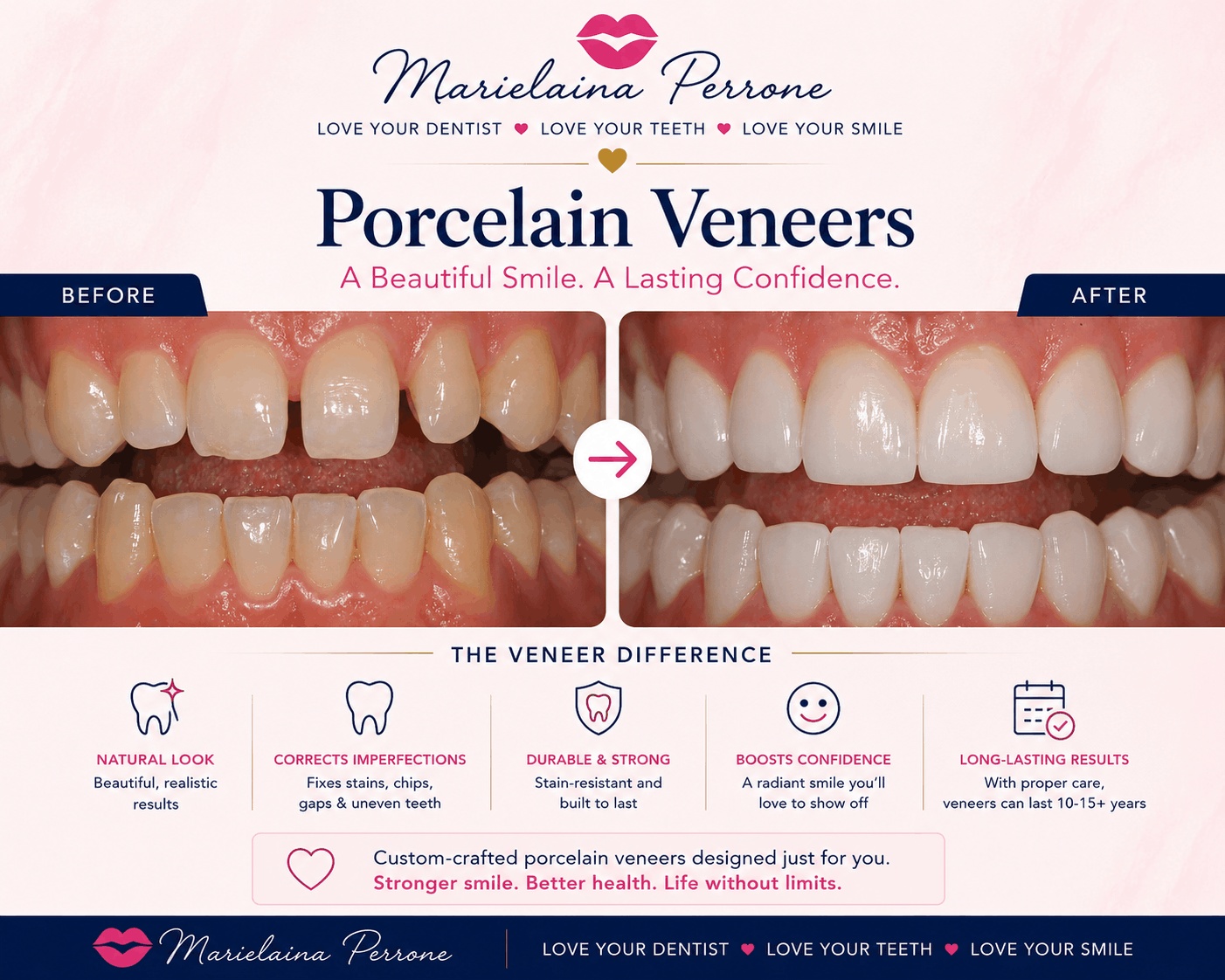
A veneer is a thin, custom-designed ceramic restoration bonded to the visible surface of a tooth. By changing the visible shape, proportion, color, and contour of selected teeth, veneers can make mildly misaligned teeth appear considerably straighter and more symmetrical.
Think of the difference this way:
Orthodontics changes where the tooth is.
Porcelain veneers can change how the tooth appears.
That is the most important concept to understand about instant orthodontics.
What Is “Instant Orthodontics”?
“Instant orthodontics” usually refers to using porcelain veneers to make selected teeth look straighter without physically moving them. Open each section to compare veneers with braces or clear aligners and see when each approach may make sense.
1. Is “Instant Orthodontics” Really Orthodontics?No—the term describes a cosmetic result, not tooth movement
Traditional orthodontics physically repositions teeth. Porcelain veneers can change the visible shape and contour of selected teeth so they appear straighter and more symmetrical.
✓ Orthodontics changes where the tooth is
✓ Veneers change how the tooth appears
✓ The two approaches solve different problems
2. How Can Veneers Make Crooked Teeth Look Straighter?By redesigning the visible surface of the tooth
A mildly rotated or uneven tooth may sometimes be reshaped and restored with porcelain so the finished surface aligns visually with neighboring teeth.
✓ Mild rotations
✓ Small spaces
✓ Uneven tooth lengths
✓ Minor crowding
✓ Irregular shapes or proportions
3. What Can Orthodontics Do That Veneers Cannot?Actually move teeth and improve certain bite relationships
Braces and clear aligners gradually reposition natural teeth and may be more appropriate when the primary problem is tooth position.
✓ Correct crowding
✓ Close or redistribute spaces
✓ Rotate teeth
✓ Improve arch alignment
✓ Address selected bite problems
4. What Can Veneers Change Beyond Alignment?Shape, color, proportion, symmetry, and wear can be addressed at the same time
✓ Tooth color
✓ Shape and width
✓ Tooth length
✓ Symmetry
✓ Chips and wear
✓ Apparent alignment
5. Who Might Be a Candidate?Patients with healthy teeth and relatively limited alignment concerns
Potential candidates may have mild crowding, small spaces, limited rotations, uneven tooth dimensions, discoloration, chips, wear, or asymmetry.
✓ Healthy gums
✓ Adequate enamel
✓ Favorable bite relationships
✓ Tooth positions that can be corrected cosmetically without excessive reduction
6. When Are Veneers NOT a Good Substitute for Orthodontics?When the underlying tooth position or bite really needs to be corrected
⚠ Significant crowding
⚠ Major rotations
⚠ Significant bite problems
⚠ Unfavorable tooth positions
⚠ Excessive enamel would need to be removed
7. What If My Teeth Are Healthy but Just Crooked?Orthodontics may be the more conservative option
If you already like the color, shape, and condition of your teeth, moving them may preserve more untouched natural tooth structure than covering them with restorations.
✓ Consider how much enamel would need to be altered
✓ Understand the long-term restorative commitment
✓ Ask whether orthodontics could solve the problem more conservatively
8. Are No-Prep Veneers Automatically Better?No—the correct amount of preparation depends on the case
Adding porcelain without enough space can create teeth that look bulky or overcontoured. Minimal-prep approaches are excellent when the tooth position and desired result allow them.
9. Can Orthodontics and Veneers Be Combined?Yes—and sometimes that is the most conservative cosmetic plan
Limited orthodontic treatment can sometimes move teeth into more favorable positions before veneers are designed.
✓ Correct a significant rotation first
✓ Improve spacing
✓ Reduce the amount of tooth preparation required
✓ Use veneers afterward for color, shape, wear, or proportion
10. Why Does the Bite Matter?A cosmetic result must also function comfortably
Veneers placed in an unfavorable bite can be exposed to excessive force, increasing stress on both porcelain and the natural teeth underneath.
11. Will “Instant Orthodontics” Look Natural?It can—if the smile is designed for the individual
Natural-looking veneers depend on proportion, translucency, texture, edge position, contour, and how the restorations relate to the face.
“The goal isn’t to erase someone’s individuality. The most successful cosmetic dentistry should make you notice the person’s smile—not immediately notice their dental work.”
— Marielaina Perrone, DDS
12. Veneers or Clear Aligners: Which Is Better?Choose based on what actually needs to change
Primarily tooth position? Orthodontics deserves serious consideration.
Color + shape + wear + proportion + apparent alignment? Veneers may address more of the cosmetic problem.
Need both? Orthodontics followed by veneers may be appropriate.
13. Questions to Ask Before Choosing “Instant Orthodontics”Move the conversation from speed to long-term decision-making
✓ Are my teeth healthy enough for veneers?
✓ Could orthodontics solve the problem more conservatively?
✓ How much enamel would need to be altered?
✓ Does my bite make veneers appropriate?
✓ Could limited orthodontics reduce preparation?
✓ How many teeth really need treatment?
✓ What maintenance will these restorations require?
14. What Is the Bottom Line?Faster isn’t always better—but veneers can be excellent in the right case
“Instant orthodontics” is best understood as cosmetic smile redesign. Veneers can create the appearance of straighter teeth while also changing shape, proportion, color, and symmetry, but they should not replace orthodontics when true tooth movement is the healthier or more conservative choice.
“Sometimes the best cosmetic treatment is porcelain veneers. Sometimes it is orthodontics. And sometimes it is a combination of treatments.”
— Marielaina Perrone, DDS
Educational Note
This guide is educational and cannot determine whether porcelain veneers, clear aligners, braces, or a combination approach is appropriate for an individual patient. A clinical examination is necessary to evaluate tooth position, enamel, gum health, bite relationships, and cosmetic goals.
How Can Porcelain Veneers Make Crooked Teeth Look Straight?
Imagine one front tooth is slightly rotated.
Orthodontic treatment could gradually rotate that tooth into a different physical position.
Cosmetic dentistry may approach the same visual problem differently.
The visible contour of the tooth can sometimes be modified, and a porcelain veneer can be designed so that the finished surface appears aligned with the neighboring teeth.
The underlying tooth hasn’t been orthodontically moved.
Its visible shape has been redesigned.
This approach may also be used to improve the appearance of:
- Minor tooth rotations
- Small spaces between teeth
- Uneven tooth lengths
- Slight crowding
- Irregular tooth shapes
- Asymmetrical front teeth
- Disproportionately small teeth
- Worn or chipped teeth
- Discoloration occurring along with alignment concerns
Because porcelain veneers can address color, shape, proportion and apparent alignment simultaneously, they can sometimes accomplish cosmetic changes that orthodontics alone cannot.
Instant Orthodontics vs. Traditional Orthodontics
The two treatments shouldn’t really be viewed as competitors because they solve different problems.
Orthodontics Moves Teeth
Traditional braces and clear aligners gradually reposition natural teeth.
That may improve:
- Crowding
- Spacing
- Tooth rotation
- Certain bite relationships
- Dental arch alignment
- The position of teeth relative to one another
Orthodontic treatment preserves the natural surfaces of the teeth and actually changes their positions.
Porcelain Veneers Redesign Their Appearance
Veneers do not move tooth roots through bone.
Instead, they change what you see when someone smiles.
That makes veneers primarily a restorative and cosmetic treatment rather than an orthodontic treatment.
For someone whose only concern is tooth position, orthodontics may therefore be the more conservative solution.
But consider another patient whose front teeth are mildly crooked and worn, stained, chipped and irregularly shaped.
Straightening the teeth would address only one part of the problem.
Veneers could potentially address several of those concerns simultaneously.
That’s where the decision becomes more nuanced.

Why Would Someone Consider Instant Orthodontics?
Speed is certainly one reason, but it shouldn’t be the only reason.
A porcelain veneer smile transformation can generally be completed much more quickly than conventional orthodontic movement. That difference in treatment time is why veneers acquired the nickname “instant orthodontics.”
However, the greater advantage for the right patient may be the number of cosmetic characteristics that can be redesigned simultaneously.
Porcelain veneers can potentially alter:
Alignment appearance. Mildly crooked teeth may appear straighter.
Shape. Narrow, short, uneven or irregular teeth can be redesigned.
Proportion. The relationship between neighboring teeth can be improved.
Color. Deep discoloration that does not respond predictably to whitening may be concealed.
Symmetry. Corresponding teeth can be designed to better complement one another.
Wear. Selected worn or chipped areas may be restored.
So the patient isn’t necessarily choosing veneers merely because they don’t want braces.
They may be choosing a comprehensive cosmetic redesign.
Who Might Be a Candidate?
There is no universal rule based simply on how crooked someone’s teeth appear.
A cosmetic dentist needs to evaluate the entire situation.
Potential candidates may have relatively healthy teeth and gums along with concerns such as mild crowding, small spaces, limited rotations, uneven tooth dimensions, discoloration, wear, chips or asymmetry.
The position of the teeth must also allow the desired result to be created without requiring an unreasonable alteration of healthy tooth structure.
That last point is extremely important.
When Are Porcelain Veneers NOT a Substitute for Orthodontics?
This is where the phrase “instant orthodontics” can become misleading.
Not every crooked smile should be corrected cosmetically.
Significant crowding, major tooth rotations, substantial bite problems or unfavorable tooth positions may be better addressed through orthodontic movement.
Porcelain veneers cannot physically correct an underlying skeletal or orthodontic problem simply by changing the visible surfaces of the teeth.
Trying to make a severely misaligned tooth appear straight with porcelain could also require excessive tooth reduction.
In those circumstances, moving the tooth first may be healthier and more conservative.
That’s why the question shouldn’t be:
“Can veneers make my teeth look straight?”
It should be:
“What treatment gives me the result I want while preserving as much healthy tooth structure as reasonably possible?”
Those are very different questions.
What About Healthy Teeth?
This deserves special attention because cosmetic dentistry is elective.
If someone has beautiful, healthy teeth that are simply mildly crooked, orthodontics may offer the ability to improve alignment without covering the teeth with restorations.
Porcelain veneers frequently require some degree of enamel preparation. Once natural tooth structure has been altered for a conventional veneer, the decision should generally be considered a long-term restorative commitment.
That doesn’t make veneers inherently undesirable.
It means their benefits should justify the treatment.
The growing discussion around veneer regret also illustrates why patients should understand the permanence, maintenance and alternatives before proceeding with cosmetic treatment.
A thoughtful cosmetic dentist shouldn’t be trying to place the greatest possible number of veneers.
The objective should be achieving the desired result with an appropriate and conservative treatment plan.
Can No-Prep or Minimal-Prep Veneers Be Used?
Sometimes.
If the teeth are small, positioned favorably or require additional facial volume, extremely conservative veneer preparation may be possible.
But “no-prep” shouldn’t automatically be interpreted as better.
Adding porcelain to a tooth without creating enough space can produce a restoration that appears:
- Bulky
- Overcontoured
- Too prominent
- Unnatural
- Difficult to integrate with the gumline
The amount of preparation should be determined by the individual tooth and the desired result—not by a marketing label.
What If My Teeth Need Both Orthodontics and Veneers?
This can actually be one of the most elegant approaches.
Sometimes limited orthodontic treatment can move teeth into better positions before cosmetic dentistry begins.
That can potentially allow the final veneers to be designed more conservatively.
For example, orthodontics might first correct a significant rotation or create better spacing. Porcelain veneers could then address remaining issues involving shape, color, wear or proportion.
Instead of asking:
Veneers or orthodontics?
The better answer may occasionally be:
Orthodontics first, veneers second.
Treatment planning matters more than forcing every patient into one category.
The Importance of the Bite
One of the biggest mistakes in cosmetic dentistry is evaluating only the teeth visible in a photograph.
A smile has to function.
Before considering veneers for apparent alignment, the dentist should evaluate how the upper and lower teeth come together.
Excessive forces can increase stress on porcelain restorations and the natural teeth supporting them.
Patients who clench or grind their teeth may require additional consideration as well.
A beautiful smile that doesn’t function comfortably isn’t successful cosmetic dentistry.
Will Instant Orthodontics Look Natural?
It certainly can—but natural-looking results depend heavily on design.
Straight teeth aren’t necessarily identical teeth.
Natural smiles contain subtle differences in:
- Tooth length
- Edge position
- Surface texture
- Translucency
- Contour
- Light reflection
- Proportion
If every tooth is made exactly the same size and brilliant opaque white, the result can appear artificial even if the teeth are perfectly symmetrical.
Dr. Perrone’s approach to cosmetic dentistry emphasizes creating a smile that complements the patient’s facial features rather than imposing the same smile design on everyone.
“The goal isn’t to erase someone’s individuality. The most successful cosmetic dentistry should make you notice the person’s smile. Not immediately notice their dental work.”
— Marielaina Perrone, DDS
How Quickly Can Porcelain Veneers Transform a Smile?
Veneer treatment is considerably faster than biologically moving teeth, but the word “instant” shouldn’t imply rushed dentistry.
Treatment typically involves several important stages:
1. Cosmetic Consultation
The teeth, gums, bite, existing restorations and cosmetic concerns are evaluated.
2. Smile Planning
The desired tooth shapes, proportions, color and overall character of the smile are discussed.
3. Tooth Preparation
When preparation is necessary, an appropriate amount of enamel is carefully modified to create room for the restorations.
4. Temporary Veneers
Depending upon the treatment plan, provisional restorations may allow the patient to experience aspects of the proposed smile before the final porcelain is completed.
5. Final Porcelain Placement
The final veneers are evaluated for fit, color, shape, bite and overall appearance before bonding.
The transformation may be relatively fast compared with orthodontics, but precision should never be sacrificed for speed.
Porcelain Veneers or Clear Aligners: Which Is Better?
Neither is universally better.
The answer depends on what needs to change.
If you like the color, shape and condition of your natural teeth and primarily want them straighter, orthodontics deserves serious consideration.
If your concerns include shape + color + wear + proportion + apparent alignment, porcelain veneers may accomplish more of your aesthetic objectives.
If substantial tooth movement is needed but cosmetic concerns will remain afterward, a combination approach may make the most sense.
That is why photographs or online smile simulations alone cannot determine the right treatment.
Questions to Ask Before Choosing “Instant Orthodontics”
Before proceeding, ask your dentist:
Are my teeth healthy enough for veneers?
Could orthodontics solve my problem more conservatively?
How much natural enamel would need to be altered?
Does my bite make veneers appropriate?
Could limited orthodontics reduce the amount of tooth preparation needed?
How many teeth actually require treatment?
What will happen to my untreated teeth as my smile ages?
What maintenance will these restorations require over time?
Those questions shift the conversation away from “How fast can I get a perfect smile?” toward “What is the best long-term decision for me?”
That’s a much healthier way to approach elective cosmetic dentistry.
The Philosophy Behind Instant Orthodontics
The phrase itself is catchy.
But good cosmetic dentistry shouldn’t really be about “instant” anything.
It should be about diagnosis, restraint, design and understanding the patient’s priorities.
There are situations where porcelain veneers can produce a remarkable transformation for someone with mildly misaligned teeth.
There are also situations where orthodontics is clearly the better choice.
And there are patients who benefit from both.
The skill lies in knowing the difference.
Instant Orthodontics in Henderson, NV
For patients in Henderson, Green Valley, Las Vegas, Summerlin and surrounding communities, Dr. Marielaina Perrone provides individualized cosmetic dentistry consultations for patients considering porcelain veneers and complete smile makeovers.
The consultation isn’t simply about deciding whether veneers are possible.
It is an opportunity to evaluate your existing teeth, bite, gums, facial proportions and cosmetic goals and determine whether veneers, orthodontic treatment, another cosmetic procedure or a combination approach makes the most sense.
Frequently Asked Questions About Instant Orthodontics
Is instant orthodontics actually orthodontics?
No. The term usually describes using porcelain veneers or other restorations to make selected teeth appear straighter. Orthodontics physically moves teeth into new positions.
Can veneers fix crooked teeth?
Veneers can sometimes improve the appearance of mildly crooked, rotated or uneven teeth, but they do not physically straighten them.
Can veneers fix an overbite?
Veneers can alter the appearance of certain teeth, but they do not correct the underlying jaw relationship responsible for a true skeletal bite problem.
Are veneers faster than braces or clear aligners?
Generally, yes. Cosmetic treatment with veneers can be completed much faster because the teeth aren’t being gradually moved through bone.
Is instant orthodontics permanent?
Porcelain veneers should be viewed as a long-term restorative commitment. Veneers themselves will not necessarily last for life, and restorations may eventually require maintenance or replacement.
Are veneers better than Invisalign or braces?
Not inherently. If the primary problem is tooth position, orthodontics may be more conservative. If the patient wants to change color, shape, proportion and apparent alignment simultaneously, veneers may offer advantages.
Can orthodontics and veneers be combined?
Yes. In selected cases, moving the teeth first can create more favorable positions for conservative cosmetic treatment afterward.
How do I know which treatment is right for me?
A clinical examination is necessary to evaluate tooth position, enamel, gum health, bite relationships and your aesthetic goals.
Final Thoughts: Faster Isn’t Always Better—But Sometimes It Makes Sense
“Instant orthodontics” is best understood as cosmetic smile redesign rather than accelerated orthodontic treatment.
Porcelain veneers can create the appearance of straighter teeth without spending months physically repositioning them. For the right patient, they can simultaneously improve alignment appearance, tooth shape, proportions, color and symmetry.
But speed shouldn’t determine treatment.
Sometimes moving healthy teeth is the more conservative choice. Sometimes porcelain veneers provide benefits orthodontics cannot. And sometimes combining the two produces the best result.
The objective isn’t simply a straighter-looking smile.
It is a smile that is beautiful, natural, functional and thoughtfully designed for the individual wearing it.
To learn whether porcelain veneers may be appropriate for your smile, schedule a cosmetic dentistry consultation with Marielaina Perrone, DDS in Henderson, NV.
Author Bio
Dr. Marielaina Perrone, DDS, is a highly skilled cosmetic and family dentist based in Henderson, NV, dedicated to transforming smiles and improving lives through compassionate, patient-centered care. With over 20 years of clinical experience, Dr. Perrone blends advanced dental techniques with an artistic eye to deliver exceptional results in porcelain veneers, dental implants, smile makeovers, periodontal therapy, dermal fillers, Botox, and comprehensive facial aesthetic treatments.
A graduate at the top of her dental class, Dr. Perrone continually pursues advanced training to remain at the forefront of modern dentistry and aesthetic medicine. Her integrative approach focuses on oral health, facial harmony, and personalized treatment planning, helping patients achieve natural, confident smiles that enhance both appearance and overall well-being.
Dr. Perrone is passionate about patient education, preventive care, and creating long-term relationships built on trust, comfort, and communication. She proudly serves the communities of Henderson, Green Valley, and the greater Las Vegas area. When she’s not caring for patients, she enjoys cooking, staying active, and spending time with her family.

Reviewed for Clinical Accuracy
This article has been written and clinically reviewed by Marielaina Perrone, DDS, to ensure it reflects current evidence-based dentistry and the personalized philosophy of care practiced at her Henderson, Nevada office.
Last Reviewed: August 2026