Truth About Porcelain Veneers: Are They Right for Your Smile Makeover?

Porcelain veneers are one of the most powerful treatments in cosmetic dentistry. They can change the color, shape, proportion, symmetry, and overall appearance of a smile. Sometimes with surprisingly conservative changes to the natural teeth.
But veneers are not automatically the right choice for everyone.
Social media can make porcelain veneers look like a simple cosmetic purchase: choose a shade, cover the teeth, and walk away with a perfect smile. In reality, excellent veneer dentistry requires much more thought. Your bite, enamel, gum health, facial features, existing restorations, tooth position, and long-term expectations all matter.
At my Henderson, Nevada dental practice, I believe the goal of a smile makeover should never be to give every patient the same set of “perfect” teeth.
The goal is to create a smile that looks like it naturally belongs to you.
“The best porcelain veneers shouldn’t make people wonder where you had your teeth done. They should simply notice that your smile looks beautiful, healthy, and completely natural.”
— Marielaina Perrone, DDS
What Are Porcelain Veneers?
Porcelain veneers are thin, custom-designed ceramic restorations bonded to the front surfaces of teeth.
They can be used to improve several cosmetic concerns, including:
- Discolored or permanently stained teeth
- Chipped teeth
- Worn or shortened teeth
- Uneven tooth shapes
- Small gaps between teeth
- Mildly crooked teeth
- Asymmetrical smiles
- Teeth that appear disproportionately small
- Certain enamel defects
- Aging or previously restored smiles
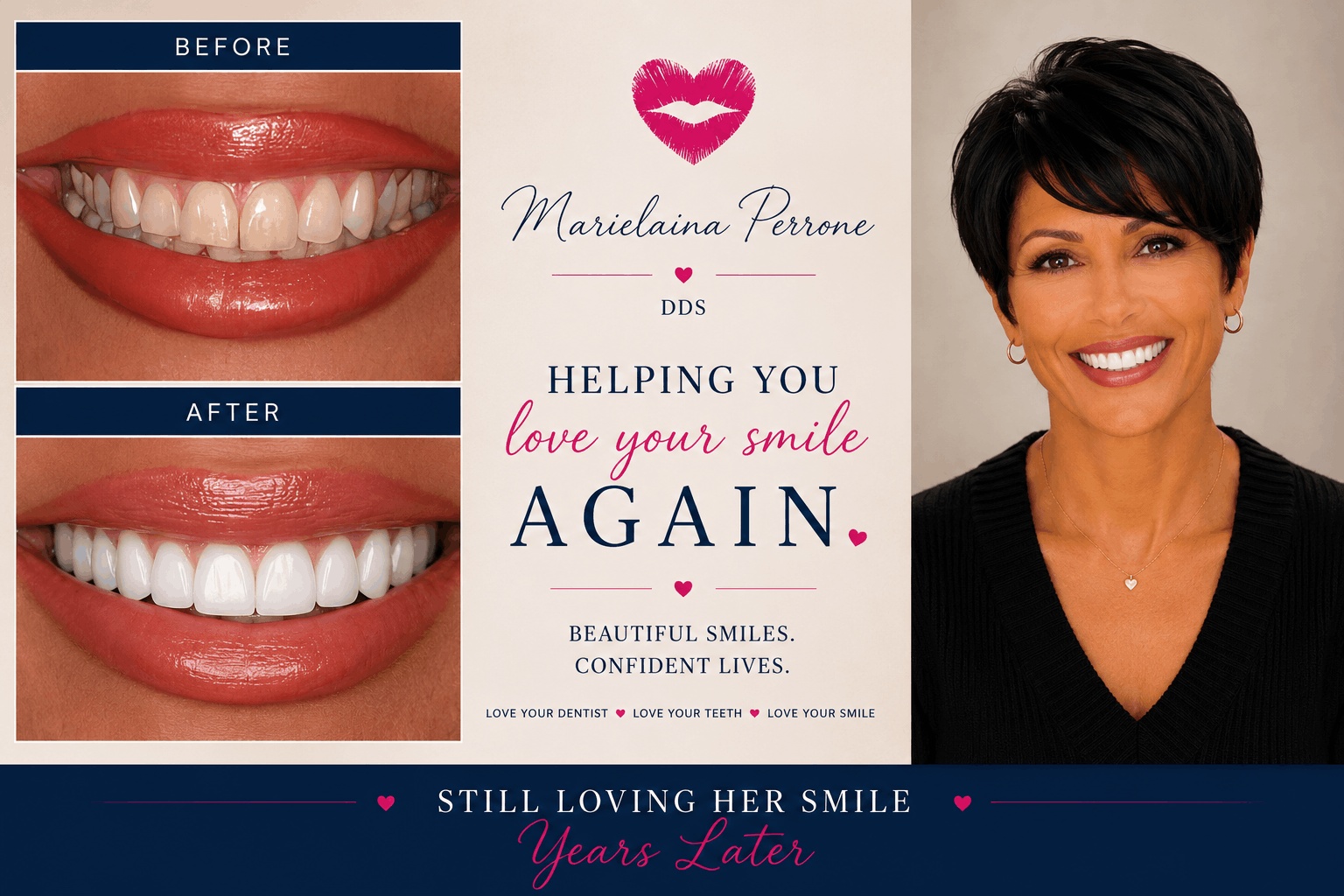
Unlike a dental crown, which generally surrounds the entire visible portion of a tooth, a veneer primarily covers its front surface.
That distinction matters because veneers can often accomplish a significant cosmetic transformation while preserving considerably more natural tooth structure than a full-coverage restoration.
One of the biggest misconceptions about veneers is that they are simply a permanent form of teeth whitening.
Color is only one element of a beautiful smile. When I evaluate someone for porcelain veneers, I am looking at the entire smile:
Tooth proportions. Tooth length. Gum levels. Facial symmetry. Lip position. Tooth position. Bite. Smile width. Age. Personality.
A beautiful smile is a composition.
Two patients could have exactly the same shade of porcelain and achieve completely different results because their facial features and smile architecture are different. This is where cosmetic dentistry becomes as much about artistic judgment as restorative technique.
Are Porcelain Veneers Right for Your Smile?
Porcelain veneers
can create a remarkable smile transformation, but they aren’t the right treatment
for everyone. Explore the questions Dr. Perrone considers before recommending veneers,
bonding, whitening, crowns, or a complete smile makeover.
1. Are Your Teeth and Gums Healthy?
Cosmetic dentistry begins with a healthy foundation
Porcelain veneers are generally most appropriate when the teeth and gums are healthy.
Active decay, untreated periodontal disease, or other dental problems should usually
be addressed before beginning cosmetic treatment.
✓ Healthy gums
✓ Stable teeth
✓ Good oral hygiene
✓ Decay treated before cosmetic care
“A beautiful smile makeover has to begin with healthy teeth and gums.
Cosmetic dentistry should never hide untreated disease.”
— Marielaina Perrone, DDS
2. What Would You Like to Change?
Veneers can address several cosmetic concerns at the same time
Veneers may be especially useful when a patient wants to improve several characteristics
of the smile rather than correcting one isolated imperfection.
Discoloration
Chipped Teeth
Worn Edges
Small Gaps
Uneven Shapes
Mild Misalignment
Short Teeth
Smile Asymmetry
3. Do You Want the Whitest Smile—or the Most Natural Smile?
Those aren’t always the same thing
Beautiful porcelain is about more than choosing a white shade. Natural teeth have
translucency, texture, contour, and subtle color variation.
✓ Natural translucency
✓ Individual tooth shapes
✓ Appropriate brightness
✓ Natural light reflection
✓ Harmony with your face
If your main concern is color rather than shape or proportion,
professional teeth whitening
may offer a more conservative solution.
“The best porcelain veneers shouldn’t make people wonder where you had your teeth done.
They should simply notice that your smile looks beautiful, healthy, and completely natural.”
— Marielaina Perrone, DDS
4. Do You Understand That Veneers Are a Long-Term Commitment?
Conventional porcelain veneers are generally not reversible
Most traditional veneer cases require removing a small amount of enamel.
Because enamel does not grow back, veneers should be viewed as a long-term
restorative commitment rather than a temporary beauty treatment.
◇ Some enamel may need to be removed
◇ Veneers may eventually require replacement
◇ The underlying teeth still require preventive care
◇ Long-term maintenance matters
5. How Much Healthy Enamel Can Be Preserved?
Conservative preparation is an important part of veneer dentistry
The amount of preparation depends on existing tooth position, color, shape,
alignment, and the planned final result.
✓ Preserve enamel whenever reasonably possible
✓ Create enough space for natural porcelain contours
✓ Avoid unnecessary removal of healthy tooth structure
✓ Design the preparation around the final smile
“My philosophy is to preserve as much natural tooth structure as possible
while still creating the space necessary for a beautiful, predictable result.”
— Marielaina Perrone, DDS
6. Do You Grind or Clench Your Teeth?
Bite forces can influence veneer longevity
Bruxism can place substantial stress on teeth and porcelain restorations.
Grinding does not automatically rule out veneers, but it should be evaluated
before treatment begins.
⚠ Worn tooth edges
⚠ Previous chipped teeth
⚠ Cracked restorations
⚠ Morning jaw soreness
⚠ History of clenching or grinding
7. Could a More Conservative Treatment Work?
The best smile makeover isn’t always the biggest one
Before deciding on veneers, Dr. Perrone considers whether another treatment
could accomplish the same goal while preserving more natural tooth structure.
✓
Professional Teeth Whitening
— when color is the primary concern
✓
Composite Dental Bonding
— for smaller chips, gaps, and contour changes
✓ Orthodontic treatment — when tooth position is the primary problem
✓ Gum contouring — when gum symmetry affects smile proportions
✓
Porcelain Veneers
— when color, shape, proportion, and symmetry need to change together
✓
Porcelain Crowns
— when a tooth also needs significant structural protection
“Excellent cosmetic dentistry isn’t measured by how many veneers I place.
Sometimes two restorations—or none at all—are the better answer.”
— Marielaina Perrone, DDS
Veneers Aren’t the Only Path to a Better Smile
Often better suited to teeth requiring significant structural protection.
A Smile Makeover Can Combine Several Treatments
Some smiles are best improved through a carefully planned combination of treatments
rather than relying on veneers alone. Whitening, bonding, veneers, crowns, gum contouring,
and other cosmetic procedures can sometimes be combined to create a balanced result.
What Makes Veneers Look Natural?
Natural Smile Design
✓ Individual tooth shapes
✓ Subtle translucency
✓ Facial harmony
✓ Appropriate proportions
✓ Natural surface texture
What Can Look Artificial?
⚠ Excessively opaque porcelain
⚠ Identical tooth shapes
⚠ Teeth that are too bulky
⚠ A shade that overwhelms the face
⚠ Ignoring lips, gums, and facial proportions
Do You Actually Need Veneers?
A cosmetic consultation shouldn’t begin with asking how many veneers you want.
It should begin by understanding what you would like to change. From there,
Dr. Perrone can determine whether
veneers,
bonding,
whitening,
porcelain crowns,
or a more comprehensive
smile makeover
offers the most appropriate and conservative solution.
“The artistry in cosmetic dentistry isn’t simply knowing what we can change.
It’s understanding what should be changed, what should be preserved, and when
we’ve done enough.”
— Marielaina Perrone, DDS
Discover What’s Possible for Your Smile
Schedule a personalized cosmetic consultation with Marielaina Perrone, DDS
in Henderson, Nevada to explore porcelain veneers, whitening, bonding,
crowns, and customized smile makeover options.
What Can Porcelain Veneers Actually Change?
Porcelain veneers provide unusual versatility because several characteristics can be addressed simultaneously.
For example, veneers may allow us to make teeth appear:
- Longer or shorter
- Wider or narrower
- Straighter
- More symmetrical
- Brighter
- More youthful
- Better proportioned
This is why veneers can sometimes create a more comprehensive transformation than whitening or dental bonding alone. The ADA notes that veneers can improve chipped, stained, crooked, misshapen teeth and spaces within a smile.

The Second Truth: Natural-Looking Veneers Should Not Look “Perfect”
This may sound strange coming from a cosmetic dentist, but sometimes too perfect looks artificial.
Natural teeth aren’t pieces of white porcelain arranged in a perfectly straight line. They have translucency, texture, subtle color variations, contours, reflections, and individual characteristics. Excellent porcelain can reproduce many of these optical properties.
The objective isn’t necessarily to create the whitest teeth possible. It is to select a shade and design that complement your complexion, lips, age, facial features, and expectations. Likewise, tooth shapes shouldn’t simply be selected from a catalog.
A sophisticated smile makeover considers how each tooth relates to the teeth beside it—and how the entire smile relates to the face.
Natural beauty requires restraint.
The Third Truth: Some Enamel May Need to Be Removed
This is an important conversation that should happen before anyone chooses veneers.
Traditional porcelain veneer treatment generally involves removing a small amount of enamel from the front and sometimes sides of the tooth to create space for the porcelain and establish appropriate contours. Because enamel does not regenerate, conventional veneer treatment is generally considered irreversible.
The amount of preparation can vary considerably depending on the patient. Some cases may require relatively minimal preparation. Others require more.
There are also minimal-preparation and so-called “no-prep” approaches, but even these aren’t appropriate for every smile and may still involve some enamel modification.
My philosophy is simple:
Preserve as much healthy natural tooth structure as reasonably possible while still creating a predictable result.
Removing more tooth structure does not automatically produce a better veneer.
In fact, preserving enamel can be advantageous for bonding. A recent systematic review and analysis found better survival and success outcomes when ceramic veneers were bonded primarily to enamel compared with cases involving substantial dentin exposure.
That is one reason careful planning and conservative preparation matter.
Are Porcelain Veneers Permanent?
Porcelain veneers should be considered a long-term commitment, not a temporary cosmetic treatment.
The porcelain itself isn’t expected to last forever.
Over many years, a veneer could chip, fracture, loosen, wear, or eventually require replacement. The underlying natural tooth also remains susceptible to decay and other dental problems.
The ADA cites research finding an overall survival rate of approximately 89% after an average of nine years for certain porcelain and glass-ceramic laminate veneers, while patient-oriented clinical guidance commonly describes veneer longevity in roughly the 10-to-15-year range with proper care.
Those aren’t expiration dates. Some veneers may need attention sooner, while others can remain successful considerably longer.
The important point is this:
If you choose porcelain veneers, you should assume that you will need to maintain—and eventually may need to replace—those restorations during your lifetime.

Who Is a Good Candidate for Porcelain Veneers?
A good veneer candidate typically has healthy teeth and gums but wants to improve cosmetic characteristics of the smile.
You may be a good candidate if you have:
- Healthy gums
- Adequate enamel
- Good oral hygiene
- Stable dental health
- Realistic expectations
- Cosmetic concerns involving several characteristics of your teeth
- A bite compatible with veneer treatment
Your dentist should evaluate your teeth and gums before cosmetic treatment begins. Active decay and significant gum disease should be treated first.
When Might Veneers NOT Be the Best Choice?
This part is equally important.
Sometimes the best cosmetic dentistry is knowing when not to place veneers.
They may not be the ideal first choice when there is:
- Active periodontal disease
- Significant untreated tooth decay
- Insufficient healthy enamel
- Severe tooth damage
- Certain bite problems
- Severe tooth misalignment
- Uncontrolled grinding or clenching
- Unrealistic cosmetic expectations
The ADA specifically notes that clenching, grinding, and a deep overbite can affect whether veneers are appropriate. Sometimes orthodontics, Invisalign, whitening, bonding, crowns, periodontal treatment or a combination of therapies provides a more appropriate solution.
Porcelain Veneers vs. Composite Bonding
Not every cosmetic imperfection requires porcelain. For a small chip, minor space, uneven edge, or localized shape problem, composite dental bonding can be an excellent conservative alternative.
Bonding usually requires less tooth preparation and can often be completed in one appointment.
Porcelain, however, generally offers advantages when we are making more comprehensive changes involving multiple teeth, significant discoloration, proportions, or an overall smile redesign. Porcelain also tends to resist staining and wear better than composite material.
Neither material is universally “better.”
The right question is:
Which treatment accomplishes your goals while preserving the greatest reasonable amount of healthy tooth structure?
Porcelain Veneers vs. Dental Crowns
Veneers and crowns are sometimes confused, but they serve different purposes.
A veneer primarily changes the visible front surface of a tooth.
A crown covers substantially more of the tooth and is often chosen when a tooth requires structural protection because of extensive decay, fracture, large restorations, or other damage.
If a healthy tooth needs cosmetic enhancement, preparing it aggressively for a crown may be unnecessary. Conversely, placing a veneer on a tooth that really requires structural reinforcement may not be appropriate.
Diagnosis should determine the restoration. Not the other way around.
What Does a Porcelain Veneer Smile Makeover Involve?
Every case is different, but successful treatment begins long before porcelain is bonded to a tooth.
1. Comprehensive Evaluation
I first evaluate your teeth, gums, bite, existing restorations, and overall oral health.
We also discuss something equally important:
What don’t you like about your smile?
Some patients immediately know. Others simply know their smile doesn’t look the way they want it to.
Understanding that distinction guides everything that follows.
2. Smile Design
We consider tooth length, proportions, contours, color, symmetry, gum position, lip movement, and facial characteristics.
This is where we determine what actually needs to change.
And sometimes we discover that fewer teeth need treatment than the patient originally expected.
3. Conservative Tooth Preparation
When preparation is necessary, the objective is to remove only the amount of tooth structure required for the planned restoration.
4. Impressions or Digital Records
Detailed records allow the dental laboratory to fabricate porcelain restorations according to the planned design.
5. Temporary Veneers
When appropriate, temporary restorations allow you to experience the approximate new tooth shapes and proportions before the final porcelain is completed.
This can be an enormously valuable part of the process. A smile shouldn’t simply look beautiful in a photograph.
It needs to feel like your smile.
6. Final Porcelain Placement
Before bonding, the veneers are carefully evaluated for:
- Shape
- Color
- Proportion
- Fit
- Symmetry
- Bite
- Overall appearance
Once everything is appropriate, the porcelain is adhesively bonded to the prepared teeth.

Will Veneers Look Bulky?
Properly designed veneers shouldn’t look like oversized shells sitting on top of your teeth.
Bulky veneers can occur when there isn’t enough room for the restorative material or when the case hasn’t been planned appropriately.
This is also why “no-prep” isn’t automatically superior.
Preserving enamel is important, but simply adding porcelain to every tooth without considering the existing tooth position can create excessive thickness.
Conservative dentistry does not mean avoiding preparation at all costs. It means performing only the preparation necessary to achieve health, function, and aesthetics.
What About the Ultra-White “Veneer Look”?
Patients occasionally bring photographs of extremely bright celebrity or social-media smiles. There is nothing inherently wrong with wanting a very white smile. But I encourage patients to think beyond shade.
Ask yourself:
Do I want people to notice my veneers—or my smile?
Those aren’t always the same thing.
A beautiful veneer can be bright while still possessing depth, translucency, texture, and natural character. My preference is to design the smile around the individual rather than around a trend.
Trends change.
Your face is uniquely yours.
What Can Go Wrong With Veneers?
Porcelain veneers have an excellent clinical history when properly planned and maintained, but no dental restoration is risk-free.
Possible complications include:
- Chipping
- Fracture
- Debonding
- Gum irritation
- Tooth sensitivity
- Decay around the restoration
- Changes in gum levels over time
- Need for repair or replacement
- Bite-related problems
Clinical research generally reports high survival and predictable outcomes, although the evidence becomes less definitive when trying to estimate veneer longevity beyond 20 years. And this is precisely why veneers should be treated as dentistry, not simply beauty services.
The American Dental Association warns that procedures altering teeth or gums should be performed by properly licensed dental professionals; unsupervised treatment can create risks including infection, nerve damage, and irreversible injury.
How Do You Care for Porcelain Veneers?
Veneers don’t make the natural teeth underneath them immune to dental disease. You still need excellent oral hygiene.
To protect your smile:
- Brush twice daily with fluoride toothpaste
- Floss or clean between the teeth every day
- Maintain professional dental examinations and cleanings
- Avoid chewing ice and other extremely hard objects
- Never use your teeth to open packages
- Wear appropriate protection during contact sports
- Wear a nightguard if recommended for grinding or clenching
You can still develop cavities around or underneath a veneer, which makes long-term preventive care essential.
The Most Important Question: Do You Actually Need Veneers?
This is the question I wish more patients asked.
Maybe you do.
But maybe your smile could be transformed with professional whitening and a little bonding.
Maybe orthodontic treatment would improve tooth position without covering healthy enamel.
Maybe gum contouring would improve proportions.
Maybe two veneers would accomplish what you thought required ten.
Or perhaps porcelain veneers really are the most predictable way to achieve the comprehensive change you want.
A cosmetic consultation shouldn’t begin with “How many veneers do you want?”
It should begin with:
“What would you like to change about your smile?”
From there, we determine the most conservative and appropriate way to accomplish it.
Dr. Perrone’s Philosophy: Your Smile Should Still Look Like You
After more than 25 years of practicing dentistry, one thing has become increasingly important to me:
Cosmetic dentistry should enhance individuality. Not erase it. I don’t believe every patient should leave with identical tooth shapes, identical proportions, or identical shades.
A 25-year-old woman, a 50-year-old executive, and a 70-year-old patient rejuvenating an aging smile shouldn’t automatically receive the same smile design. Age, facial structure, personality, expectations, and lifestyle matter.
The artistry is in understanding how much to change and when to stop. That philosophy is especially important with porcelain veneers because these are restorations you may live with for many years.
Frequently Asked Questions About Porcelain Veneers
Do porcelain veneers ruin your natural teeth?
Properly planned veneers do not inherently “ruin” teeth, but conventional treatment generally requires permanent removal of some enamel. That is why conservative preparation, appropriate diagnosis, and careful case selection are important.
Are porcelain veneers reversible?
Traditional porcelain veneers should generally be considered irreversible because enamel is removed during preparation.
How long do porcelain veneers last?
Many veneers provide approximately 10–15 years of service or longer, although longevity varies considerably with the individual case, bite, preparation, material, oral hygiene, and habits.
Can porcelain veneers stain?
Porcelain is more stain resistant than natural enamel and composite resin, although the surrounding natural teeth and margins still require proper care.
Can I get veneers if I grind my teeth?
Possibly, but bruxism increases the forces placed on restorations and needs to be evaluated before treatment. A protective nightguard may be recommended. Severe grinding may make veneers inappropriate in some cases.
Can veneers fix crooked teeth?
Veneers can visually correct certain mild alignment and proportion problems, sometimes described as “instant orthodontics.” More significant misalignment or bite problems may be better treated orthodontically.
How many veneers do I need?
There is no correct universal number. The appropriate number depends on how many teeth show when you smile, your existing tooth color, symmetry, smile width, and what you want to change. Some patients need only a few restorations; others benefit from a more comprehensive design.
Are veneers better than dental bonding?
Not necessarily. Bonding can be an excellent conservative choice for smaller cosmetic changes. Porcelain may be preferable when greater changes in color, shape, proportion, durability, or multiple teeth are required.
So, Are Porcelain Veneers Right for Your Smile?
Porcelain veneers can create extraordinary results. But the real value of veneers isn’t simply that they can create white teeth.
It’s their ability, when thoughtfully designed, to create harmony between the teeth, gums, lips, smile, and face. The right patient, conservative preparation, excellent materials, meticulous bonding, and individualized smile design all contribute to a successful result.
And sometimes the best recommendation is not veneers at all.
If you’re considering a smile makeover in Henderson, Green Valley, Anthem, Seven Hills, Inspirada, Las Vegas, Summerlin, or surrounding Southern Nevada communities, a personalized cosmetic consultation with Marielaina Perrone, DDS can help determine whether porcelain veneers—or a more conservative alternative—best fits your smile.
Because the goal isn’t to create someone else’s perfect smile.
It’s to create the best version of yours.
About Marielaina Perrone, DDS
Dr. Marielaina Perrone, DDS, is a trusted cosmetic and family dentist in Henderson, NV, known for helping patients achieve healthy, beautiful smiles through personalized, compassionate care. With more than 20 years of clinical experience, she combines advanced dental expertise with an artistic eye to deliver exceptional results in porcelain veneers, dental implants, smile makeovers, periodontal therapy, Botox, dermal fillers, and facial aesthetic treatments.
A graduate with honors from Stony Brook University School of Dental Medicine, Dr. Perrone remains committed to lifelong learning and regularly pursues advanced continuing education in cosmetic dentistry, implant dentistry, and facial aesthetics. Her comprehensive approach focuses on enhancing oral health, facial harmony, and overall confidence through customized treatment plans tailored to each patient’s unique goals.
Dr. Perrone is passionate about patient education, preventive care, and building lasting relationships founded on trust, communication, and comfort. She believes every patient deserves individualized attention and treatment that supports both long-term health and a confident smile.
Proudly serving Henderson, Green Valley, Las Vegas, Summerlin, and surrounding communities, Dr. Perrone is dedicated to providing modern, patient-centered dentistry in a welcoming environment. Outside the office, she enjoys cooking, staying active, spending time with family, and participating in community activities throughout the Las Vegas Valley.

Reviewed for Clinical Accuracy
This article has been written and clinically reviewed by Marielaina Perrone, DDS, to ensure it reflects current evidence-based dentistry and the personalized philosophy of care practiced at her Henderson, Nevada office.
Last Reviewed: August 2026