Beyond the Deep Cleaning: When Arestin May Help Treat Persistent Periodontal Pockets
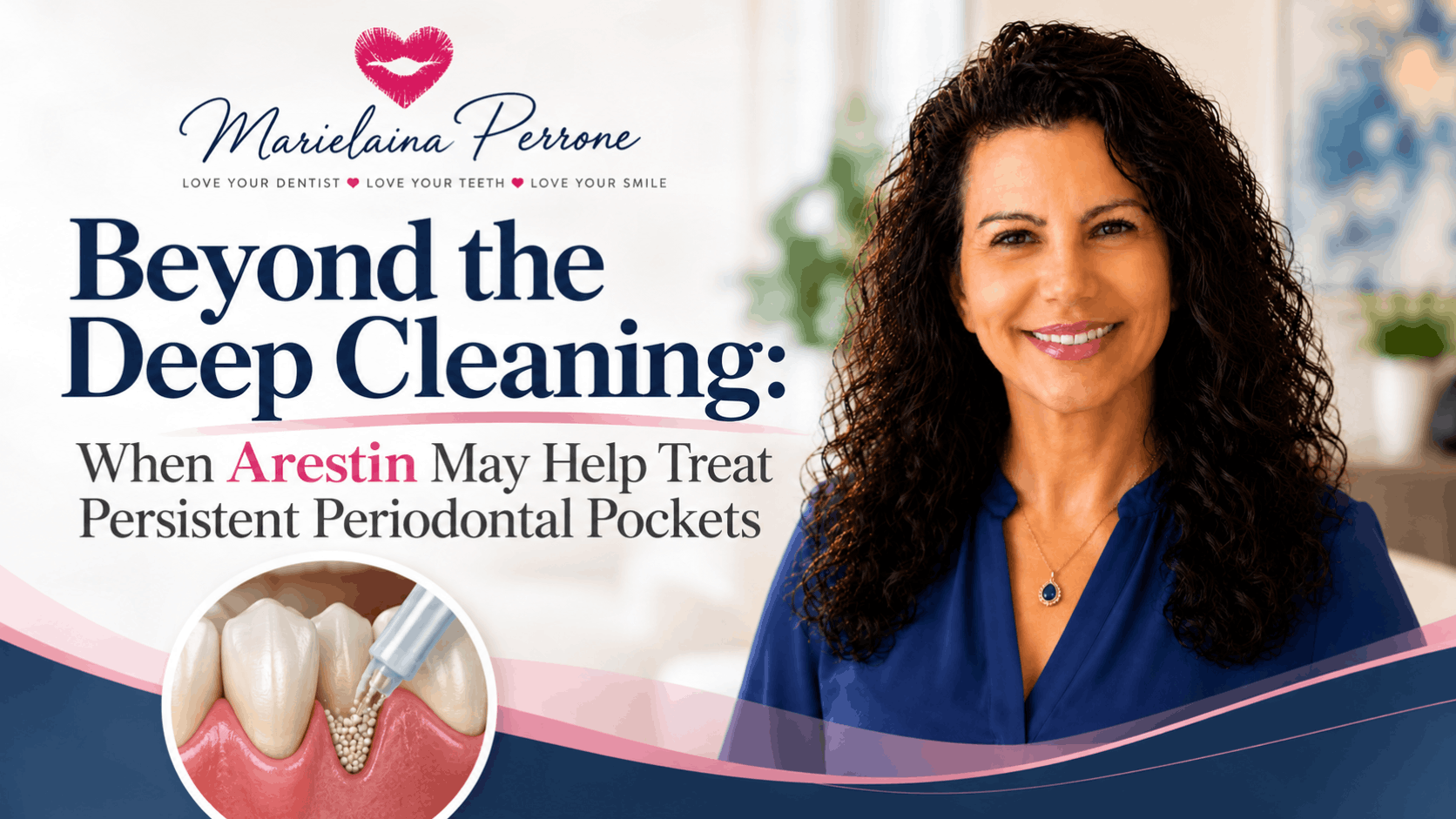
Periodontal disease rarely comes down to a single treatment. For many patients, the foundation of nonsurgical periodontal therapy is scaling and root planing, often called a deep cleaning. This treatment physically removes plaque, calculus and bacterial deposits from beneath the gumline and along the root surfaces. But what happens when certain periodontal pockets need additional help?
That’s where a locally delivered antibiotic such as Arestin may enter the conversation.
Arestin contains minocycline hydrochloride, an antibiotic formulated into tiny microspheres that are placed directly into periodontal pockets. Rather than replacing scaling and root planing, it may be used as an adjunct to mechanical periodontal treatment in selected sites.
That distinction is important.
Arestin isn’t a cure for periodontal disease. It isn’t something every periodontal patient automatically needs. And it doesn’t eliminate the need for excellent home care or ongoing periodontal maintenance.
Instead, it gives us another tool for situations in which localized bacterial control may be beneficial.
“When I use Arestin, I’m not treating periodontal disease with an antibiotic instead of cleaning the teeth. I’m using a localized medication as one part of a much larger periodontal treatment plan.”
— Marielaina Perrone, DDS
What Is Arestin?
Arestin is a locally administered form of minocycline hydrochloride, a tetracycline-class antibiotic. Unlike an antibiotic pill that circulates throughout the body, Arestin is placed directly into a periodontal pocket. The medication is contained in microspheres designed to release minocycline locally over time. This approach makes sense when we consider what a periodontal pocket actually is.
Healthy gum tissue fits relatively closely around a tooth. With periodontitis, inflammation and destruction of the tissues supporting the tooth can create deeper spaces between the tooth and gum. These pockets can become difficult to clean effectively at home and may harbor disease-associated bacterial biofilm.
Arestin allows medication to be delivered right where a problematic periodontal pocket exists.

Why Isn’t a Deep Cleaning Always the Entire Treatment?
Scaling and root planing remains fundamental to nonsurgical periodontal treatment. The American Dental Association’s clinical practice guideline supports scaling and root planing as the initial nonsurgical treatment for periodontitis.
During treatment, deposits and bacterial biofilm are removed from beneath the gums and root surfaces. Afterward, we evaluate how the tissues respond. Some areas may improve beautifully.
Bleeding decreases. Inflammation subsides. Pocket depths become easier to maintain. Other sites may remain deeper or continue to show signs of inflammation.
That’s why periodontal treatment shouldn’t simply be:
Deep cleaning → finished.
It is better thought of as:
Diagnose → treat → heal → reevaluate → maintain or modify treatment.
That reevaluation helps determine whether additional therapy is warranted.
Where Does Arestin Fit Into Gum Disease Treatment?
Arestin isn’t a replacement for a deep cleaning. It is a locally delivered antibiotic that may be added to scaling and root planing for selected periodontal pockets when additional bacterial control may be beneficial.
Diagnose First. Treat Second. Reevaluate Always.
Periodontal Evaluation
Pocket depths, bleeding, attachment loss, bone levels and individual risk factors are evaluated.
Scaling & Root Planing
Plaque, calculus and bacterial deposits are mechanically removed from beneath the gums.
Arestin
Minocycline microspheres may be placed directly into selected periodontal pockets as an adjunct.
Reevaluation
Healing, bleeding, inflammation and periodontal pocket response are reassessed.
Maintenance
Long-term periodontal maintenance helps protect the stability achieved through treatment.
What Arestin Can Do—and What It Can’t
One Deep Pocket Doesn’t Tell the Whole Story
Dr. Perrone considers the complete periodontal picture before recommending adjunctive treatment.
An Adjunct—Not a Stand-Alone Solution
Controlled clinical studies have found additional probing-pocket-depth improvement when minocycline microspheres were combined with scaling and root planing. However, the additional benefit varies, which is why treatment should be individualized rather than automatically added for every patient.
The Goal Isn’t to Use Arestin.
The Goal Is to Control Periodontal Disease.
The right combination of periodontal therapy is different for every patient. Treatment should preserve teeth, protect supporting bone and create an oral environment that can realistically be maintained over time.
Concerned About Deep Gum Pockets or Periodontal Disease?
A periodontal evaluation can determine the extent of disease, identify areas that need treatment and help determine whether scaling and root planing, localized therapy such as Arestin, or another approach is appropriate.
Where Does Arestin Fit?
Arestin is intended to be used as an adjunct to scaling and root planing, not as a substitute for it. Clinical trials have evaluated locally delivered minocycline microspheres in combination with scaling and root planing.
For example, a multicenter controlled trial involving 748 patients with moderate-to-advanced periodontitis found greater probing-depth reduction when minocycline microspheres were added to scaling and root planing compared with scaling and root planing alone.
Another randomized study involving 127 patients reported greater improvements in several clinical measures—including pocket depth, bleeding on probing and clinical attachment—when minocycline microspheres were combined with scaling and root planing.
That sounds compelling, but there’s an important piece of context.
A systematic review conducted for the ADA found that adjuncts to scaling and root planing produced varying additional improvements. For minocycline microspheres specifically, the certainty of evidence was low. The ADA guideline therefore categorized locally delivered minocycline microspheres as “expert opinion for” and stated that the net benefit was uncertain.
That is exactly why I don’t think Arestin should be presented as a miracle treatment. It is an adjunct that may be useful in appropriately selected circumstances.

Why Local Antibiotic Delivery Can Be Appealing
One advantage of local therapy is straightforward: We can target the periodontal pocket rather than automatically exposing the entire body to an antibiotic. The medication is placed beneath the gumline in a specific treatment site.
For a patient with a few problematic periodontal pockets, that targeted approach can be particularly appealing.
It also fits with a broader philosophy I believe strongly in:
“More treatment isn’t automatically better treatment. If an additional therapy is appropriate, I want to understand exactly what problem we’re trying to solve with it.”
— Dr. Marielaina Perrone, DDS
What Does Arestin Treatment Feel Like?
Placement is relatively straightforward. The minocycline microspheres are delivered directly into the periodontal pocket. The material is bioresorbable, so there isn’t a piece of medication that the patient needs to return to have removed. Patients generally don’t need injections solely for placement of Arestin.
The more important part of the appointment is deciding where and whether it belongs in the treatment plan. That requires periodontal measurements and clinical judgment.
Do You Put Arestin in Every Pocket?
Not necessarily. This is one of the most important points for patients to understand. Periodontal treatment should be based on the individual pattern of disease. When I evaluate periodontal health, I’m considering much more than one pocket-depth number.
I may look at:
- Probing depths
- Bleeding on probing
- Clinical attachment
- Gum recession
- Radiographic bone levels
- Plaque and calculus
- Tooth mobility
- Furcation involvement
- Previous response to treatment
- Smoking or tobacco exposure
- Diabetes and other relevant health factors
- The patient’s ability to maintain the area
Arestin is therefore not something that should simply be sprinkled around the mouth because someone has been diagnosed with periodontal disease. The diagnosis comes first. The treatment follows the diagnosis.

Can Arestin Cure Gum Disease?
No. Periodontitis is much more complicated than a simple bacterial infection that disappears after an antibiotic. We now understand periodontal disease as a complex interaction among microbial biofilm, the host inflammatory response, individual susceptibility, environmental factors and time.
An antibiotic can affect susceptible bacteria.
It cannot rebuild all bone that has already been lost.
It cannot correct every anatomical problem.
It cannot remove calculus.
And it cannot maintain periodontal health indefinitely after treatment.
That is why successful periodontal therapy requires a much broader strategy.
What Happens After Arestin?
The next step isn’t simply waiting until something hurts. Periodontal disease is often quiet. Instead, we reevaluate.
Has bleeding decreased?
Have the tissues become less inflamed?
Has the pocket responded?
Is the site maintainable?
Are deeper areas persisting?
Does the patient need additional nonsurgical treatment, periodontal maintenance, surgical evaluation or simply continued monitoring?
The answer can vary from tooth to tooth. This is one reason periodontal charting matters so much. We aren’t simply recording numbers for a dental record—we’re creating a map that allows us to evaluate how the disease changes over time.
Why Periodontal Maintenance Still Matters
One of the biggest misunderstandings surrounding periodontal treatment is the idea that once a deep cleaning is completed, the disease has been permanently cured. Periodontitis is better understood as a condition that requires long-term management.
Once periodontal support has been lost, patients may require a different maintenance strategy from someone who has never had periodontitis. That may include more frequent professional periodontal maintenance, careful monitoring of pocket depths and bleeding, excellent plaque control at home and management of modifiable risk factors.
Arestin doesn’t change that.
In fact, the success of any adjunctive treatment becomes much less meaningful if the underlying disease isn’t monitored afterward.
“My goal isn’t simply to make a periodontal pocket look better at one appointment. I want to create a healthier environment that we have a realistic chance of maintaining over time.”
— Marielaina Perrone, DDS

What About Antibiotic Resistance?
This deserves discussion whenever antibiotics enter the treatment conversation. Antibiotics are valuable medications, but they shouldn’t be treated casually. The existence of a locally delivered antibiotic doesn’t mean it should be used routinely in every patient or every periodontal pocket.
That’s another reason individualized treatment matters.
Dentistry increasingly has to balance potential clinical benefit against responsible antimicrobial use. For me, that reinforces the idea that Arestin should have a specific reason for being used, rather than becoming an automatic addition to every deep cleaning.
Is Arestin Better Than Scaling and Root Planing?
That’s the wrong comparison. Arestin isn’t intended to replace scaling and root planing.
The better question is:
Could locally delivered minocycline provide enough additional benefit at a particular periodontal site to justify adding it to conventional therapy?
Research has shown statistically significant additional improvements in some clinical trials. But systematic reviews have also emphasized that improvements from locally delivered antimicrobials can be modest and that statistical significance does not always equal a large clinical difference for every patient. That’s a much more realistic way to discuss the treatment.
Arestin can be valuable.
Scaling and root planing can be valuable.
Periodontal maintenance can be valuable.
Excellent home care can be valuable.
The art is determining what combination a particular patient actually needs.
Arestin and Periodontal Treatment in Henderson, NV
At my Henderson dental practice serving Green Valley, Anthem, Seven Hills, Summerlin, and the greater Las Vegas Valley, periodontal treatment begins with understanding the disease pattern—not automatically selecting a product.
For one patient, scaling and root planing followed by excellent home care and periodontal maintenance may produce a very good response.
Another patient may have particular periodontal pockets where adjunctive local antimicrobial treatment deserves consideration.
Someone else may have advanced periodontal destruction that requires evaluation beyond nonsurgical treatment.
Those patients shouldn’t all receive identical care simply because the diagnosis says “periodontitis.”
Personalized periodontal treatment means treating the disease in front of us—not following the same recipe for every mouth.

Frequently Asked Questions
What exactly is Arestin?
Arestin is a locally delivered antibiotic containing minocycline hydrochloride in microspheres. It is placed directly into periodontal pockets and is used as an adjunct to scaling and root planing.
Is Arestin the same as taking an antibiotic pill?
No. Arestin is administered locally into periodontal pockets rather than taken orally as a systemic antibiotic.
Does everyone who has a deep cleaning need Arestin?
No. Whether a locally delivered antimicrobial is appropriate depends on the patient’s periodontal findings, disease severity, individual sites, response to treatment and clinical judgment. The ADA’s evidence-based guideline notes uncertainty regarding the net additional benefit of minocycline microspheres.
Can Arestin replace a deep cleaning?
No. Arestin is an adjunct to scaling and root planing, not a replacement for mechanical periodontal therapy.
Does Arestin rebuild lost bone?
Arestin is intended to help control bacteria within periodontal pockets. It should not be presented as a treatment that predictably regenerates bone already lost to periodontitis.
Will I still need periodontal maintenance?
Yes. Controlling periodontal disease requires ongoing monitoring and maintenance. A localized antibiotic does not eliminate the need for professional periodontal care and good plaque control at home.
Is Arestin right for every deep periodontal pocket?
Not necessarily. Pocket depth is only one part of periodontal diagnosis. Bleeding, attachment loss, bone levels, anatomy, disease activity, risk factors and response to previous treatment all matter.
The Bigger Picture
Arestin is a useful example of how modern periodontal treatment can become more targeted.
We don’t have to think in extremes:
Either deep cleaning works, or it doesn’t.
Instead, we can perform appropriate mechanical therapy, allow tissues to respond, reevaluate the disease and decide whether specific areas may benefit from additional treatment.
For selected patients, locally delivered minocycline may be one of those additional tools.
But the real objective isn’t to use Arestin.
The objective is to control periodontal disease while preserving the teeth, bone and supporting tissues for as long as possible.
“The best periodontal treatment plan isn’t the one with the most procedures. It’s the one that gives us the best opportunity to control disease and maintain the patient’s natural teeth over time.” — Marielaina Perrone, DDS
Frequently Asked Questions About Arestin and Periodontal Disease
What is Arestin used for in dentistry?
Arestin is a locally administered antibiotic containing minocycline hydrochloride. It is placed directly into selected periodontal pockets and is used in combination with scaling and root planing to help manage periodontitis. It is not intended to replace a deep cleaning.
How does Arestin work?
Arestin contains minocycline in tiny microspheres that are placed beneath the gumline. The microspheres release the antibiotic locally within the periodontal pocket, helping reduce susceptible bacteria in the treated area.
Does everyone who has periodontal disease need Arestin?
No. Many patients can respond well to scaling and root planing, improved home care and appropriate periodontal maintenance without locally delivered antibiotics. Arestin may be considered for selected periodontal sites based on pocket depth, inflammation, bleeding, disease pattern and response to treatment.
Is Arestin better than a deep cleaning?
They shouldn’t be viewed as competing treatments. Scaling and root planing is the foundation of nonsurgical periodontal therapy, while Arestin may be used as an adjunct in selected cases. Arestin does not remove plaque or calculus from root surfaces.
Is Arestin the same as taking an oral antibiotic?
No. Oral antibiotics circulate systemically throughout the body. Arestin is placed directly into a periodontal pocket, allowing minocycline to be delivered locally to the treatment site.
Does getting Arestin hurt?
Placement is generally straightforward because the microspheres are delivered directly into the periodontal pocket. An injection is not typically required solely to place Arestin. Individual sensitivity can vary, particularly when gum tissues are already inflamed.
How long does Arestin stay in the periodontal pocket?
Arestin is formulated as bioresorbable minocycline microspheres, so it does not need to be physically removed at a later appointment. Patients should follow the specific post-treatment instructions provided by their dentist.
Can Arestin cure periodontal disease?
No. Arestin may help manage bacteria within selected periodontal pockets, but periodontitis is a complex chronic inflammatory disease. Successful management also depends on disrupting plaque biofilm, controlling inflammation, maintaining good oral hygiene, addressing relevant risk factors and receiving appropriate periodontal maintenance.
Can Arestin regrow bone lost from periodontal disease?
Arestin should not be considered a predictable method for regenerating bone that has already been destroyed by periodontitis. Its role is primarily local antimicrobial therapy as an adjunct to scaling and root planing.
Will I still need periodontal maintenance after Arestin?
Yes. Arestin does not eliminate the need for ongoing periodontal care. Periodontal pocket depths, bleeding, inflammation, attachment levels and other findings should be monitored over time. Patients with a history of periodontitis often require continuing periodontal maintenance to help keep the disease controlled.
How do I know if Arestin is appropriate for me?
That decision should be made after a periodontal evaluation. Dr. Perrone considers the entire pattern of disease rather than one pocket-depth number, including bleeding, attachment loss, bone levels, plaque and calculus, tooth anatomy, medical history, risk factors and how individual sites have responded to previous treatment.
Is Arestin available for periodontal treatment in Henderson, NV?
Yes. Marielaina Perrone, DDS, provides individualized periodontal care in Henderson and Green Valley, Nevada, for patients throughout the Las Vegas Valley. When appropriate, locally delivered antimicrobial therapy such as Arestin may be incorporated into a broader periodontal treatment and maintenance plan.
About Marielaina Perrone, DDS
Dr. Marielaina Perrone, DDS, is a trusted cosmetic and family dentist in Henderson, NV(opens in new tab), known for helping patients achieve healthy, beautiful smiles through personalized, compassionate care. With more than 20 years of clinical experience, she combines advanced dental expertise with an artistic eye to deliver exceptional results in porcelain veneers, dental implants, smile makeovers, periodontal therapy, Botox, dermal fillers, and facial aesthetic treatments.
A graduate with honors from Stony Brook University School of Dental Medicine, Dr. Perrone remains committed to lifelong learning and regularly pursues advanced continuing education in cosmetic dentistry, implant dentistry, and facial aesthetics. Her comprehensive approach focuses on enhancing oral health, facial harmony, and overall confidence through customized treatment plans tailored to each patient’s unique goals.
Dr. Perrone is passionate about patient education, preventive care, and building lasting relationships founded on trust, communication, and comfort. She believes every patient deserves individualized attention and treatment that supports both long-term health and a confident smile.
Proudly serving Henderson, Green Valley, Seven Hills, Anthem, Las Vegas, Summerlin, and surrounding communities, Dr. Perrone is dedicated to providing modern, patient-centered dentistry in a welcoming environment. Outside the office, she enjoys cooking, staying active, spending time with family, and participating in community activities throughout the Las Vegas Valley.

Reviewed for Clinical Accuracy
Every article published on drperrone.com is personally written or clinically reviewed by Marielaina Perrone, DDS to ensure it reflects current evidence-based dentistry, modern treatment recommendations, and her philosophy that beautiful smiles are created through personalized care, facial harmony, and long-term oral health.
Last Reviewed: August 2026