Dental Implants: What Actually Determines Whether They Last a Lifetime?

A Dentist’s Guide to the Biology, Planning, Placement, Restoration, and Maintenance Behind Long-Term Dental Implant Success
Dental implants are often described as a permanent solution for missing teeth. I understand why. When properly planned, restored, and maintained, dental implants can provide remarkable long-term function and aesthetics.
But I think patients deserve a more complete answer.
No dentist can promise that a dental implant will last a lifetime. What we can do is understand the factors associated with long-term success and design treatment around them.
A 2026 systematic review and meta-analysis examining prospective studies with at least 20 years of follow-up estimated 20-year dental implant survival at 93.0%. That’s impressive. But the same research also documented failures from both biological and mechanical causes.
And there is an important distinction hidden inside that statistic:
Implant survival is not necessarily the same thing as implant success.
An implant can remain integrated in the bone while the patient experiences inflammation, bone loss, food trapping, difficulty cleaning, gum recession, porcelain complications, bite problems, or an aesthetic result that doesn’t blend naturally into the smile.
My definition of a successful dental implant is therefore broader.
A successful dental implant should be healthy, functional, comfortable, maintainable, and aesthetically integrated into the patient’s smile.
That changes the conversation from “How long does a dental implant last?” to the much more useful question:
“What determines whether my dental implant will remain successful for decades?”
“The most important decision in dental implant treatment isn’t which implant we use. It’s whether an implant is the right treatment for that patient in the first place.”
— Marielaina Perrone, DDS

Dental Implant Success Begins Before the Implant Is Placed
When someone comes to my Henderson, NV dental practice with a missing tooth or a tooth that may need to be removed, I don’t begin by deciding which implant to place.
I begin with diagnosis.
Can the natural tooth predictably be saved? Why was the tooth lost? Is there periodontal disease? What does the bone look like? What is the condition of the surrounding gum tissue? How does the patient bite? Are they grinding or clenching? What medications are they taking? What does the final tooth need to look like? Most importantly, what does this particular patient want from treatment?
Sometimes a dental implant is the most predictable solution. Sometimes a bridge, another restorative option, or preservation of the natural tooth makes more sense.
Good implant dentistry isn’t about placing as many implants as possible. It’s about placing the right implants in the right patients for the right reasons.
What Makes a Dental Implant Last?
Long-term implant success is about much more than placing titanium in bone.
Follow the pathway below to see how I think about implant treatment.
“The most important decision in dental implant treatment isn’t which implant we use.
It’s whether an implant is the right treatment for that patient in the first place.”
— Marielaina Perrone, DDS
Are Dental Implants Right for You?
Implant planning begins with diagnosis. Bone, gum health, neighboring teeth,
your bite, medical history, medications, aesthetic goals, and long-term
maintenance all help determine whether an implant is the right solution.
Missing Most or All of Your Teeth?
When many teeth are missing or the remaining teeth have a poor long-term
prognosis, replacing each tooth individually isn’t always the best approach.
Full-arch options such as All-on-4 dental implants may offer a more practical
way to restore function, stability, and confidence.
More Treatment Isn’t Automatically Better
My philosophy is to preserve what is healthy, understand the person behind
the smile, and recommend treatment that makes sense biologically,
functionally, aesthetically, and for the long term.
→
BONE & GUM HEALTH
→
IMPLANT POSITION
→
RESTORATION
→
BITE
→
MAINTENANCE
Implant longevity isn’t determined by one step. Each part of treatment
contributes to creating dentistry that is healthy, functional, beautiful,
and maintainable.
Start With a Personalized Dental Implant Evaluation
If you’re considering a single dental implant, implant-supported restoration,
or All-on-4 treatment, the first step is understanding your individual
health, anatomy, goals, and long-term options.
“My goal isn’t simply for an implant to survive. I want it to remain healthy,
functional, comfortable, maintainable, and naturally integrated into the smile.”
— Marielaina Perrone, DDS
Dental implant care in Henderson, NV, serving Green Valley, Anthem,
Seven Hills, Inspirada, Las Vegas, Summerlin, and surrounding
Southern Nevada communities.
The 10 Factors That Can Determine How Long a Dental Implant Lasts
1. Was the Original Tooth Correctly Diagnosed?
The first step in successful implant dentistry may actually be deciding not to place an implant.
Natural teeth should not automatically be removed simply because dental implants are available. If a tooth can predictably be restored and maintained, preservation may be the more conservative choice.
On the other hand, repeatedly investing in a tooth with a hopeless prognosis can lead to additional bone loss, infection, expense, and more complicated implant treatment later.
This is why the long-term prognosis of the natural tooth and the long-term prognosis of the proposed implant both deserve consideration.
2. Is There Healthy Bone in the Right Place?
Dental implants depend on bone for support, but implant planning is more sophisticated than simply asking whether someone has “enough bone.”
The amount, shape, quality, and location of available bone matter.
Following tooth loss, the jawbone naturally remodels. In some patients, adequate bone remains for straightforward implant placement. Others may benefit from bone grafting or a different treatment strategy.
Just as importantly, systemic osteoporosis and the local anatomy of the jaw are not the same thing.
Recent systematic reviews have found that osteoporosis alone generally should not be considered an automatic contraindication to dental implants. A 2025 systematic review involving 2,102 patients and 5,954 implants reported survival above 90% across the included studies, while emphasizing careful, individualized planning.
The diagnosis is what matters. Not an assumption based on age or a medical label.

3. What Is the Health of the Gums?
This is one of the most important parts of implant dentistry and one patients sometimes overlook.
Dental implants cannot develop cavities, but they can develop disease in the tissues surrounding them.
Peri-implant mucositis involves inflammation of the soft tissue around an implant. Peri-implantitis involves inflammation accompanied by progressive loss of supporting bone.
A history of periodontal disease doesn’t automatically mean someone cannot have implants, but it can influence risk and makes periodontal stability and long-term maintenance especially important. Current periodontal/implant consensus recommendations identify previous periodontitis, smoking, uncontrolled diabetes, poor plaque control, implant position, prosthetic factors, and certain soft-tissue characteristics among important considerations for peri-implant disease.
If I’m planning an implant for the next 20 years, I need to think about the tissues surrounding it for the next 20 years as well.
4. What Does the Patient’s Overall Health Tell Us?
The mouth doesn’t exist independently from the rest of the body.
Diabetes control, smoking, periodontal history, medications, osteoporosis treatment, immune health, healing capacity, oral hygiene, and other individual factors can influence how I approach implant treatment.
This doesn’t mean that having a medical condition automatically prevents someone from receiving dental implants. Quite the opposite: many patients who once assumed they weren’t candidates may still have excellent options.
It means that medical history is part of dental implant planning.
For example, someone being treated for osteoporosis deserves an individualized conversation about the condition, bone health, and medications. Anabolic medications and antiresorptive medications should not simply be lumped together, and patients should never discontinue prescribed osteoporosis medication based solely on something they read online.
“I don’t treat an X-ray. I treat a person. Their medical history, dental history, anatomy, expectations, lifestyle, and ability to maintain the result are all part of the implant treatment plan.”
— Marielaina Perrone, DDS
5. Was the Implant Placed Where the Final Tooth Needs to Be?
This is one of the most important concepts I wish more patients understood. The purpose of a dental implant isn’t simply to place titanium into bone.
The purpose is to create a tooth.
That means implant position should be planned with the final restoration in mind. The angle, depth, and three-dimensional position of an implant can influence the appearance of the final crown, gum contours, bite, accessibility for cleaning, and long-term tissue health.
An implant can integrate successfully with bone and still be positioned in a way that makes the final restoration unnecessarily difficult. This is why I think about the finished smile before treatment begins.

6. Is There Healthy, Maintainable Gum Tissue Around the Implant?
Beautiful implant dentistry isn’t only about porcelain.
The gum tissue framing the restoration can be equally important—particularly when replacing a front tooth.
Tissue thickness, gum contours, smile line, neighboring teeth, bone position, and the way the restoration emerges through the tissue all contribute to whether an implant looks natural.
But this isn’t purely cosmetic.
The surrounding tissues also need to remain healthy and accessible for cleaning. Contemporary implant consensus guidance recognizes soft-tissue characteristics and prosthetic design as relevant considerations in long-term peri-implant health.
The best-looking implant restoration today should also be designed so the patient can maintain it tomorrow.
7. How Was the Implant Crown, Bridge, or Denture Designed?
Placing the implant is only part of treatment. What gets attached to it matters enormously.
The implant restoration needs to account for aesthetics, function, bite forces, material selection, contours, hygiene access, surrounding teeth, and the patient’s individual anatomy.
This becomes even more important with implant-supported bridges and full-arch restorations.
The American College of Prosthodontists specifically emphasizes hygienic prosthetic contours, plaque control, home care, and professional recall maintenance for long-term full-arch implant rehabilitation.
I don’t want to create an implant restoration that looks impressive in a photograph but becomes almost impossible for the patient to clean.
“Patients naturally focus on the tooth because that’s what they see. I’m also thinking about everything underneath and around that tooth. The implant position, bone, gum tissue, bite, contours, and whether the patient will realistically be able to maintain it.”
— Marielaina Perrone, DDS
8. How Much Force Is Being Placed on the Implant?
Dental implants are strong. That doesn’t mean biomechanics can be ignored.
A back tooth experiences different forces than a front tooth. Someone who clenches or grinds heavily presents different considerations than someone who doesn’t. The number and location of missing teeth, opposing teeth, bite relationship, restoration design, and distribution of forces can all influence treatment planning.
Implants don’t have the same periodontal ligament that surrounds natural teeth, so understanding how forces are distributed remains important. For certain patients, managing bruxism or protecting the final restoration with an appropriate nightguard may become part of the long-term plan.
9. Can the Patient Actually Clean It?
This may sound remarkably simple compared with implant surgery, bone biology, and restorative materials.
But it matters.
An implant restoration should be designed with maintenance in mind from the beginning. If plaque consistently accumulates around an implant and the patient cannot adequately access the area, inflammation can become a long-term problem.
Depending on the restoration, home care may involve brushing, floss, interdental brushes, water flossing, specialized flossing aids, or techniques customized to the individual restoration.
There is no single hygiene routine appropriate for every implant patient.
The restoration and the maintenance plan should fit each other.
10. What Happens After the Implant Treatment Is Finished?
I don’t consider an implant case finished simply because the final tooth has been delivered. Long-term implant dentistry requires monitoring.
Professional examinations allow us to evaluate the surrounding tissue, hygiene, bite, restoration, bone levels when appropriate, and changes that may develop over time.
Current consensus recommendations emphasize supportive peri-implant maintenance and continued monitoring as essential components of long-term implant health.
That matters because problems are generally easier to manage when identified early.
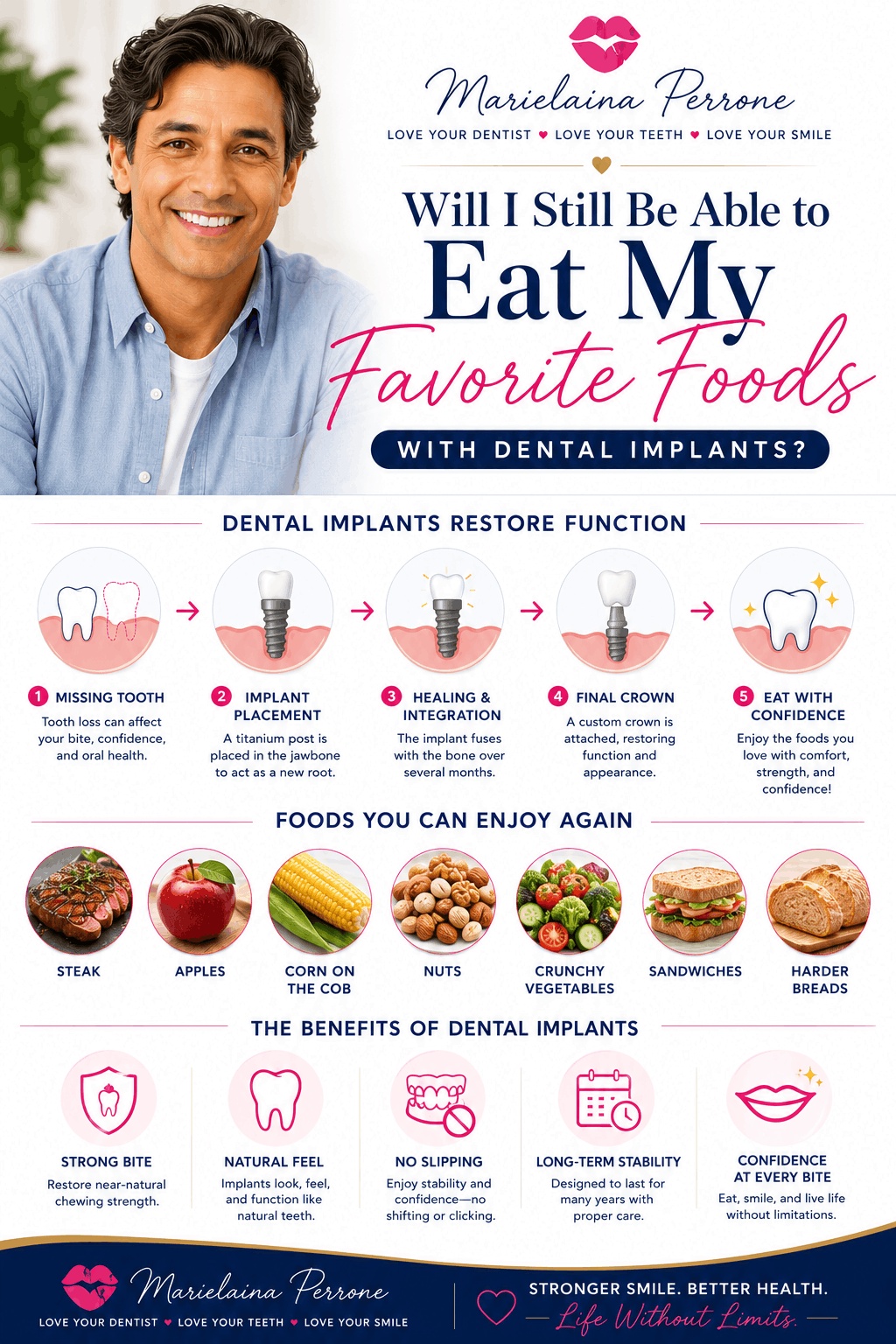
Can Dental Implants Really Last 20 Years or Longer?
Yes.
We now have meaningful long-term evidence showing that many implants can function for decades.
The 2026 systematic review of prospective studies I mentioned earlier followed more than 1,000 implants for at least 20 years and estimated 93% survival at 20 years.
That’s encouraging.
But I would never translate that statistic into:
“Your implant has a 93% chance of lasting 20 years.”
Research populations and individual patients aren’t interchangeable. Implant systems, health conditions, smoking, periodontal history, prosthetic designs, implant locations, maintenance habits, and many other variables differ.
The more useful lesson is this:
Dental implants have demonstrated excellent long-term potential. But longevity is the result of an entire system of care, not simply the durability of titanium.
Survival Is Not the Same as Success
This distinction deserves repeating.
Imagine an implant that remains integrated for 20 years but develops progressive bone loss. Or an implant crown that continually traps food. Or a full-arch restoration that is extremely difficult to clean. Or a front implant that remains stable but develops an unattractive gumline.
Technically, the implant may still be present. But would we consider that an ideal outcome?
I wouldn’t.
My goal is not merely implant survival. My goal is long-term implant health, function, aesthetics, comfort, and maintainability.
Single Dental Implant, Implant Bridge, or All-on-4?
There isn’t one “best” type of dental implant treatment.
A patient missing one tooth may need a single implant and crown. Someone missing several teeth might benefit from individual implants or an implant-supported bridge. Someone with extensive tooth loss or a failing dentition may be better served by a full-arch solution such as All-on-4. Another patient may benefit from an implant-supported removable prosthesis.
And sometimes the best treatment involves fewer implants, not more.
The question isn’t:
“How many implants can we place?”
It is:
“What is the most predictable, maintainable, biologically appropriate way to restore this patient’s function and smile?”
What I Evaluate Before Recommending Dental Implants in My Henderson, NV Practice
When I evaluate a patient for dental implants, I’m looking beyond the empty space. I consider why the tooth was lost, the condition of neighboring teeth, available bone, gum tissue, periodontal history, smile line, bite, medical history, medications, age, lifestyle, aesthetic expectations, hygiene, and the patient’s long-term goals.
For a highly visible front tooth, tissue architecture and aesthetic integration may dominate the planning.
For a posterior implant, forces and function may become particularly important.
For a patient considering full-arch implant dentistry, cleansability, prosthetic design, long-term maintenance, anatomy, remaining teeth, and lifestyle can become central issues.
For an older adult, I may also be thinking about something patients rarely hear discussed:
Will this dentistry remain manageable as this person continues to age?
A technically elaborate solution isn’t automatically a better solution. Sometimes simplicity is a form of sophistication.
Are You Too Old for Dental Implants?
Chronological age by itself generally isn’t the deciding factor. I’ve written separately about dental implants after 60 because this question deserves more nuance than a simple age cutoff.
Older adults may have osteoporosis, take medications, experience dry mouth, have a history of periodontal disease, or face changes in dexterity and hygiene ability. Those factors deserve consideration.
But being 60, 70, or older doesn’t automatically make someone a poor dental implant candidate.
Recent evidence is reassuring regarding osteoporosis as well. A 2025 meta-analysis found no significant difference in implant survival or failure between patients with osteoporotic conditions and controls, although the authors emphasized limitations in the evidence and the need for individualized assessment.
The right question isn’t “Am I too old?”
It’s:
“What does my individual health, anatomy, and long-term treatment outlook tell us?”
What Causes Dental Implants to Fail?
There isn’t one cause.
Early implant failure can occur when adequate integration with bone does not develop. Later problems may involve peri-implant disease, progressive bone loss, biomechanical complications, restoration problems, fracture or other biological and mechanical factors.
The 2026 long-term review found that among failures where a specific cause was reported, biological and mechanical causes were represented in roughly similar proportions.
That’s another reason I don’t think implant longevity can be reduced to choosing an implant brand.
The implant, patient, tissues, restoration, bite, and maintenance all have to work together.
Dental Implants Should Be Designed for the Person, Not the Procedure
Dental implant technology has changed tremendously during my years in private practice. Materials, imaging, surgical techniques, restorative options, and our understanding of implant biology continue to evolve.
But one principle hasn’t changed: Treatment has to make sense for the individual patient. A beautiful X-ray isn’t enough.
A successful implant should allow someone to smile comfortably, chew confidently, maintain good oral health, and live without constantly thinking about the dentistry in their mouth.
And aesthetically, particularly in the front of the smile, my favorite implant restoration is usually the one nobody notices.
“A successful dental implant shouldn’t make someone think, ‘That’s a beautiful implant.’ Ideally, they shouldn’t be able to tell which tooth is the implant at all.”
— Marielaina Perrone, DDS
The Bottom Line: What Makes Dental Implants Last?
Dental implants have the potential to be one of the most successful long-term treatments available in modern dentistry. But titanium alone isn’t responsible for that success.
Diagnosis matters.
Bone matters.
Periodontal health matters.
Implant position matters.
Gum tissue matters.
Restorative design matters.
The bite matters.
Home care matters.
Professional maintenance matters.
And above all, the patient matters.
That’s why my philosophy toward implant dentistry is the same philosophy that guides the rest of my practice:
Diagnose first. Understand the person. Preserve what is healthy. Then choose the most appropriate treatment—not simply the most aggressive treatment available.
For patients considering dental implants in Henderson, NV, Green Valley, Anthem, Seven Hills, Inspirada, Las Vegas, Summerlin, and surrounding Southern Nevada communities, a comprehensive implant evaluation can help determine whether a single dental implant, implant-supported bridge, All-on-4 treatment, or another tooth-replacement option makes the most sense for your health, smile, and long-term goals.

Frequently Asked Questions About Dental Implants
How long do dental implants last?
Dental implants can function for decades. A 2026 systematic review of prospective studies estimated 93% implant survival at 20 years. Individual longevity varies based on health, periodontal history, implant position, restoration design, hygiene, bite forces, smoking, maintenance, and other factors.
Can a dental implant last a lifetime?
It is possible for an implant to remain functional for the rest of a patient’s life, but no dentist can guarantee lifetime survival. The implant itself, surrounding bone and gum tissue, and implant restoration all require long-term monitoring and care.
Can you get dental implants if you have osteoporosis?
For many patients, yes. Current systematic reviews suggest osteoporosis alone is not necessarily a contraindication to dental implant treatment, although bone health, medications, anatomy, and individual risk factors should be evaluated carefully.
Can dental implants get gum disease?
Implants cannot develop tooth decay, but the tissues surrounding them can develop peri-implant mucositis and peri-implantitis. Good plaque control, professional monitoring, and management of individual risk factors are important for long-term peri-implant health.
Is a dental implant better than a bridge?
Neither treatment is automatically better for every patient. The condition of neighboring teeth, bone, gum health, bite, location of the missing tooth, aesthetics, medical history, maintenance requirements, and patient preferences should all influence the decision.
What is the most important factor in dental implant success?
There isn’t one factor. Long-term success depends on appropriate diagnosis and patient selection, healthy supporting tissues, proper implant positioning, appropriate restorative design, management of bite forces, home hygiene, and continuing professional maintenance.
Who should I see for dental implants in Henderson, NV?
Choose a dentist who evaluates more than the missing tooth. Dental implant planning should consider the bone, gums, neighboring teeth, bite, medical history, aesthetic goals, restorative design, hygiene, and long-term maintenance requirements. Dr. Marielaina Perrone provides personalized dental implant treatment in Henderson, Nevada, with an emphasis on health, function, natural aesthetics, and long-term maintainability. Her existing implant service page similarly emphasizes individualized treatment planning and more than 25 years of experience in cosmetic, restorative, and implant dentistry.

About Marielaina Perrone, DDS
Dr. Marielaina Perrone, DDS, is a trusted cosmetic and family dentist in Henderson, NV, known for helping patients achieve healthy, beautiful smiles through personalized, compassionate care. With more than 20 years of clinical experience, she combines advanced dental expertise with an artistic eye to deliver exceptional results in porcelain veneers, dental implants, smile makeovers, periodontal therapy, Botox, dermal fillers, and facial aesthetic treatments.
A graduate with honors from Stony Brook University School of Dental Medicine, Dr. Perrone remains committed to lifelong learning and regularly pursues advanced continuing education in cosmetic dentistry, implant dentistry, and facial aesthetics. Her comprehensive approach focuses on enhancing oral health, facial harmony, and overall confidence through customized treatment plans tailored to each patient’s unique goals.
Dr. Perrone is passionate about patient education, preventive care, and building lasting relationships founded on trust, communication, and comfort. She believes every patient deserves individualized attention and treatment that supports both long-term health and a confident smile.
Proudly serving Henderson, Green Valley, Las Vegas, Summerlin, and surrounding communities, Dr. Perrone is dedicated to providing modern, patient-centered dentistry in a welcoming environment. Outside the office, she enjoys cooking, staying active, spending time with family, and participating in community activities throughout the Las Vegas Valley.
Reviewed for Clinical Accuracy
This article has been written and clinically reviewed by Marielaina Perrone, DDS, to ensure it reflects current evidence-based dentistry and the personalized philosophy of care practiced at her Henderson, Nevada office.
Last Reviewed: September 2026