Chipped Tooth? How Dental Bonding Can Restore Your Smile in One Visit

A chipped front tooth can feel like a much bigger problem than it actually is.
Even a small chip can immediately change the way your smile looks, how your teeth feel against your tongue, and how confident you feel when speaking or smiling. Fortunately, not every chipped tooth requires a crown or porcelain veneer.
For many patients, composite dental bonding offers a conservative, natural-looking way to repair the damage—often in a single appointment.
At my Henderson, Nevada dental practice, I use dental bonding to restore chipped teeth while preserving as much healthy enamel as possible.
“When a front tooth chips, my first goal is to understand how much healthy tooth structure remains. If bonding can restore the tooth beautifully without unnecessary preparation, that is often the most conservative option.”
— Marielaina Perrone, DDS
What Is Dental Bonding?
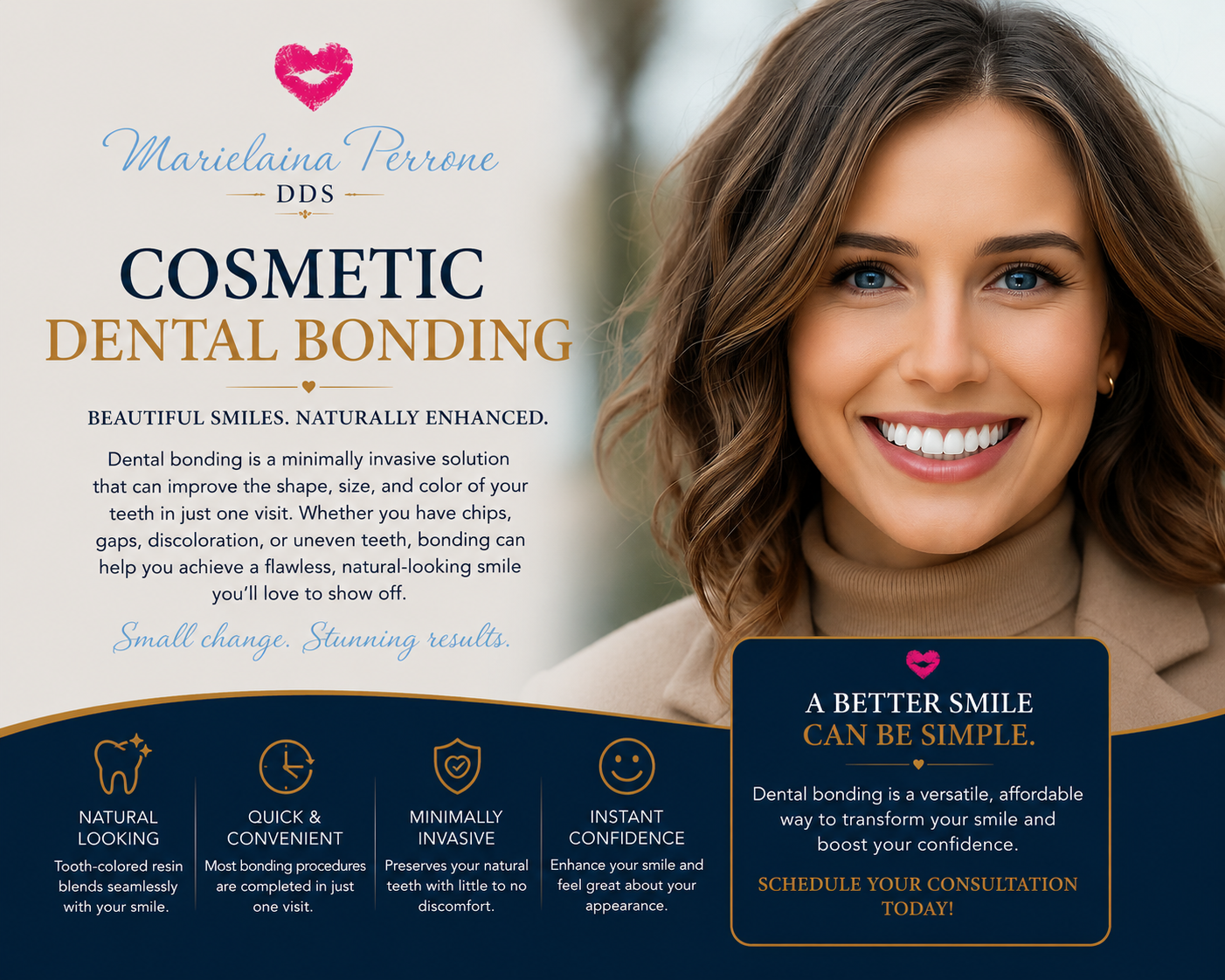
Dental bonding uses a tooth-colored composite resin to repair or reshape a tooth.
The material is carefully matched to the surrounding enamel, applied directly to the tooth, sculpted into the desired shape, hardened with a curing light, and polished until it blends naturally with the rest of the smile.
Bonding is commonly used to improve:
- Chipped teeth
- Small fractures
- Uneven tooth edges
- Minor gaps
- Worn enamel
- Small areas of discoloration
- Irregular tooth shape
- Certain areas of exposed root surface
Because the material is placed directly on the tooth, bonding can often be completed without the laboratory steps required for porcelain restorations.
How Should a Chipped Front Tooth Be Repaired?
Not every chipped tooth needs the same restoration. Open the sections below to see when conservative dental bonding may be enough—and when a porcelain veneer or crown may provide a better solution.
1. Is It a Small Enamel Chip? Dental bonding may be the most conservative solution
When only a small portion of a healthy front tooth has fractured, tooth-colored composite resin can often replace exactly what was lost without covering the entire tooth.
✓ Small chip or irregular edge
✓ Healthy surrounding enamel
✓ Little or no additional tooth reduction
✓ Often completed in one appointment
✓ Easy to repair if future wear occurs
Learn More About Dental Bonding →
“For a small chip in an otherwise healthy tooth, I don’t want to remove unnecessary enamel. If bonding can restore the tooth beautifully and predictably, it is often my first consideration.”
— Marielaina Perrone, DDS
2. Is the Chip Extremely Small? Sometimes no restorative material is necessary
A tiny irregularity involving only the edge of a tooth may sometimes be gently smoothed and polished rather than rebuilt.
✓ Very superficial enamel defect
✓ No significant change in tooth length
✓ No deeper fracture
✓ Tooth remains structurally sound
An examination is still important because the visible chip does not always reveal the full depth of an injury.
3. Is the Chip Larger but the Tooth Still Strong? Composite bonding can rebuild surprisingly significant defects
A larger area can sometimes still be restored with composite if adequate healthy enamel remains and the bite allows a predictable repair.
✓ Rebuild missing tooth length
✓ Restore natural contour
✓ Match neighboring tooth color
✓ Preserve healthy tooth structure
4. Is the Chip Part of a Larger Cosmetic Concern? A porcelain veneer may offer greater control over the entire visible tooth
If the damaged tooth also has significant discoloration, shape problems, wear, spacing, or another cosmetic concern, a porcelain veneer may provide a more comprehensive solution.
✓ Larger visible fracture
✓ Significant discoloration
✓ Tooth proportion needs improvement
✓ Multiple cosmetic concerns
✓ Greater long-term stain resistance desired
Learn More About Porcelain Veneers →
“A veneer becomes more valuable when we’re trying to restore the damaged area while also improving the overall color, shape, proportion, or symmetry of the tooth.”
— Marielaina Perrone, DDS
5. Has the Tooth Lost Significant Structure? Structural protection may become more important than cosmetic repair alone
When a large portion of the tooth is fractured or weakened, bonding may not provide sufficient long-term protection. A porcelain crown can surround and protect substantially more of the remaining tooth.
⚠ Major fracture
⚠ Large existing filling
⚠ Significant loss of healthy tooth structure
⚠ Structurally weakened tooth
⚠ Tooth requires greater protection
6. Why Did the Tooth Chip? Repairing the tooth is only half the job
Understanding what caused the fracture helps reduce the chance of repairing the tooth only to have the same problem happen again.
“The restoration is only part of my diagnosis. I want to understand why the tooth chipped so we can protect the repair—and the rest of the smile—from the same forces.”
— Marielaina Perrone, DDS
7. Does the Tooth Hurt? Pain or sensitivity may signal deeper injury
A chipped tooth that hurts, becomes very sensitive, moves, or changes color may have sustained more than superficial enamel damage.
⚠ Significant pain
⚠ Lingering temperature sensitivity
⚠ Tooth feels loose
⚠ Bleeding around the tooth
⚠ Large section has fractured
⚠ Tooth changes color after trauma
These findings deserve prompt professional evaluation before deciding whether bonding, a veneer, a crown, or another treatment is appropriate.
Match the Restoration to the Amount of Damage
Small to moderate chips with good remaining tooth structure.
Most Conservative
Larger cosmetic defects or changes involving color, shape, and proportion.
Cosmetic Redesign
Major structural damage when the tooth needs greater protection.
Structural Protection
Don’t Treat More Tooth Than Necessary
A small chip shouldn’t automatically result in a large restoration. Dr. Perrone evaluates how much healthy enamel remains, the cause of the fracture, the bite, cosmetic expectations, and the long-term needs of the tooth before recommending dental bonding, a porcelain veneer, or a porcelain crown.
“The goal isn’t to make the repaired tooth look fixed. The goal is to restore the shape, color, and character of the tooth so naturally that the chip simply disappears.”
— Marielaina Perrone, DDS
Which Treatment Is Right for Your Tooth?
The visible size of a chip alone cannot determine the ideal restoration. Tooth structure, enamel, fracture depth, pulp health, bite forces, existing restorations, cosmetic goals, and the cause of the damage all influence treatment.
Chipped a Front Tooth?
Schedule an evaluation with Marielaina Perrone, DDS in Henderson, Nevada. We’ll determine the extent of the damage, identify why the tooth chipped, and recommend the most conservative treatment that can restore your smile beautifully and predictably.
Why Is Dental Bonding Such a Good Option for a Chipped Tooth?
The biggest advantage is conservation.
A small chip does not necessarily mean the entire tooth needs to be covered. If the tooth is otherwise healthy and structurally sound, composite resin can often replace only the missing portion.
That means:
- Minimal removal of healthy enamel
- Little or no anesthesia in many cases
- Same-day treatment
- Natural-looking results
- Lower initial cost than porcelain restorations
- Easy repair if the bonding chips later
“Good cosmetic dentistry isn’t always about doing more. Sometimes the best result comes from replacing only what was lost and leaving the rest of the natural tooth alone.”
— Dr. Marielaina Perrone, DDS

What Causes Front Teeth to Chip?
Front teeth can chip for many reasons.
Some are sudden and obvious. Others develop slowly over time.
Common causes include:
- Biting ice
- Hard candy
- Popcorn kernels
- Sports injuries
- Falls
- Using teeth to open packages
- Teeth grinding
- Clenching
- Tooth decay
- Previous dental restorations
- Natural wear
- Bite problems
Understanding why the tooth chipped is just as important as repairing it.
If the underlying cause is not addressed, the new bonding may be subjected to the same forces that damaged the tooth originally.
Is Every Chipped Tooth a Candidate for Bonding?
No.
Dental bonding works best when the damage is relatively limited and enough healthy tooth structure remains to support the restoration.
Bonding may be an excellent choice for:
- Small enamel chips
- Minor front-tooth fractures
- Irregular edges
- Small cosmetic defects
- Mild wear
- Minor spacing concerns
But more extensive damage may require another type of treatment.
For example:
Porcelain veneers may be more appropriate when a larger area of the visible tooth needs cosmetic improvement.
Porcelain crowns may be recommended when the tooth has lost significant structure and needs greater protection.
Root canal therapy may be necessary if trauma reaches or damages the dental pulp.
The right treatment depends on the depth and location of the fracture—not simply how noticeable it looks.
What Happens During a Dental Bonding Appointment?
Dental bonding is usually straightforward.
1. Evaluation
I first examine the tooth carefully.
The important questions include:
- How large is the chip?
- Is there a deeper crack?
- Is the tooth sensitive?
- Is the nerve healthy?
- Is decay present?
- What caused the fracture?
- Are bite forces contributing?
Dental X-rays may be recommended when deeper damage is suspected.
2. Shade Matching
The composite resin is selected to match the surrounding natural tooth color.
The goal is for the restoration to disappear into the smile.
3. Tooth Preparation
In many small bonding cases, very little tooth structure needs to be removed.
The enamel is gently prepared so the composite material can bond securely.
4. Composite Placement
The resin is added in carefully controlled layers.
This is where the artistic portion of the procedure becomes important.
The tooth must be rebuilt with the correct:
- Length
- Shape
- Edge contour
- Surface texture
- Symmetry
- Proportion
5. Curing
A specialized light hardens the composite resin.
6. Final Shaping and Polishing
The restoration is refined until the bite feels comfortable and the surface resembles natural enamel.
In many cases, the entire repair can be completed in one visit.

Does Dental Bonding Look Natural?
Yes, when it is properly designed.
Modern composite materials are available in multiple shades and levels of translucency. This allows the restoration to imitate the way natural teeth reflect light. The cosmetic result depends on more than color matching.
A natural front tooth has subtle contours, edge characteristics, surface texture, and light reflection.
“The goal isn’t to make the repaired tooth look ‘fixed.’ The goal is to make it look as though it was never chipped in the first place.”
— Marielaina Perrone, DDS
How Long Does Dental Bonding Last?
Composite bonding does not last forever.
For many patients, bonding can remain attractive and functional for several years, often around 5 to 10 years, depending on the location, bite, habits, and amount of material involved.
Longevity can be affected by:
- Teeth grinding
- Nail biting
- Chewing ice
- Biting pens
- Hard foods
- Smoking
- Oral hygiene
- Bite forces
- Size of the restoration
One advantage of bonding is that it can often be repaired relatively easily if a small area chips or wears.
Dental Bonding vs. Porcelain Veneers
Both treatments can improve chipped front teeth, but they serve different purposes.
Dental bonding is generally:
- More conservative
- Less expensive
- Completed in one visit
- Easier to repair
- More prone to staining
- Less durable than porcelain
Porcelain veneers are generally:
- More stain resistant
- More durable
- Better for larger cosmetic changes
- More involved
- Usually require more tooth preparation
- More expensive initially
For a small isolated chip, bonding may be all that is necessary. For a larger smile makeover involving several teeth, porcelain veneers may provide a more predictable long-term result.

Dental Bonding vs. a Crown
A crown is usually not my first choice for a small chip in an otherwise healthy front tooth.
Crowns cover substantially more tooth structure and are generally better suited to teeth that have significant structural damage.
A crown may be appropriate when:
- A large portion of the tooth is missing
- The tooth has a major fracture
- A large existing filling weakens the tooth
- The tooth has undergone root canal treatment
- There is insufficient remaining enamel for predictable bonding
- Significant strength is needed
The most conservative restoration that predictably solves the problem is usually preferable.
What If the Tooth Chipped Because of Grinding?
This is an important issue.
If you grind or clench your teeth, repairing the chip without addressing the bite forces may lead to repeated damage.
Signs of bruxism may include:
- Flattened front teeth
- Worn edges
- Small recurring chips
- Cracks
- Jaw soreness
- Morning headaches
- Sensitive teeth
A custom nightguard may be recommended to protect both the natural teeth and the bonding.
Can Bonding Fix More Than One Chipped Tooth?
Yes.
Bonding can be used on one tooth or several. In some cases, multiple worn or uneven front teeth can be reshaped to improve symmetry and balance.
However, when many teeth require major changes in color, shape, or proportion, porcelain veneers or a comprehensive smile makeover may be more appropriate. This is why treatment planning matters.
The question should never be:
“Can bonding do this?”
The better question is:
“Which treatment gives you the best balance of appearance, durability, and preservation of natural tooth structure?”
What Should You Do Immediately After Chipping a Tooth?
If your front tooth chips:
- Save any broken fragment if you can.
- Rinse gently with water.
- Avoid biting with the damaged tooth.
- Use a cold compress if there is swelling.
- Contact your dentist for an evaluation.
If the tooth is painful, bleeding, loose, or significantly fractured, prompt dental care is especially important.
Why You Shouldn’t Ignore a Small Chip
A minor chip may be purely cosmetic.
But sometimes a visible chip is only the outer part of a deeper fracture.
Left untreated, a damaged tooth may develop:
- Increased sensitivity
- Additional cracking
- Sharp edges
- More extensive fracture
- Pulp inflammation
- Bacterial contamination
Early evaluation gives us the best opportunity to choose the most conservative solution.
Caring for Bonded Teeth
Once the tooth is repaired, routine care is simple.
To protect the restoration:
- Brush twice daily
- Floss every day
- Avoid chewing ice
- Don’t use your teeth as tools
- Avoid biting fingernails
- Limit extremely hard foods
- Wear a mouthguard during contact sports
- Wear a nightguard if recommended
- Maintain regular dental examinations and cleanings
Composite resin can also stain more readily than porcelain, so coffee, tea, red wine, tobacco, and other staining substances may gradually affect the appearance.
Professional polishing can sometimes refresh the surface.
Can Dental Bonding Be Repaired?
Yes.
This is one of the treatment’s major advantages. If a bonded area chips or becomes worn, it can often be repaired without replacing the entire restoration.
That makes composite particularly attractive for conservative front-tooth repairs.
Is Dental Bonding Painful?
Most cosmetic bonding procedures involve little or no discomfort. If the chip involves only enamel, anesthesia may not be necessary.
However, deeper fractures, decay, sensitivity, or trauma may require additional treatment or local anesthetic.

Will Bonding Change Color Over Time?
Composite resin can absorb stains gradually. It is generally less stain resistant than porcelain.
Good oral hygiene and limiting frequent exposure to staining substances can help maintain the appearance.
If neighboring natural teeth are going to be professionally whitened, it is often better to complete whitening before final bonding so the composite can be matched to the new tooth shade.
When Is a Porcelain Veneer Better Than Bonding?
A veneer may be preferable when a patient wants to correct:
- A larger fractured area
- Significant discoloration
- Multiple shape concerns
- Larger gaps
- More extensive wear
- Several visible teeth
- Greater long-term stain resistance
Porcelain also allows us to control multiple aspects of smile design simultaneously. But if a small amount of composite can beautifully repair an isolated chip, I don’t believe in automatically recommending porcelain.
“The best cosmetic treatment is the one that accomplishes the patient’s goal while preserving as much healthy natural tooth structure as reasonably possible.”
— Marielaina Perrone, DDS
Frequently Asked Questions About Dental Bonding for Chipped Teeth
Can dental bonding fix a chipped front tooth?
Yes. Small to moderate chips in otherwise healthy teeth can often be repaired very effectively with tooth-colored composite bonding.
Can a chipped tooth heal itself?
No. Enamel does not regenerate. Once a portion of the tooth has broken away, it must either remain chipped or be restored.
How quickly can a chipped tooth be bonded?
Many bonding repairs can be completed during a single appointment.
Does bonding require drilling?
Minimal preparation may be necessary, but many cosmetic bonding procedures require very little removal of healthy tooth structure.
How long does bonding last on a front tooth?
Many restorations last approximately 5–10 years, although longevity varies considerably depending on bite forces, habits, oral hygiene, and the size and location of the repair.
Can I whiten a bonded tooth?
Composite resin itself does not respond to whitening agents the same way natural enamel does. If whitening is planned, it is often best to whiten first and then match new bonding to the final shade.
What happens if the bonding chips?
It can often be repaired by adding and polishing additional composite resin.
Is bonding better than veneers?
Neither treatment is universally better. Bonding is usually more conservative and suitable for smaller corrections. Veneers may be more appropriate for broader cosmetic changes or when greater stain resistance and durability are desired.

Dr. Perrone’s Perspective: Repair the Tooth, Understand the Cause
When a patient comes to me with a chipped front tooth, the cosmetic repair is only part of my concern.
I want to know why it happened.
Was it trauma?
Grinding?
A weakened tooth?
An unfavorable bite?
An old restoration?
A hard-food accident?
If we understand the cause, we have a better opportunity to prevent the problem from repeating itself.
That is what conservative dentistry means to me.
It isn’t simply doing the smallest procedure possible.
It means providing the least invasive treatment that appropriately solves the problem and protects the tooth for the future.
A Small Repair Can Make a Big Difference
A chipped tooth may seem minor clinically, but it can feel enormous when it is the first thing you notice every time you smile.
Fortunately, many chipped front teeth can be restored quickly and naturally with composite dental bonding.
If you have a chipped, worn, or uneven front tooth, schedule an evaluation with Marielaina Perrone, DDS in Henderson, Nevada.
We’ll determine how much damage occurred, why the tooth chipped, and whether dental bonding, a porcelain veneer, a crown, or another conservative option is the best way to restore your smile.
Because sometimes restoring confidence only requires rebuilding a few millimeters of tooth.
About Marielaina Perrone, DDS
Dr. Marielaina Perrone, DDS, is a trusted cosmetic and family dentist in Henderson, NV, known for helping patients achieve healthy, beautiful smiles through personalized, compassionate care. With more than 20 years of clinical experience, she combines advanced dental expertise with an artistic eye to deliver exceptional results in porcelain veneers, dental implants, smile makeovers, periodontal therapy, Botox, dermal fillers, and facial aesthetic treatments.
A graduate with honors from Stony Brook University School of Dental Medicine, Dr. Perrone remains committed to lifelong learning and regularly pursues advanced continuing education in cosmetic dentistry, implant dentistry, and facial aesthetics. Her comprehensive approach focuses on enhancing oral health, facial harmony, and overall confidence through customized treatment plans tailored to each patient’s unique goals.
Dr. Perrone is passionate about patient education, preventive care, and building lasting relationships founded on trust, communication, and comfort. She believes every patient deserves individualized attention and treatment that supports both long-term health and a confident smile.
Proudly serving Henderson, Green Valley, Las Vegas, Summerlin, and surrounding communities, Dr. Perrone is dedicated to providing modern, patient-centered dentistry in a welcoming environment. Outside the office, she enjoys cooking, staying active, spending time with family, and participating in community activities throughout the Las Vegas Valley.

Reviewed for Clinical Accuracy
This article has been written and clinically reviewed by Marielaina Perrone, DDS, to ensure it reflects current evidence-based dentistry and the personalized philosophy of care practiced at her Henderson, Nevada office.
Last Reviewed: August 2026