Can I Get Dental Bonding Instead of Porcelain Veneers? What I Tell My Patients

One of the most common questions I hear from patients considering cosmetic dentistry is:
“Can I just get dental bonding instead of porcelain veneers?”
The answer isn’t simply yes or no.
In some situations, cosmetic bonding is an outstanding treatment that produces beautiful, natural-looking results while preserving nearly all of your tooth structure.
In other cases, choosing bonding instead of veneers may lead to disappointment, repeated repairs, and higher long-term costs.
The right treatment isn’t determined by price alone. It’s determined by your smile goals, your bite, your lifestyle, and the condition of your teeth.
At my Henderson practice, my philosophy is simple: recommend the most conservative treatment that can achieve a predictable, long-lasting result.
“The best cosmetic dentistry isn’t about doing the most treatment. It’s about doing the right treatment for the right patient.”
— Marielaina Perrone, DDS
Bonding and Veneers Aren’t Competitors
Patients often compare bonding and porcelain veneers as if they’re interchangeable.
They’re not.
Think of them as two different artistic mediums.
A watercolor painting and an oil painting can both be beautiful, but each is better suited for different situations.
Likewise, cosmetic bonding and porcelain veneers each have strengths and limitations.
The goal isn’t choosing one because it’s “better.”
The goal is choosing the treatment that best fits your smile.
What Is Cosmetic Dental Bonding?
Dental bonding uses a tooth-colored composite resin that is carefully sculpted directly onto the tooth.
After shaping the material, it is hardened with a special curing light and polished to blend naturally with the surrounding teeth.
Bonding is commonly used to correct:
- Small chips
- Minor cracks
- Small spaces between teeth
- Slightly irregular tooth shapes
- Small areas of discoloration
- Worn edges
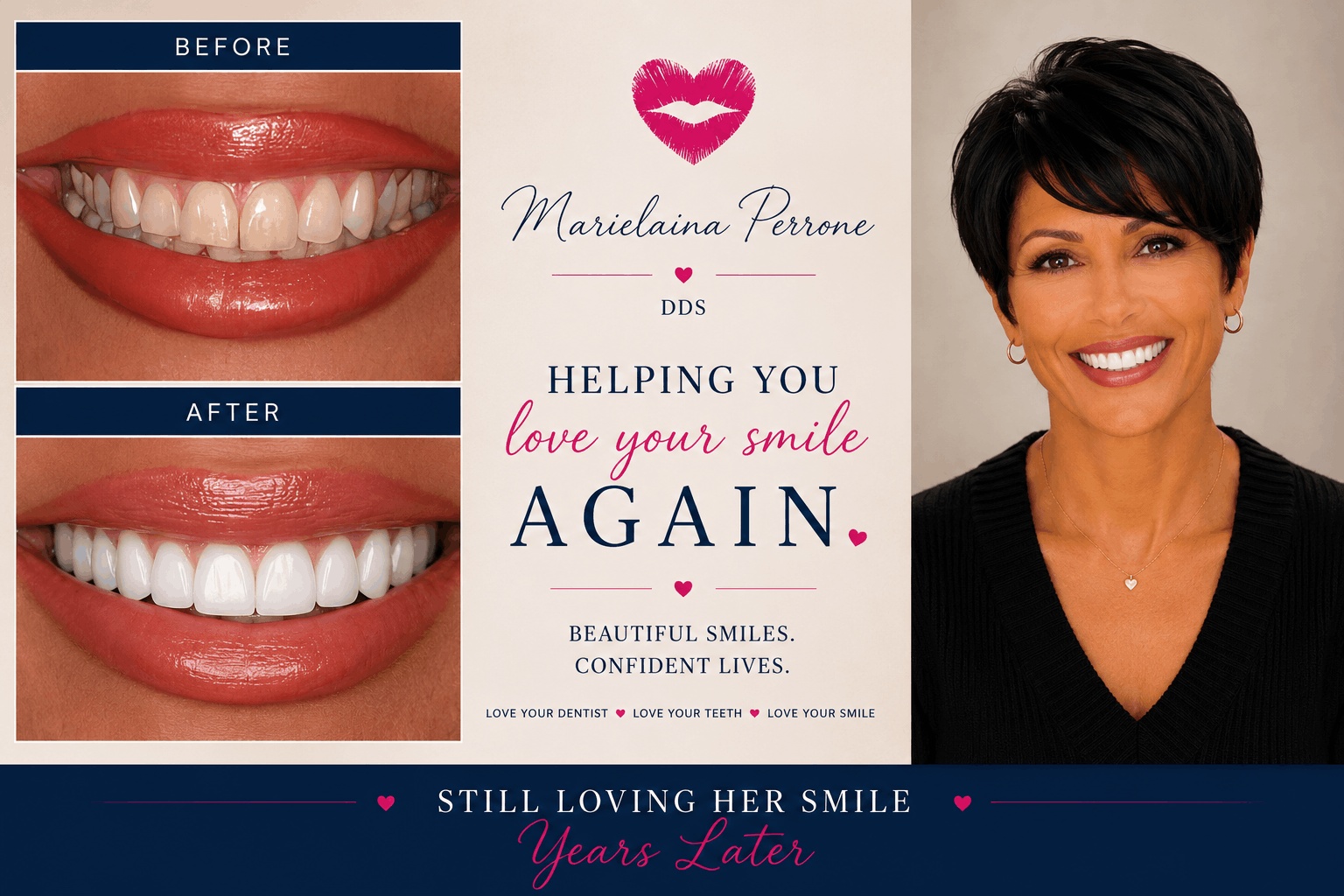
Because very little natural tooth structure is removed, bonding is considered one of the most conservative cosmetic procedures available.
What Are Porcelain Veneers?
Porcelain veneers are thin, custom-crafted ceramic restorations bonded to the front surfaces of the teeth.
Unlike bonding, veneers are fabricated in a dental laboratory after careful smile planning.
They may improve:
- Tooth color
- Shape
- Length
- Width
- Smile symmetry
- Moderate spacing
- Multiple cosmetic concerns simultaneously
Porcelain is highly resistant to staining and maintains its appearance for many years with proper care.

When Bonding May Be the Better Choice
Many patients are surprised when I recommend bonding instead of veneers.
If only one or two teeth need improvement, bonding often provides an excellent solution.
Bonding is frequently appropriate for:
- Small chips
- Minor spacing
- Limited cosmetic corrections
- Young adults whose smiles may continue to change
- Patients wanting conservative treatment
“Sometimes a fifteen-minute bonding procedure can create exactly the improvement a patient has been hoping for. Not every smile needs veneers.”
— Dr. Marielaina Perrone, DDS
When Veneers Often Produce Better Results
There are situations where porcelain veneers provide a more predictable long-term outcome.
Examples include:
- Multiple worn teeth
- Significant discoloration
- Several chipped teeth
- Uneven tooth proportions
- Smile redesign
- Larger cosmetic makeovers
When several cosmetic concerns affect multiple front teeth, veneers often allow better overall harmony and consistency.
The Question Isn’t “Can We?”
It’s “Should We?”
Technically, many cosmetic problems can be treated with bonding.
That doesn’t necessarily make bonding the best long-term choice.
For example, rebuilding severely worn front teeth entirely with composite resin may require more maintenance over time than porcelain veneers.
Likewise, preparing healthy teeth for veneers when only one small chip exists would be unnecessarily aggressive.
“Just because dentistry can accomplish something doesn’t always mean it should. Conservative treatment is part of good treatment planning.”
— Dr. Marielaina Perrone, DDS

Appearance Over Time
One of the biggest differences between bonding and porcelain is how they age.
Composite Bonding
Over time, bonding may:
- Lose some surface polish
- Pick up stains from coffee, tea, or wine
- Wear gradually
- Occasionally chip
Most repairs are relatively straightforward.
Porcelain Veneers
Porcelain generally:
- Maintains its gloss
- Resists staining
- Holds its color well
- Wears more slowly
- Reflects light similarly to natural enamel
This is one reason porcelain remains a popular option for comprehensive smile makeovers.
Maintenance Matters
Neither treatment is maintenance-free.
Patients should continue to:
- Brush twice daily
- Floss every day
- Attend regular dental examinations
- Avoid chewing ice
- Avoid opening packages with their teeth
- Wear a nightguard if recommended
Protecting your investment is just as important as choosing the right treatment.
Cost Shouldn’t Be the Only Decision
Bonding generally costs less initially than porcelain veneers.
However, cosmetic dentistry should always be viewed over the long term.
If a bonded tooth requires repeated repairs every few years, the overall investment may become greater than expected.
Conversely, if bonding solves a small cosmetic concern beautifully for many years, veneers may never be necessary.
Looking beyond the initial fee often leads to better decisions.

Every Smile Is Different
Two patients may both have chipped front teeth.
Yet one may benefit from bonding, while the other is a better candidate for veneers.
Why?
Because treatment planning considers much more than the visible chip.
I evaluate:
- Bite relationships
- Tooth position
- Enamel quality
- Existing restorations
- Smile symmetry
- Facial proportions
- Long-term durability
These details influence which treatment is most likely to succeed.
“I don’t choose a treatment because it’s popular. I choose it because it gives my patient the healthiest, most natural-looking result for years to come.”
— Dr. Marielaina Perrone, DDS
The Most Beautiful Smiles Rarely Look Like Dentistry
One of the biggest misconceptions in cosmetic dentistry is believing everyone needs a dramatic smile makeover.
In reality, many of the most attractive smiles involve subtle improvements.
A single bonded corner.
A slightly reshaped tooth.
A carefully designed veneer.
The artistry lies in creating dentistry that doesn’t draw attention to itself.
When treatment is done well, people notice the smile. Not the procedure.
The Difference Is Personal
Choosing between dental bonding and porcelain veneers isn’t about selecting the most expensive option or the quickest solution.
It’s about understanding your goals and choosing the treatment that fits your smile, your lifestyle, and your long-term expectations.
At my Henderson practice, every cosmetic consultation begins with a conversation. Together, we’ll evaluate your smile, discuss your priorities, and create a personalized treatment plan that balances beauty, function, and conservation of healthy tooth structure.
Because great cosmetic dentistry isn’t measured by how much dentistry is done.
It’s measured by how naturally the final result becomes part of you.
Frequently Asked Questions
Is dental bonding cheaper than porcelain veneers?
Yes. Bonding usually has a lower initial cost, but long-term maintenance should also be considered when comparing treatment options.
Does bonding look as natural as veneers?
For small cosmetic improvements, bonding can look extremely natural. For larger smile transformations, porcelain veneers often provide greater consistency and long-term esthetics.
Can bonding stain?
Yes. Composite resin can gradually absorb stains from coffee, tea, red wine, and tobacco, while porcelain is much more stain-resistant.
Is bonding reversible?
Because little or no tooth structure is typically removed, bonding is often more conservative than porcelain veneers.
How do I know which treatment is right for me?
A comprehensive cosmetic consultation allows your dentist to evaluate your smile, bite, tooth structure, and goals before recommending the most appropriate option.
Medically Reviewed By
Marielaina Perrone, DDS
Cosmetic Dentist • Facial Aesthetics Provider • Henderson, NV
Dr. Marielaina Perrone is a graduate of Stony Brook University School of Dental Medicine and has over 20 years of experience in cosmetic dentistry, facial aesthetics, Botox Cosmetic®, Juvederm® dermal fillers, Smooth PDO Threads, and comprehensive smile design. She regularly completes advanced continuing education in facial anatomy, injectable therapies, minimally invasive facial rejuvenation, and aesthetic dentistry to provide patients with safe, evidence-based, natural-looking results.