More Than Replacing a Tooth: What Dental Implants Can Preserve Over Time

When people ask me about the benefits of dental implants, the conversation usually begins with the missing tooth.
How will we replace it?
Will the new tooth look natural?
Can I chew normally again?
Those are important questions. But after decades of treating patients, I think some of the most meaningful benefits of dental implants become apparent years after treatment. Not the day the implant crown is placed.
A missing tooth changes more than the appearance of a smile. It can affect how you chew, how neighboring teeth are treated, how forces are distributed through the mouth, and what restorative choices may be available in the future.
That is why I don’t think of a dental implant simply as a replacement tooth.
For an appropriately selected patient, it can be a way of preserving function, independence, and future choices.
“When I recommend a dental implant, I’m not only thinking about how we replace the tooth today. I’m thinking about how that decision may affect the patient’s smile, function, and treatment options ten or twenty years from now.”
— Marielaina Perrone, DDS
Let’s look at the benefits from that perspective.
1. Dental Implants Can Replace a Tooth Without Relying on the Teeth Beside It
This is one of the advantages I value most. When a single tooth is missing, a traditional dental bridge commonly uses neighboring teeth for support. Depending on their condition and the restoration being planned, those teeth may need to be prepared for crowns.
A dental implant takes a different approach. The implant is placed in the missing-tooth site and supports its own restoration. In appropriate cases, this allows us to replace the missing tooth without using the adjacent teeth as supports for a conventional bridge.
That can be particularly meaningful when those neighboring teeth are healthy and unrestored. Preserving healthy natural tooth structure whenever reasonably possible is an important part of my treatment philosophy.
What Can a Dental Implant Help Preserve?
The value of a dental implant isn’t limited to replacing what was lost.
For the right patient, implant treatment may help preserve function,
neighboring teeth, confidence, and future restorative options.
Neighboring Teeth
A single implant can support its own restoration without relying on
adjacent teeth for support as a traditional dental bridge typically does.
Everyday Function
Stable implant-supported teeth can help appropriate patients regain
confidence when biting, chewing, speaking, and enjoying everyday meals.
Bone at the Implant Site
Implants transfer functional forces to surrounding bone and can help
maintain bone at the site of a missing tooth.
Confidence
A natural-looking, stable replacement tooth may reduce the everyday
self-consciousness that can accompany missing teeth or unstable dentures.
Future Choices
Thoughtful implant treatment today may preserve restorative options
that become valuable as your dental needs change in the future.
Everyday Freedom
Sometimes the greatest benefit is simply getting through your day
without constantly thinking about the tooth that was lost.
A Dental Implant Is a Long-Term Decision
Good implant treatment begins with diagnosis—not with the implant itself.
“When I recommend a dental implant, I’m not only thinking about how we
replace the tooth today. I’m thinking about how that decision may affect
the patient’s smile, function, and treatment options ten or twenty years
from now.”
— Marielaina Perrone, DDS
Is a Dental Implant the Right Long-Term Choice for You?
The answer depends on your oral health, available bone, neighboring teeth,
bite, medical considerations, and long-term goals. Explore implant
dentistry or meet Dr. Perrone before deciding which approach is right for you.
examination and appropriate diagnostic imaging are necessary to determine
candidacy and treatment options.
2. Implants Can Restore Independent Support
A natural tooth has its own root. A dental implant is not a natural root, but it provides independent support for a replacement tooth by integrating with the surrounding bone.
That changes the restorative equation.
Rather than simply filling an empty space above the gums, we’re creating support within the jaw for the restoration.
For a single missing tooth, that can mean an independently supported implant crown. When several or all teeth are missing, strategically placed implants may also support bridges or implant-supported dentures. The number and position of implants depend upon the individual case, anatomy, bone availability, bite, restorative design, and overall health.
3. Dental Implants Help Maintain Bone at the Implant Site
Jawbone responds to function. After a tooth is lost, the bone that once supported it can gradually remodel and decrease in volume.
Dental implants transmit functional forces to the surrounding bone and can help maintain bone at the implant site compared with leaving the area without a tooth root or implant. This doesn’t mean an implant prevents every future change in the jaw.
Bone can still change over time, and implant patients can experience bone loss from inflammation, excessive forces, systemic factors, or other causes. But preserving functional stimulation at the site is one of the important biological differences between an implant and many other tooth-replacement approaches.

4. They Can Give Patients Greater Confidence When Eating
Replacing teeth isn’t merely about appearance. It’s about function.
Missing teeth, loose dentures, or unstable dental appliances can influence what people choose to eat and how confidently they chew.
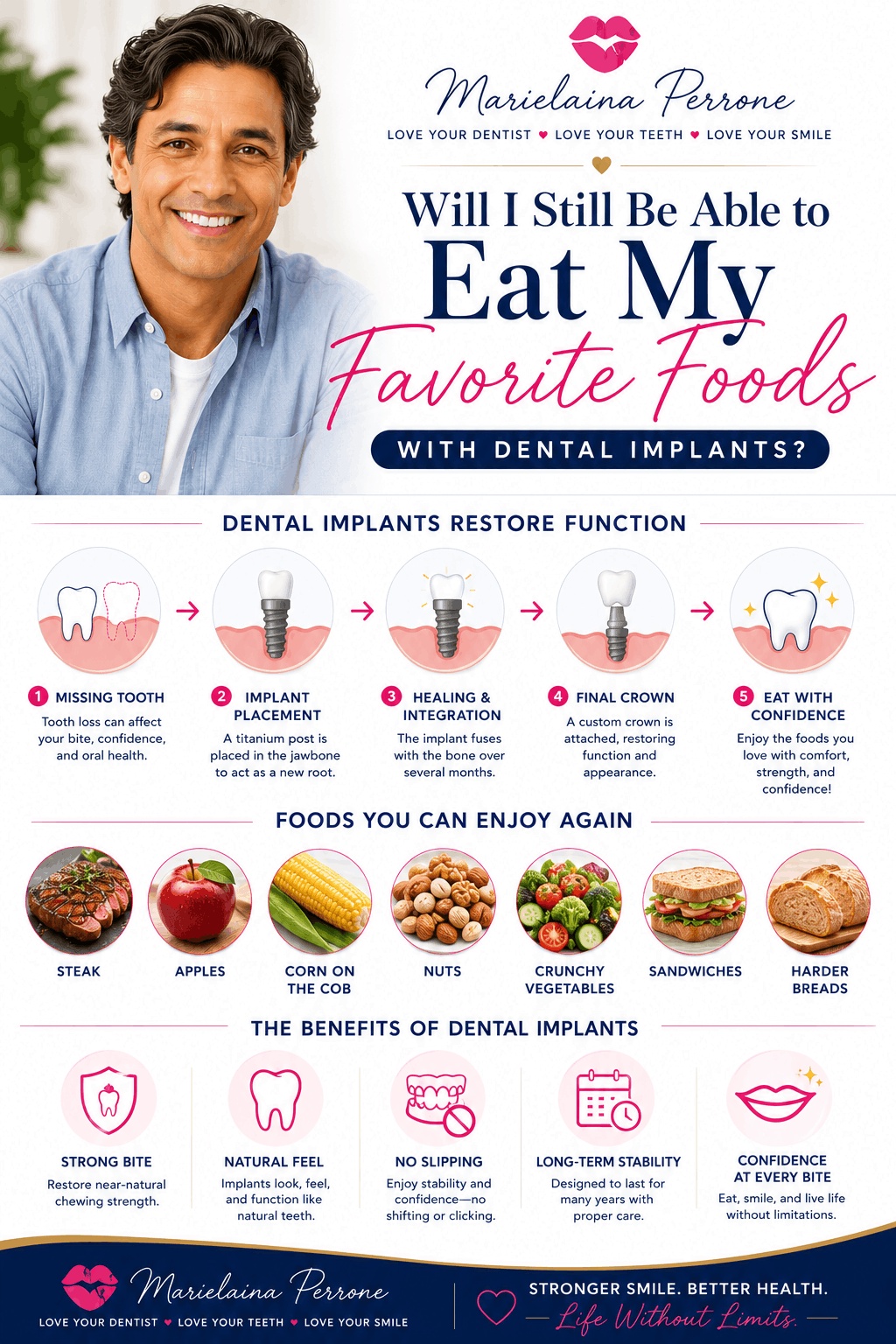
For appropriately selected patients, implant-supported teeth can provide greater stability than traditional removable options. That can make everyday activities feel more normal.
Eating dinner with friends.
Ordering food without first wondering whether you can chew it.
Traveling without worrying as much about a loose prosthesis.
Enjoying foods you’ve gradually stopped choosing.
These may not sound like dramatic dental achievements. But they can have a meaningful effect on everyday life.
“One of the best things a patient can tell me after implant treatment isn’t, ‘My new teeth look beautiful.’ It’s, ‘I don’t think about my teeth when I eat anymore.’ That’s when dentistry has given something back.”
— Marielaina Perrone, DDS
5. Dental Implants Can Help Preserve Future Treatment Choices
This benefit is rarely discussed. Dental decisions create consequences for later dental decisions.
A patient who loses one tooth today may lose another tooth many years from now. Existing restorations can fail. Bite conditions can change. Natural teeth can wear or fracture.
We can’t predict everything that will happen over a lifetime. But good restorative dentistry should consider what today’s treatment leaves available for tomorrow.
An implant can sometimes provide useful independent support without involving neighboring teeth. In larger restorative cases, implants may become part of a future fixed or removable prosthetic design.
That doesn’t mean everyone should receive implants simply “in case” they’re useful later. It means long-term treatment planning matters.
I don’t just ask:
What works now?
I also ask:
What options does this leave us later?
6. Implants Can Reduce Some of the Limitations of Removable Dentures
Traditional dentures remain an appropriate treatment for many patients, and not everyone needs or is a candidate for implant treatment. But removable dentures have inherent limitations. They rest primarily on oral tissues rather than being anchored like natural teeth. Patients may experience movement, pressure areas, changes in fit, or reduced chewing efficiency.
Dental implants can change how a denture is supported or retained. Depending upon the clinical situation, implants may be used to improve the retention of a removable denture or support a fixed full-arch restoration.
For some patients, that difference can have a significant effect on comfort and confidence. The appropriate design depends on much more than simply how many implants can be placed. Bone, anatomy, bite forces, hygiene access, restorative space, health, and long-term maintenance all matter.
7. Dental Implants Can Look and Feel Like Part of the Smile
Patients naturally care about appearance. An implant itself isn’t visible once treatment is completed. What people see is the restoration attached to it.
For a front tooth, creating a natural result involves far more than matching a shade.
We consider tooth shape, proportions, translucency, gum contours, the position of the implant, the available bone and soft tissue, and how the restoration emerges through the gumline.
A beautifully integrated implant restoration shouldn’t call attention to itself. It should simply look like it belongs there.
That is particularly important in cosmetic areas of the smile, where small differences in gum position, tooth length, or contour can be noticeable.
8. Perhaps the Biggest Benefit Is Not Having to Think About the Missing Tooth
There is an emotional side to tooth loss that clinical descriptions sometimes overlook.
A missing tooth can make someone aware of their smile every time they speak or laugh.
An unstable denture can make them think about their teeth during meals.
A failing tooth can become something they continually protect or worry about.
Successful treatment can reduce some of that mental burden.
The ultimate objective isn’t for a patient to spend every day appreciating their dental implant. It’s almost the opposite.
The goal is for the replacement tooth to become an ordinary part of life.
You smile.
You talk.
You eat.
You go about your day.
And you aren’t constantly thinking about the tooth that was lost.
But Dental Implants Aren’t Automatically the Best Choice
With all of these potential benefits, it’s easy for dental implant discussions to become overly enthusiastic. Dental implants are not perfect substitutes for natural teeth. They can develop complications.
The tissues surrounding an implant require lifelong care. Plaque accumulation can contribute to peri-implant inflammation and disease. Restorations can wear, loosen, chip, or eventually require replacement.
Smoking, uncontrolled medical conditions, inadequate bone, poor oral hygiene, certain medications, severe grinding or clenching, and other factors may affect treatment planning and risk. And whenever a natural tooth can predictably be maintained in health and function, saving that tooth deserves serious consideration.
I don’t believe an implant should replace a maintainable natural tooth merely because implant treatment is available.
What Makes Someone a Good Candidate for Dental Implants?
Age alone doesn’t determine candidacy.
I look at the entire clinical picture, including:
- General health
- Oral and periodontal health
- Available bone
- Location of the missing tooth
- Bite forces
- Smoking history
- Medications
- Grinding or clenching
- Ability to maintain excellent oral hygiene
- Expectations
- Long-term restorative goals
Some patients require additional treatment such as bone grafting or a sinus augmentation before implant placement. Others may have several reasonable treatment alternatives.
The right question isn’t simply:
“Can I get a dental implant?”
It’s:
“Is a dental implant the best long-term solution for me?”
How Long Do Dental Implants Last?
Dental implants have demonstrated high long-term survival in appropriately selected and maintained patients, but survival and success are not the same thing.
An implant can remain in place while the surrounding tissues or restoration require treatment. The implant fixture, abutment, crown, surrounding bone, gums, bite, and neighboring teeth all need to be monitored. That’s why I hesitate when I see dental implants described as “permanent teeth.”
They are better described as a long-term tooth-replacement solution that requires lifelong maintenance.
Regular dental examinations, professional maintenance, excellent home care, and management of risk factors remain important after implant treatment is complete.
Dental Implants in Henderson and the Las Vegas Valley
If you’re considering dental implants in Henderson, Green Valley, Las Vegas, Summerlin, Anthem, Seven Hills, or surrounding communities, don’t begin by asking how quickly an implant can be placed.
Begin with the diagnosis.
Why was the tooth lost?
Is there active periodontal disease?
How much bone is available?
What condition are the neighboring teeth in?
What are the alternatives?
How will the final restoration function?
And what is the long-term maintenance plan?
Implant dentistry isn’t simply the surgical placement of an implant.
The final tooth should guide the plan from the beginning.
The Real Benefit of Dental Implants
Dental implants can replace missing teeth beautifully. But I think their value is larger than that.
A well-planned implant may help preserve healthy neighboring tooth structure.
It can provide independent support.
It may help maintain bone at the implant site.
It can improve stability and chewing function.
It can contribute to a natural-looking smile.
And it may preserve restorative choices that become valuable years later.
Ultimately, however, one of the greatest benefits may be something much simpler: Getting back to life without organizing your day around a missing tooth.
That is the kind of success I’m interested in. Not simply replacing what was lost. But helping preserve what still matters.
Frequently Asked Questions
What is the biggest advantage of a dental implant?
There isn’t one universal advantage, but for a single missing tooth, an important benefit is the ability to support a replacement tooth independently without relying on neighboring teeth as a traditional bridge typically does.
Do dental implants prevent bone loss?
Implants provide functional stimulation to surrounding bone and can help maintain bone at the implant site. They don’t guarantee that no bone changes will occur in the future.
Are dental implants better than bridges?
Not necessarily. Both can be excellent treatments. The condition of the adjacent teeth, available bone, health, anatomy, cost, treatment time, and long-term goals should all be considered.
Are implants better than dentures?
Implant-supported restorations can provide greater retention and stability for appropriate patients, but conventional dentures remain a reasonable treatment for many people. There isn’t one solution that’s best for everyone.
Can seniors get dental implants?
Yes. Chronological age alone does not determine implant candidacy. Overall health, oral health, bone, medications, ability to heal and maintain the implants, and individual goals are more important considerations.
Are dental implants permanent?
Implants are intended as a long-term treatment, but they should not be considered maintenance-free or guaranteed for life. The implant, surrounding tissues, and restoration require ongoing professional and home care.
Do dental implants look natural?
A well-designed implant restoration can look extremely natural. The result depends on implant position, bone and gum anatomy, restorative materials, laboratory craftsmanship, and careful aesthetic planning.
How do I know if dental implants are right for me?
A comprehensive examination and appropriate imaging are needed to evaluate your oral health, bone, anatomy, bite, medical considerations, and restorative options.
Author Bio
Dr. Marielaina Perrone, DDS, is a highly skilled cosmetic and family dentist based in Henderson, NV, dedicated to transforming smiles and improving lives through compassionate, patient-centered care. With over 20 years of clinical experience, Dr. Perrone blends advanced dental techniques with an artistic eye to deliver exceptional results in porcelain veneers, dental implants, smile makeovers, periodontal therapy, dermal fillers, Botox, and comprehensive facial aesthetic treatments.
A graduate at the top of her dental class, Dr. Perrone continually pursues advanced training to remain at the forefront of modern dentistry and aesthetic medicine. Her integrative approach focuses on oral health, facial harmony, and personalized treatment planning—helping patients achieve natural, confident smiles that enhance both appearance and overall well-being.
Dr. Perrone is passionate about patient education, preventive care, and creating long-term relationships built on trust, comfort, and communication. She proudly serves the communities of Henderson, Green Valley, and the greater Las Vegas area. When she’s not caring for patients, she enjoys cooking, staying active, and spending time with her family.

Reviewed for Clinical Accuracy
This article has been written and clinically reviewed by Marielaina Perrone, DDS, to ensure it reflects current evidence-based dentistry and the personalized philosophy of care practiced at her Henderson, Nevada office.
Last Reviewed: September 2026